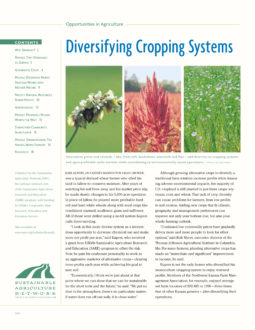
The following profiles demonstrate how producers across the U.S. successfully tested strategies that helped them diversify their farms, enhancing profits, achieving environmental benefits and aiding their communities.
They Diversified to Survive
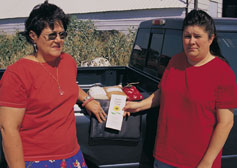
The Beguins had one compelling reason to diversify: “We wanted to keep the ranch,” said Robert Beguin of Rushville, Neb.
With only 120 cow-calf pairs on their 2,000-acre ranch, the family had depended on its trenching business to “keep everything else floating.” It still does, but the Beguins’ agricultural enterprises have become significantly more profitable since they went organic in 1996 and since a SARE grant helped them market their new value-added products and obtain equipment to outfit a 2,160-square foot cleaning and bagging facility.
Now the Beguins sell their cleaned, organic wheat for $6.75 a bushel rather than $2.50. They ship their brown and golden flaxseed to Internet markets, their blue corn to chip-makers, their millet to California bakers and Japanese snack-makers, their radish seed to overseas sprout buyers, their oil and confection sunflowers to Minnesota, their dry beans in 2,000-pound totes to the West Coast and their pea seed to local cattle-feed and green-manure users. The Beguins’ cowpea seed goes to customers who grow the plants, then chop them young for tender salad greens.
“That blew our minds,” Beguin said.
Daughter-in-law Shelley and daughter Barb pitch in as well: They sell the family’s bean-soup mixes over the Internet, at area craft shows and during community events.
Marketing Gets Easier
“Finding markets is pretty hard the first three years,” Beguin cautions farmers considering alternative crops. “You have to spend a lot of time on the telephone. After about three years or so, they’ll start calling you.”
Beguin stores his crops for up to two years when the price isn’t right—an advantage of producing dry grains and shelf-stable value-added products – and advises other entrepreneurs to do the same. “I won’t contract millet at 10 cents,” he said. “I’ll let it sit in the bin for two or three years and I’ll get my 20 cents out of it.” His radish seed will still germinate nicely after a year and his alfalfa seed will actually sprout better.
The family’s new facility—in which they also clean crops for a neighbor—allows the Beguins to sack varieties separately. They still ship everything together, filling one California-bound truck with $15,550 worth of dry edible beans, peas, millet, and alfalfa and radish seed. Not bad, especially when the cracked-grain “cleanings” have value, too: as feed for the Beguins’ cattle.
Diversified North Dakotan Works With Mother Nature
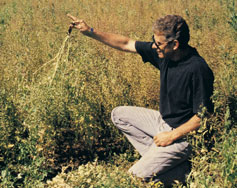
In 1976, when Vern Mayer began farming his 4,000 acres in southwestern North Dakota, he used the same wheat-fallow rotation that had become the area’s agricultural two-step. “We’d plant only half the land every year,” he said. “We were storing moisture in the fallow, but we were burning organic matter.”
As the economics of farming tightened, Mayer and his neighbors began planting wheat—and the occasional field of oats or barley—two years out of three. As profits became rarer, most growers eliminated fallow years entirely because it failed to produce sorely needed income.
Mayer didn’t simplify his rotation, however; he expanded it. In addition to spring and durum wheats, he now grows corn, flax, buckwheat, sunflowers, Austrian winter peas, crambe and either canola or mustard. With the “minimum-disturbance” tillage system he adopted a decade ago, his soils are never bare—even though his region’s brief frost-free periods put the chill on double- and cover-cropping.
“Caramel Popcorn” Soil Conserves Critical Moisture
Instead, his soil structure is like caramel popcorn: secretions released by the soil microorganisms bind the soil particles together, but the matrix remains so porous that the soil soaks up even heavy thunderstorms. With no streams or even aquifers to tap, Mayer is dependent for moisture on whatever falls from the sky. “In this semi-arid climate, we cannot afford to squander any of it,” he said.
Nor does water still run wasted off Mayer’s rolling fields, taking precious soil particles with it. “Water erosion used to be a regular fact of life on my farm,” he said. “Now it’s essentially a non-issue.” His healthy soils conserve enough moisture so that he can grow corn for local livestock feeders; after harvest, his corn stalks—like all of his other crop residues—capture rains and snows and hang onto soil.
To Reduce Pest Problems, Be Unpredictable
Mayer’s diverse, minimum-disturbance system also stands up well to potential pest pressures. He “cheaply and easily” controls grassy weeds like wild oats in his grains by switching to broadleaf crops. He treats seed for insects and soil-borne diseases but rarely battles pests after planting, except for cyclical grasshoppers. “That’s another reason why crop rotation is really important,” he said: “The leaf diseases that attack the wheat are not a problem with some of the broadleaf crops, and vice versa, so by rotating those crops we minimize those problems.”
Mayer likes to plant wheat two years in a row. He also likes to rotate out of wheat for at least two years, but his crops don’t follow one another in any pre-established pattern. Mayer aims to be unpredictable, so that Mother Nature can’t define—and then defeat—his system. “If you’re very predictable in what you do, Mother Nature will find a combination of pests that fit that particular pattern to plague you.”
When it comes to markets, it’s human nature that makes it hard for Mayer to predict what will happen next. His planting decisions are consequently straightforward: If he can’t identify a market for a crop, he doesn’t plant it. When he knows he can get an acceptable price for a niche crop like crambe, Mayer gladly grows it. As a rule, though, he focuses on larger markets.
Mayer’s Austrian winter peas go to a local buyer of bird feed ingredients, who markets them as homing pigeon food. “It is hard to believe that this industry is large enough to have this kind of demand,” he said. Some of Mayer’s mustard seed goes to flour millers and some to sausage manufacturers.
More Profits Lie Ahead
While prairie soils contained 6 to 8 percent organic matter before white settlers began farming North Dakota, the region’s wheat-fallow rotations stripped organic matter down to 2 percent or less. Mayer estimates that he has rebuilt his soil organic matter to about 3 percent and that this enrichment has not come at the expense of his farm’s bottom line. He clears as much profit now as conventional farmers do, he said, and he’ll soon clear even more. “After 10 years, we’ve kind of turned the corner in our productivity; in the next 10 years, the changes will be even more pronounced.”
“I would never, never go back—absolutely never,” Mayer said. “When you see the benefits, I just quite frankly don’t understand why everybody doesn’t do this.”
Profitable Pecans Worth the Wait in Missouri Alley-Cropping Systems
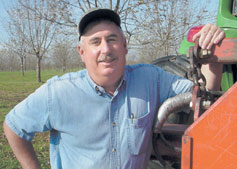
On 12 acres of flood plain near Chiftonhill, Mo., Dan Shepherd helped his dad plant the family’s first pecan trees nearly three decades ago. Eighteen years later, the trees produced their first harvest. “It takes a special type of person to be in the orchard business,” said Shepherd. “You have to have staying power.”
Shepherd planted 200 more acres of pecans in the early 1980s and another 50 or so in the late 1990s. The trees in his 1980s planting won’t reach full production until 2008 or 2010.
“You have to look way down the road,” he said.” But at the end of that road lies a crunchy pot of golden nuggets. Shepherd’s pecans—more profitable than any other nut crop he could grow—are bringing $1 a pound and yielding 1,000 pounds an acre. After costs, each acre clears $600.
Income From Alley Crops Makes the System Work
Shepherd’s orchard began paying its own freight even before the first nut fell from the first tree. In the 40-foot rows between his trees, he rotated wheat,which he grew, and field corn and soybeans, which a lessee grew, for more than 15 years. Since then, Shepherd has planted bluegrass for hay in those narrowing rows. “I get $75 worth of hay an acre, and I have to mow it anyway,” he said.
The bluegrass is beautifully compatible with the pecans. Its shallow root system doesn’t steal moisture from the trees, and its fine, smooth mat makes an easy bed from which to pick up nuts. Another plus in Shepherd’s lowland location: His bluegrass doesn’t mind floods.
Pecans aren’t the only trees on Shepherd’s north central Missouri farm. On another 125 scattered acres, he grows white oaks that he logs about every five years. A half-dozen acres of walnuts, planted in the mid-1970s, will be ready to cut in another quarter-century.
So Many Enterprises, So Little Time
In the meantime, the energetic Shepherd is doing much more than watching his trees and bluegrass grow. While his wife, Jan, operates a bustling farm-based store that features their products, Shepherd sells buffalo meat, occasionally raises cull beef cows for the hamburger market and has become the nation’s largest producer of eastern gamagrass seed: a lush, native grass that is in demand by wildlife managers and cattle and sheep producers.
Every 10 or 15 years, when seed yield starts to decline in a gamagrass field, Shepherd will rotate into what he considers a frankly tedious rotation of corn, soybeans and wheat. “I don’t care for row crop farming,” he said. “I don’t think I would have liked farming without the trees. When you have pecans, gamagrass, buffalo and a store, you’ve got stuff to do all year round.”
Strengthening Ties Among Farmers in Northern Maine
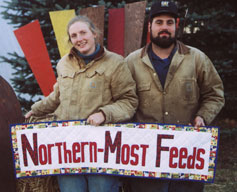
Catherine Albert has a New Englander’s fierce commitment to community. Albert, whose forebears settled in New Hampshire in the 1600s, farms in Madawaska, Maine, a stone’s throw from the Canadian border, on the 214-acre family farm homestead of her husband, Ben, and his mother, Kathren, in Aroostock County.
With soil temperatures that don’t warm for planting until mid-May and frosts that start nipping crops in late August, northern Maine doesn’t overwhelm its small farmers with planting options. However, Albert, who excels at pulling the community together, has made diversifying northern Maine crop options her latest priority.
Her new venture: developing Maine-grown poultry feed.
“There’s a very strong interest in buying local products in our state,” she said. “I buy my maple syrup from somebody in the next town. As we all realize, to survive as farmers, you need to support other farmers.”
Need Organic Poultry Feed? Make Your Own
Catherine teaches forestry part time at the University of Maine at Fort Kent, and Ben works at the local paper mill. Together, they raise beef cattle, laying hens, turkeys, timber and conventional and organic grains, expanding their farm with tillable rented acreage. They sell their turkeys locally at Thanksgiving, and, like the milkman of yore, Catherine delivers farm-fresh eggs to their customers weekly.
But when the Alberts were sourcing organic feed for their soon-to-be-organic chickens, the closest suppliers they found were in Vermont and Quebec. They decided to produce their own.
After extensive research and testing, funded by a SARE grant, Catherine and University of Maine animal nutritionist Linda Kling developed feed formulas for the layers, broilers and turkeys. The process was not without challenges: Field corn wouldn’t grown in the cold climate. Barley was no good, either—to be digestible to chickens, it needs an added enzyme. Instead, the women based their formula on hull-less oats. The formula also includes protein-rich soybeans, which Albert hopes she’ll soon be able to grow. She supplements the feed with vitamins imported from Wisconsin, and, to ensure the yolks will be a “real yellow” that corn feed puts in eggs, Albert spent six months finding a certified organic marigold.
Fellow Producers Confirm the Need for Feed
It isn’t just the organic poultry producers who will benefit, Albert notes. “This is an ideal opportunity for organic farmers in Aroostock County. They need to find economically viable organic rotation crops. You can’t grow potatoes every year on the same piece of land.”
Nor, of course, can you grow oats on the same acres every year, so Albert plans to rotate with green-manure clover and eventually with short-season soybeans. The Alberts’ beef cows provide the farm’s fertilizer.
Albert looks forward to the day when Northernmost Feeds is large enough to source all of its inputs locally. She’s put out the word to organic potato growers that she’ll buy their organic oats.
The Alberts hope the feed business will provide jobs for other members of their community, where population has declined due to lack of employment opportunities. Farming in Maine’s northernmost county remains their top priority: “It comes down to what’s in your blood,” Albert said.