• WebStore |
  • Advanced Search |
  • MySARE Login |
  • SARE Social Media |
  • Contact Us |
  • SANET Listserv |
  • Low Bandwidth |
Search MySARE Reports
  • Grants
    • Apply for a Grant
    • Funded Grants in Your State
  • Project Reports
    • Submit a Report
    • Search the Database
    • Project Search Tips
    • About Project Reports
    • About Search Results
    • Project Products
  • Learning Center
    • Books
    • Bulletins
    • Fact Sheets
    • Topic Rooms
    • From the Field
    • Newsletters
    • Multimedia
    • Courses and Curricula
    • Project Products
    • SARE Biennial Reports
    • SANET Listserv
    • SARE Program Materials
    • Conference Materials
    • WebStore
  • Professional Development
    • PDP Overview
    • Fellows & Search for Excellence Programs
    • Sample PDP Grant Projects
    • Educator Curriculum Guides
    • National Continuing Education Program
    • State Coordinator Contact Information
  • State Programs
    • State Coordinator Program Overview
    • State Coordinator Contact Information
    • Funded Grants in Your State
  • Events
    • Event Calendar
    • Past Conferences
  • Newsroom
    • Press Releases
    • SARE in the News
    • Media Contacts
    • Newsletters
    • Media Toolkit
    • A Guide To This Site
    • SARE and Social Media
  • About SARE
    • SARE's Four Regions
    • SARE Grants
    • Learning Center
    • Professional Development
    • SARE Outreach
    • Historical Timeline
    • Staff
    • Vision & Mission
    • Join Our Mailing List
    • What is Sustainable Agriculture?
  • Home»
  • Learning Center»
  • Books»
  • Managing Cover Crops Profitably, 3rd Edition»
  • Text Version»
  • Nonlegume Cover Crops
facebook
Twitter
YouTube
- + Font Size
Print
Share

Text Version

  • Acknowledgments
  • Printable Version
  • Foreword
  • Table of Contents
  • How to Use This Book
  • Benefits of Cover Crops
  • Selecting the Best
  • Building Soil Fertility
  • Managing Pests
  • Crop Rotation with Cover Crops
  • Managing Cover Crops in Conservation Tillage Systems
  • Charts
  • Nonlegume Cover Crops
    • Annual Ryegrass
    • Barley
    • Brassicas and Mustards
    • Buckwheat
    • Oats
    • Cereal Rye
    • Sorghum Sudangrass
    • Winter Wheat
  • Legume Cover Crops
  • Producer Profiles
  • Appendix A
  • Appendix B
  • Appendix C
  • Appendix D
  • Appendix E
  • Appendix F
  • Printable Version

Can't find something? Ask or send feedback.

SARE's mission is to advance—to the whole of American agriculture—innovations that improve profitability, stewardship and quality of life by investing in groundbreaking research and education. SARE's vision is...

Nonlegume Cover Crops

OVERVIEW OF NONLEGUME COVER CROPS

Commonly used nonlegume cover crops include:

Annual cereals (rye, wheat, barley, oats)
Annual or perennial forage grasses such as ryegrass
Warm-season grasses like sorghum-sudangrass
Brassicas and mustards

Nonlegume cover crops are most useful for:

Scavenging nutrients—especially N—left over from a previous crop
Reducing or preventing erosion
Producing large amounts of residue and adding organic matter to the soil
Suppressing weeds

Annual cereal grain crops have been used successfully in many different climates and cropping systems. Winter annuals usually are seeded in late summer or fall, establish and produce good root and topgrowth biomass before going dormant during the winter, then green up and produce significant biomass before maturing. Rye, wheat, and hardy triticale all follow this pattern, with some relatively small differences that will be addressed in the section for each cover crop.

There is growing interest in the use of brassica and mustard cover crops due to their “biofumigation” characteristics. They release biotoxic chemicals as they break down, and have been found to reduce disease, weed and nematode pressure in the subsequent crop. Brassicas and mustards provide most of the benefits of other nonlegume cover crops, while some (forage radish, for example) are thought to alleviate soil compaction. See the chapter, Brassicas and Mustards, for more information.

Perennial and warm-season forage grasses also can serve well as cover crops. Forage grasses, like sod crops, are excellent for nutrient scavenging, erosion control, biomass production and weed control. Perennials used as cover crops are usually grown for about one year. Summer-annual (warm-season) grasses may fill a niche for biomass production and weed or erosion control if the ground would otherwise be left fallow (between vegetable crops, for example). Buckwheat, while not a grass, is also a warm-season plant used in the same ways as summer-annual grasses.

Nonlegume cover crops are higher in carbon than legume cover crops. Because of their high carbon content, grasses break down more slowly than legumes, resulting in longer-lasting residue. As grasses mature, the carbon-to-nitrogen ratio (C:N) increases. This has two tangible results: The higher carbon residue is harder for soil microbes to break down, so the process takes longer, and the nutrients contained in the cover crop residue usually are less available to the next crop.

So although grass cover crops take up leftover N from the previous crop, as they mature the N is less likely to be released for use by a crop grown immediately after the grass cover crop. As an example of this, think of how long it takes for straw to decompose in the field. Over time, the residue does break down and nutrients are released. In general, this slower decomposition and the higher carbon content of grasses can lead to increased soil organic matter, compared to legumes.

The carbon content and breakdown rate of brassicas is usually intermediate to grasses and legumes, depending on maturity when terminated. Brassicas and mustards can take up as much N as grass cover crops, but may release that N more readily to the subsequent crop.

Nonlegume cover crops can produce a lot of residue, which contributes to their ability to prevent erosion and suppress weeds while they are growing or when left on the soil surface as a mulch.

Although grasses and other nonlegumes contain some nitrogen in their plant tissues, they generally are not significant sources of N for your cropping system. They do, however, keep excess soil N from leaching, and prevent the loss of soil organic matter through erosion.

Management of nonlegumes in your cropping system may involve balancing the amount of residue produced with the possibility of tying up N for more than one season. Mixtures of grass and legume cover crops can alleviate the N-immobilization effect, can produce as much or more dry matter as a pure grass stand and may provide better erosion control due to the differences in growth habit. Suggestions for cover crop mixtures are found in the individual cover crop sections.

In addition to grasses, another summer non-legume is buckwheat, which is described in detail in its own section. Buckwheat is usually classed as a non-grass coarse grain. While it is managed like a quick-growing grain, it has a succulent stem, large leaves and white blossoms.


Top | Annual Ryegrass

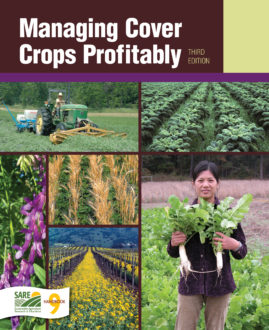
You are reading the SARE book Managing Cover Crops Profitably, 3rd Edition.

Order this publication.

25th SARE logo USDA Logo

1122 Patapsco Building | University of Maryland | College Park, MD 20742-6715

This Web site is maintained by the national outreach office of the SARE program, supported by the National Institute of Food and Agriculture, U.S. Department of Agriculture.

North Central SARE | Northeast SARE | Southern SARE | Western SARE

Sustainable Agriculture Research & Education ©2012

  • Help |
  • RSS Feeds |
  • A Guide To This Site