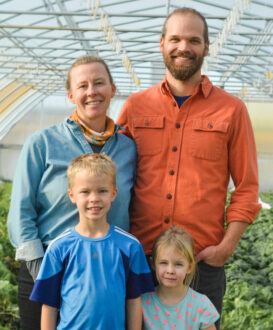
Expanding winter sales can improve year-round revenue for many small-scale vegetable farms. High tunnels are a common way to extend the growing season, but they only offer a limited amount of space. To continue expanding the season, a grower would need to add more high tunnels. At Waxwing Farm in Webster, Minn., Anna Racer and Peter Skold explored a different approach to expanding winter sales that doesn’t require adding more high tunnel space.
Since 2021, over 7,268 farmers and ranchers have participated in research funded by North Central SARE to advance innovative practices that improve profitability, stewardship, and quality of life in American agriculture.
Racer and Skold looked to specialty chicory crops, such as Belgian endives and radicchio, as a potential winter crop. Both crops are grown in the field during the regular growing season. The harvested roots are then trimmed and “forced” after harvest in a dark environment, enhancing the flavor and changing the color of the newly emerging greens. Because forcing can take place in cold storage units, chicory crops offered a way to add winter products while leaving high tunnels available for other crops.
With support from a SARE Farmer/Rancher grant, Racer and Skold tried to grow and force chicory crops in Minnesota’s cold climate. They compared different planting, harvest, trimming, and forcing techniques using existing equipment. To keep labor costs down, they relied on mechanical planting and harvesting tools.
The project helped Racer and Skold to identify radicchio as a strong fit for their farm’s winter production system. They found that with proper seeding and harvest techniques, radicchio offered promising sales opportunities in specialty markets. And while they could easily grow Belgian endives, this crop required a production scale that did not align with the farm’s capacity. The results gave Waxwing Farm a new strategy for diversifying winter sales and guided future crop planning decisions.
“We learned that these crops can be successfully grown in this part of the country and have the potential to be valuable additions to any vegetable farm’s mix of winter crops,” says Skold.
Read Diversifying Vegetable Production and Sales with Chicory Crops for more information on this project.
Diversifying Vegetable Production and Sales with Chicory Crops is just one of 12 stories featured in SARE’s 2025/2026 Report from the Field. Download or order your free print copy at https://sare.org/report or by calling (301) 779–1007. 2025/2026 Report from the Field is available in quantity for free to educators for use in educational workshops, classes or tours.
For information on grants and resources available from SARE, visit www.sare.org.