SARE: Sustainable Agriculture Research and Education Grants and Education to Advance Innovations in Sustainable Agriculture
  • WebStore |
  • Advanced Search |
  • MySARE Login |
  • SARE Social Media |
  • SANET Listserv |
  • Contact Us |
  • Low Bandwidth |
Search MySARE Reports
  • Grants
    • Apply for a Grant
    • Funded Grants in Your State
  • Project Reports
    • Submit a Report
    • Search the Database
    • Project Search Tips
    • About Project Reports
    • About Search Results
    • Project Products
  • Learning Center
    • Books
    • Bulletins
    • Fact Sheets
    • Topic Rooms
    • From the Field
    • Newsletters
    • Multimedia
    • Courses and Curricula
    • SARE Project Products
    • SARE Biennial Reports
    • SANET Listserv
    • SARE Program Materials
    • Conference Materials
    • En Español
    • WebStore
  • Professional Development
    • PDP Overview
    • Sample PDP Grant Projects
    • Educator Curriculum Guides
    • National Continuing Education Program
    • State Coordinator Contact Information
    • Fellows Program
    • Search for Excellence
  • State Programs
    • State Coordinator Program Overview
    • State Coordinator Contact Information
    • State Program Webpages
    • Funded Grants in Your State
  • Events
    • National Conference on Cover Crops and Soil Health
    • Event Calendar
    • Past Conferences
  • Newsroom
    • Press Releases
    • Media Contacts
    • Newsletters
    • Media Toolkit
    • A Guide To This Site
    • SARE and Social Media
  • About SARE
    • SARE's Four Regions
    • Join Our Mailing List
    • SARE Grants
    • Learning Center
    • Professional Development
    • SARE Outreach
    • Historical Timeline
    • Staff
    • Vision and Mission
    • What is Sustainable Agriculture?
  • Home»
  • Learning Center»
  • Multimedia»
  • Videos from the Field»
  • Adding Cover Crops to a No-Till System
facebook
Twitter
YouTube
- + Font Size
Print
  • by Type
  • by Topic
  • Books
  • Bulletins
  • Fact Sheets
  • Topic Rooms
  • From the Field
  • Newsletters
  • Multimedia
  • Courses and Curricula
  • SARE Project Products
  • SARE Biennial Reports
  • SANET Listserv
  • SARE Program Materials
  • Conference Materials
  • En Español
  • WebStore
  • Animal Production
  • Community Development
  • Cover Crops
  • Crop Production
  • Economic/Marketing
  • Education & Training
  • Energy Conservation & Renewable Energy
  • Farm to Table: Building Local and Regional Food Systems
  • For Consumers
  • High Tunnels and Other Season Extension Techniques
  • Integrated Systems
  • Natural Resources/Environment
  • Pest Management
  • Quality of Life
  • Soil Management
  • Specialty Crops
  • Value Added
  • WebStore

Multimedia

Adding Cover Crops to a No-Till System

Dan Forgey

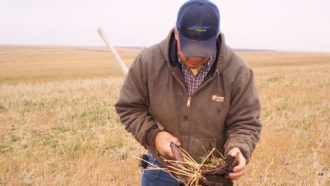
Dan Forgey, farm manager at Cronin Farms in South Dakota, has been using no-till management for more than 17 years. Over that time, Forgey has developed a keen understanding of how his farming system works and where new challenges and opportunities exist. Several years ago, Forgey began thinking about how he might include cover crops on the 8500-acre farm to improve soil and the bottom line. But how best to do this in a no-till system? Usually, cover crops are tilled into the soil while they are still green in order to promote soil quality and fertility, but that is not an option in a no-till system. Forgey received a SARE grant to test the feasibility of using cover crops at Cronin Farms. It’s an on-going experiment, but after three years, results are promising. One cover crop mix of turnips, cowpeas and lentils increased corn yields by 18-20 bushels per acre in the SARE farm trials. Other benefits include:

  • healthier soil, with increasing benefits over a period of 4 to 5 years
  • better soil aggregation and texture through the addition of organic matter and enhanced activity of soil microorganisms 
  • economic savings as a result of reduced use of purchased fertilizer

Forgey is aware that the cover crops in this system may perform differently in drought years, when a cover crop could deplete soil water needed by the cash crop (wheat, corn, soybeans). He will monitor this closely in coming years. As for managing cover crops without tillage, Forgey's answer is to have his cattle graze them. Enjoy watching this video to learn more.

Download an illustration of the rotations used at Cronin Farms:

CroninRotation.pdf 44.77 kB

Want more information? See the related SARE grant(s) FNC06-615, Utilizing Late Season Cover Crops in a No-Till System.

Product Specs

Published: 2010

How to Order

Only available online

Other Dan Forgey Videos

Adding Cover Crops to a No-Till System (14:48)

Growing Cover Crops with a Cash Crop (2:11)

No-Till Farmer: Steward of the Land (5:10) 


Dig Deeper - Dan Forgey

Download an illustration of the rotations used at Cronin Farms:

CroninRotation.pdf 44.77 kB

Check out these additional resources:

  • A From the Field profile of Forgey's work with cover crops and no-till
  • Building Soils for Better Crops, 3rd Edition
  • Managing Cover Crops Profitably, 3rd Edition
  • Crop Rotation on Organic Farms

No-till at work:

  • Smart Water Use on Your Farm or Ranch
  • Cedar Meadow Farm in Holtwood, Penn.
  • Ralph "Junior" Upton, Springfield, Ill.
 

Related Resources

You may be interested in more information about: Soil Management.

Search the MySARE project reports database for research about Soil Management.


Video Help

Watching video from a slow internet connection? Here are some tips for a better experience.

SARE: Sustainable Agriculture Research and Education USDA Logo

1122 Patapsco Building | University of Maryland | College Park, MD 20742

North Central SARE | Northeast SARE | Southern SARE | Western SARE

This site is maintained by SARE Outreach for the SARE program and is based upon work supported by the National Institute of Food and Agriculture, U.S. Department of Agriculture, under award No. 2014-38640-22173. SARE Outreach operates under cooperative agreements with the University of Maryland to develop and disseminate information about sustainable agriculture. USDA is an equal opportunity provider and employer.

Sustainable Agriculture Research & Education ©2012

  • Help |
  • RSS Feeds |
  • A Guide To This Site