• WebStore |
  • Advanced Search |
  • MySARE Login |
  • SARE Social Media |
  • Contact Us |
  • SANET Listserv |
  • Low Bandwidth |
Search MySARE Reports
  • Grants
    • Apply for a Grant
    • Funded Grants in Your State
  • Project Reports
    • Submit a Report
    • Search the Database
    • Project Search Tips
    • About Project Reports
    • About Search Results
    • Project Products
  • Learning Center
    • Books
    • Bulletins
    • Fact Sheets
    • Topic Rooms
    • From the Field
    • Newsletters
    • Multimedia
    • Courses and Curricula
    • Project Products
    • SARE Biennial Reports
    • SANET Listserv
    • SARE Program Materials
    • Conference Materials
    • WebStore
  • Professional Development
    • PDP Overview
    • Fellows & Search for Excellence Programs
    • Sample PDP Grant Projects
    • Educator Curriculum Guides
    • National Continuing Education Program
    • State Coordinator Contact Information
  • State Programs
    • State Coordinator Program Overview
    • State Coordinator Contact Information
    • State Program Webpages
    • Funded Grants in Your State
  • Events
    • Event Calendar
    • Past Conferences
  • Newsroom
    • Press Releases
    • SARE in the News
    • Media Contacts
    • Newsletters
    • Media Toolkit
    • A Guide To This Site
    • SARE and Social Media
  • About SARE
    • SARE's Four Regions
    • Join Our Mailing List
    • SARE Grants
    • Learning Center
    • Professional Development
    • SARE Outreach
    • Historical Timeline
    • Staff
    • Vision & Mission
    • What is Sustainable Agriculture?
  • Home»
  • Learning Center»
  • Fact Sheets»
  • In-House Composting in High-Rise, Caged Layer Facilities»
  • Text Version»
  • Managing Compost Inside Poultry Facilities»
  • Managing Compost Inside Poultry Facilities, Page 3
facebook
Twitter
YouTube
- + Font Size
Print
Share

Text Version

  • Overview of High-Rise, Caged Layer Facilities and In-House Composting
  • Managing Compost Inside Poultry Facilities
    • Managing Compost Inside Poultry Facilities, Page 2
    • Managing Compost Inside Poultry Facilities, Page 3
  • Economic Evaluation
  • Research Synopsis
  • References
  • Printable Version

Can't find something? Ask or send feedback.

SARE's mission is to advance—to the whole of American agriculture—innovations that improve profitability, stewardship and quality of life by investing in groundbreaking research and education. SARE's vision is...

Managing Compost Inside Poultry Facilities, Page 3

Fly control
The farmer cooperators on this SARE research project were able to discontinue using a feed-based larvicide and shift to topical applications of an insecticide when needed as long as the material was managed appropriately to maintain high temperatures. Fly outbreaks, though infrequent, did occur when equipment broke down and turning schedules could not be maintained. Similar success in controlling flies with in-house composting has been reported by other researchers [7].

Ammonia volatilization and control
One of the main challenges with in-house composting is the accumulation of high levels of ammonia and other gasses inside layer houses and venting of these gasses from the facility. Active biological decomposition coupled with the low carbon to nitrogen ratio and frequent turning of the material contributes to higher ammonia levels than in high-rise layer facilities where manure accumulates in static beds. Monitoring showed that atmospheric ammonia in the composting area peaked well above safe levels for humans and poultry when the compost was being turned (Figure 3). Atmospheric ammonia was also higher in winter when fan use to cool buildings was reduced. Ammonia concentrations in the cage area were less than 50% of the concentrations in the composting area due to air flow patterns created by operation of the ventilation system [8].
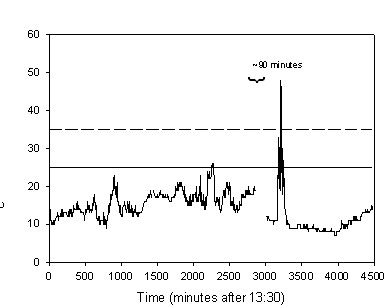
Figure 3
Figure 3. Ammonia concentrations over time in the manure storage area of a high-rise layer structure during in-house composting. The peak concentration occurred during a compost turning event. The –— line indicates the 8 hour human health exposure limit. The — — line indicates the 10 minute human health exposure limit. Data are from Koenig et al. (in press) [9].

There are several options to manage atmospheric ammonia during in-house composting. Practices that conserve nitrogen and reduce ammonia volatilization are the most desirable and environmentally sustainable solutions. Using rates of carbon calculated to maintain optimum C:N ratios will increase ammonia assimilation by microorganisms and reduce ammonia volatilization. Chemical amendments such as aluminum sulfate also have the potential to reduce ammonia volatilization from in-house compost [9], but more research remains to be done in this area. To reduce exposure in the short term, facility personnel where this research was conducted would over-ride the automated fan system for 15 to 30 minutes to vent ammonia when compost was being turned. It is recommended that facilities using in-house composting invest in ammonia gas sensors to prevent exposure of workers and poultry to high levels of atmospheric ammonia. In light of impending air quality regulations, practitioners of in-house composting also are cautioned to adopt practices that reduce ammonia emissions from poultry facilities.


Page: 1 | 2 | 3 | Next Section

You are reading the SARE fact sheet In-House Composting in High-Rise, Caged Layer Facilities.

Order this publication.

Sare 25 Years

1122 Patapsco Building | University of Maryland | College Park, MD 20742-6715

This Web site is maintained by the national outreach office of the SARE program, supported by the National Institute of Food and Agriculture, U.S. Department of Agriculture.

North Central SARE | Northeast SARE | Southern SARE |  Western SARE

Sustainable Agriculture Research & Education ©2012

  • Help |
  • RSS Feeds |
  • A Guide To This Site