• WebStore |
  • Advanced Search |
  • MySARE Login |
  • SARE Social Media |
  • Contact Us |
  • SANET Listserv |
  • Low Bandwidth |
Search MySARE Reports
  • Grants
    • Apply for a Grant
    • Funded Grants in Your State
  • Project Reports
    • Submit a Report
    • Search the Database
    • Project Search Tips
    • About Project Reports
    • About Search Results
    • Project Products
  • Learning Center
    • Books
    • Bulletins
    • Fact Sheets
    • Topic Rooms
    • From the Field
    • Newsletters
    • Multimedia
    • Courses and Curricula
    • Project Products
    • SARE Biennial Reports
    • SANET Listserv
    • SARE Program Materials
    • Conference Materials
    • WebStore
  • Professional Development
    • PDP Overview
    • Fellows & Search for Excellence Programs
    • Sample PDP Grant Projects
    • Educator Curriculum Guides
    • National Continuing Education Program
    • State Coordinator Contact Information
  • State Programs
    • State Coordinator Program Overview
    • State Coordinator Contact Information
    • Funded Grants in Your State
  • Events
    • Event Calendar
    • Past Conferences
  • Newsroom
    • Press Releases
    • SARE in the News
    • Media Contacts
    • Newsletters
    • Media Toolkit
    • A Guide To This Site
    • SARE and Social Media
  • About SARE
    • SARE's Four Regions
    • SARE Grants
    • Learning Center
    • Professional Development
    • SARE Outreach
    • Historical Timeline
    • Staff
    • Vision & Mission
    • Join Our Mailing List
    • What is Sustainable Agriculture?
  • Home»
  • Learning Center»
  • Fact Sheets»
  • In-House Composting in High-Rise, Caged Layer Facilities»
  • Text Version»
  • Managing Compost Inside Poultry Facilities
facebook
Twitter
YouTube
- + Font Size
Print
Share

Text Version

  • Overview of High-Rise, Caged Layer Facilities and In-House Composting
  • Managing Compost Inside Poultry Facilities
    • Managing Compost Inside Poultry Facilities, Page 2
    • Managing Compost Inside Poultry Facilities, Page 3
  • Economic Evaluation
  • Research Synopsis
  • References
  • Printable Version

Can't find something? Ask or send feedback.

SARE's mission is to advance—to the whole of American agriculture—innovations that improve profitability, stewardship and quality of life by investing in groundbreaking research and education. SARE's vision is...

Managing Compost Inside Poultry Facilities

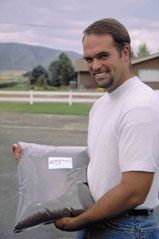
holding a bag of chicken compost
Photo B. Utah egg producer Mike Shepherd holds composted poultry manure.
Photo by Gary Neuenswander.

Managing Compost Inside Poultry Facilities
Details on composting processes and methods are outside the scope of this article but are presented elsewhere in comprehensive manuals [3 ]. Two of the most important factors for successful in-house composting are the appropriate C:N ratio and moisture content of the material. Carbon to nitrogen ratio should be in the range of 20:1 to 40:1, with moisture contents in the range of 40 to 65% by weight. Practitioners are encouraged to purchase a comprehensive reference on composting methods, and to periodically have samples of material analyzed to compare results to desired ranges and make adjustments as necessary.

Carbon requirements
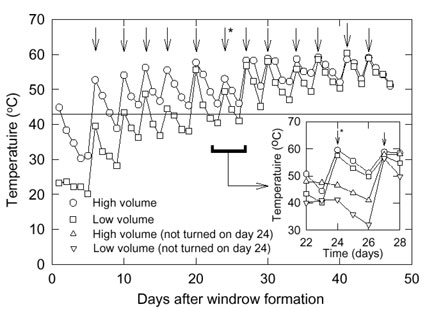
Initial research showed that high composting temperatures could be achieved in-house using relatively low rates of carbon material (200 to 600 lbs per 1,000 square feet of floor area, [4,5 ]) (Figure 2). The resulting C:N ratio of the compost, however, was approximately 10:1, much lower than recommended for optimum composting. Composting with a low C:N ratio contributes to high rates of ammonia gas evolution and atmospheric ammonia concentrations inside the layer facility. While using less carbon extends the length of time compost can accumulate before the volume exceeds the capacity of the turner, the resulting high rates of ammonia volatilization are not sustainable from an air quality perspective.
Increasing the amount of carbon used to produce a target C:N ratio of 20:1 to 40:1 will reduce ammonia volatilization. Formulae are available to calculate the exact amount of carbon necessary to achieve a target C:N ratio, knowing the characteristics of the manure and carbon source material [3]. Higher C:N ratio carbon sources are desirable, as they reduce the total amount of carbon required. Depending on the source, from 1/3 to 2 pounds of carbon per pound of manure would be required for an optimum C:N ratio with in-house composting.

According to published research, a single laying hen produces approximately 0.058 lb manure per day (41% moisture equivalent) [6]. The C:N ratio of layer manure averages 8.5 [4,5]. Using this information, together with data on the carbon source and the formulae cited above, the total amount of carbon needed for a given number of birds and length of time composting will occur can be calculated. Research [1] also suggests that as much as 35% of the manure decomposes during in-house composting, so some adjustment in the amount of manure may be warranted when forecasting carbon requirements.

Since manure is added continuously over time, all of the carbon should not be added at the beginning of an in-house composting cycle. Divide the carbon into three or more separate applications made at regular intervals during a cycle. For example, in a six-week cycle, add approximately 33% of the carbon at the beginning of the cycle, 33% after two weeks, and the final 33% after four weeks.

Figure 2
Figure 2. Daily compost temperatures measured during a seven-week in-house cycle. The treatments consisted of high and low initial volumes of composting material. Arrows indicate when compost was turned. The horizontal line represents the lethal limit for fly larvae (43 oC = approximately 110o F). The * indicates when certain replications of the treatments were not turned on day 24. Data from Miner et al. (2001) [5].
Page: 1 | 2 | 3


You are reading the SARE fact sheet In-House Composting in High-Rise, Caged Layer Facilities.

Order this publication.

25th SARE logo USDA Logo

1122 Patapsco Building | University of Maryland | College Park, MD 20742-6715

This Web site is maintained by the national outreach office of the SARE program, supported by the National Institute of Food and Agriculture, U.S. Department of Agriculture.

North Central SARE | Northeast SARE | Southern SARE | Western SARE

Sustainable Agriculture Research & Education ©2012

  • Help |
  • RSS Feeds |
  • A Guide To This Site