• WebStore |
  • Advanced Search |
  • MySARE Login |
  • SARE Social Media |
  • Contact Us |
  • SANET Listserv |
  • Low Bandwidth |
Search MySARE Reports
  • Grants
    • Apply for a Grant
    • Funded Grants in Your State
  • Project Reports
    • Submit a Report
    • Search the Database
    • Project Search Tips
    • About Project Reports
    • About Search Results
    • Project Products
  • Learning Center
    • Books
    • Bulletins
    • Fact Sheets
    • Topic Rooms
    • From the Field
    • Newsletters
    • Multimedia
    • Courses and Curricula
    • Project Products
    • SARE Biennial Reports
    • SANET Listserv
    • SARE Program Materials
    • Conference Materials
    • WebStore
  • Professional Development
    • PDP Overview
    • Fellows & Search for Excellence Programs
    • Sample PDP Grant Projects
    • Educator Curriculum Guides
    • National Continuing Education Program
    • State Coordinator Contact Information
  • State Programs
    • State Coordinator Program Overview
    • State Coordinator Contact Information
    • State Program Webpages
    • Funded Grants in Your State
  • Events
    • Event Calendar
    • Past Conferences
  • Newsroom
    • Press Releases
    • SARE in the News
    • Media Contacts
    • Newsletters
    • Media Toolkit
    • A Guide To This Site
    • SARE and Social Media
  • About SARE
    • SARE's Four Regions
    • Join Our Mailing List
    • SARE Grants
    • Learning Center
    • Professional Development
    • SARE Outreach
    • Historical Timeline
    • Staff
    • Vision & Mission
    • What is Sustainable Agriculture?
  • Home»
  • Learning Center»
  • Fact Sheets»
  • In-House Composting in High-Rise, Caged Layer Facilities»
  • Text Version
facebook
Twitter
YouTube
- + Font Size
Print
Share

Text Version

  • Overview of High-Rise, Caged Layer Facilities and In-House Composting
  • Managing Compost Inside Poultry Facilities
  • Economic Evaluation
  • Research Synopsis
  • References
  • Printable Version

Can't find something? Ask or send feedback.

SARE's mission is to advance—to the whole of American agriculture—innovations that improve profitability, stewardship and quality of life by investing in groundbreaking research and education. SARE's vision is...

In-House Composting in High-Rise, Caged Layer Facilities

photo - caption below
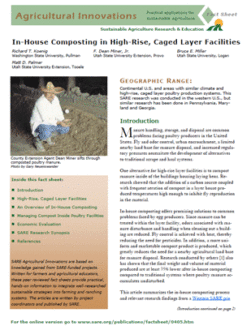
County Extension Agent Dean Miner sifts through composted poultry manure.
Photo by Gary Neuenswander
Geographic Range: Western U.S.
Continental U.S. and areas with similar climate and high-rise, caged layer poultry production systems. This SARE research was conducted in the western U.S., but similar research has been done in Pennsylvania, Maryland and Georgia.

Introduction
Manure handling, storage, and disposal are common problems facing poultry producers in the United States. Fly and odor control, urban encroachment, a limited nearby land base for manure disposal, and increased regulatory pressures necessitate the development of alternatives to traditional scrape and haul systems.

One alternative for high-rise layer facilities is to compost manure inside of the buildings housing laying hens. Research showed that the addition of a carbon source coupled with frequent aeration of compost in a layer house produced temperatures high enough to inhibit fly reproduction in the material.

In-house composting offers promising solutions to common problems faced by egg producers. Since manure can be treated within the layer facility, odors associated with manure disturbance and handling when cleaning out a building are reduced. Fly control is achieved with heat, thereby reducing the need for pesticides. In addition, a more uniform and marketable compost product is produced, which greatly reduces the need for a nearby agricultural land base for manure disposal. Research conducted by others [1]also has shown that the final weight and volume of material produced are at least 35% lower after in-house composting compared to traditional systems where poultry manure accumulates undisturbed.

This article summarizes the in-house composting process and relevant research findings from a Western SARE project in Utah for producers interested in adopting the process on their farms. Additional information on in-house composting can be found on the Internet and in the publications cited in this article.

See Full Article

You are reading the SARE fact sheet In-House Composting in High-Rise, Caged Layer Facilities.

Order this publication.

Sare 25 Years

1122 Patapsco Building | University of Maryland | College Park, MD 20742-6715

This Web site is maintained by the national outreach office of the SARE program, supported by the National Institute of Food and Agriculture, U.S. Department of Agriculture.

North Central SARE | Northeast SARE | Southern SARE |  Western SARE

Sustainable Agriculture Research & Education ©2012

  • Help |
  • RSS Feeds |
  • A Guide To This Site