• WebStore |
  • Advanced Search |
  • MySARE Login |
  • SARE Social Media |
  • Contact Us |
  • SANET Listserv |
  • Low Bandwidth |
Search MySARE Reports
  • Grants
    • Apply for a Grant
    • Funded Grants in Your State
  • Project Reports
    • Submit a Report
    • Search the Database
    • Project Search Tips
    • About Project Reports
    • About Search Results
    • Project Products
  • Learning Center
    • Books
    • Bulletins
    • Fact Sheets
    • Topic Rooms
    • From the Field
    • Newsletters
    • Multimedia
    • Courses and Curricula
    • Project Products
    • SARE Biennial Reports
    • SANET Listserv
    • SARE Program Materials
    • Conference Materials
    • WebStore
  • Professional Development
    • PDP Overview
    • Fellows & Search for Excellence Programs
    • Sample PDP Grant Projects
    • Educator Curriculum Guides
    • National Continuing Education Program
    • State Coordinator Contact Information
  • State Programs
    • State Coordinator Program Overview
    • State Coordinator Contact Information
    • State Program Webpages
    • Funded Grants in Your State
  • Events
    • Event Calendar
    • Past Conferences
  • Newsroom
    • Press Releases
    • SARE in the News
    • Media Contacts
    • Newsletters
    • Media Toolkit
    • A Guide To This Site
    • SARE and Social Media
  • About SARE
    • SARE's Four Regions
    • Join Our Mailing List
    • SARE Grants
    • Learning Center
    • Professional Development
    • SARE Outreach
    • Historical Timeline
    • Staff
    • Vision & Mission
    • What is Sustainable Agriculture?
  • Home»
  • Learning Center»
  • Fact Sheets»
  • Cultural Practices for Root-Knot and Root-Lesion Nematode Suppression in Vegetable...
facebook
Twitter
YouTube
- + Font Size
Print
Share
  • by Type
  • by Topic
  • Books
  • Bulletins
  • Fact Sheets
  • Topic Rooms
  • From the Field
  • Newsletters
  • Multimedia
  • Courses and Curricula
  • Project Products
  • SARE Biennial Reports
  • SANET Listserv
  • SARE Program Materials
  • Conference Materials
  • WebStore
  • Animal Production
  • Community Development
  • Cover Crops
  • Crop Production
  • Economic/Marketing
  • Education & Training
  • Energy Conservation & Renewable Energy
  • For Consumers
  • Integrated Systems
  • Natural Resources/Environment
  • Pest Management
  • Quality of Life
  • Season Extension
  • Soil Management
  • Specialty Crops
  • Value Added
  • WebStore

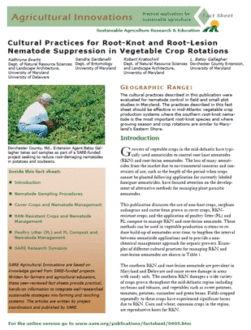
Fact Sheet

Cultural Practices for Root-Knot and Root-Lesion Nematode Suppression in Vegetable Crop Rotations

06AGI2005
Download Product

Growers of vegetable crops in the mid-Atlantic have typically used nematicides to control root knot nematodes (RKN) and root-lesion nematodes. The loss of many nematicides from the market due to environmental concerns and constraints of use, such as the length of the period when crops cannot be planted following application for currently labeled fumigant nematicides, have focused attention on the development of alternative methods for managing plant parasitic nematodes.
 
 This publication discusses the use of non-host crops, sorghum sudangrass and castor bean grown as cover crops, RKN-resistant crops, and the application of poultry litter (PL) and PL compost to manage RKN and root-lesion nematode. These methods can be used in vegetable production systems to reduce build-up of nematodes over time, to lengthen the interval between nematicide applications and to provide a non-chemical management approach for organic growers.

Geographic Adaptability: The cultural practices described in this publication were evaluated for nematode control in field and small plot studies in Maryland. The practices described in this fact sheet should be effective in mid-Atlantic vegetable crop production systems where the southern root-knot nematode is the most important root-knot species and where growing season and crop rotations are similar to Maryland’s Eastern Shore.

Want more information? See the related SARE grant(s) LNE00-131, Development and Evaluation of Management Alternatives for Root Knot Nematodes and Volunteer Potatoes.

Product Specs

Author: Kathryne Everts, Sandra Sardanelli, Robert Kratochvil, L. Betsy Gallagher
 | 
Published: 2005
 | 
Pages: 5

How to Order

Online Version (Free)
Download File (329.22 kB)
 | 
View the Online HTML

Only available online


Related Resources

You may be interested in more information about: Pest Management.

Search the MySARE project reports database for research about Pest Management.

Sare 25 Years

1122 Patapsco Building | University of Maryland | College Park, MD 20742-6715

This Web site is maintained by the national outreach office of the SARE program, supported by the National Institute of Food and Agriculture, U.S. Department of Agriculture.

North Central SARE | Northeast SARE | Southern SARE |  Western SARE

Sustainable Agriculture Research & Education ©2012

  • Help |
  • RSS Feeds |
  • A Guide To This Site