When farmers diversify, they create opportunities for their communities to benefit. One way is grower to grower: Teaming up to market alternative crops can spread the workload, while co-buying seed or equipment can lower costs. Sharing knowledge, farm to farm, can enhance crop performance. Some farmers even share labor.
Sustaining Communities
The concept can be right and the timing can be perfect, but without community buy-in, Ron Doetch doubts that agricultural innovations will be adopted.
Indeed, in Midwestern communities where a “small-grains initiative,” coordinated in Wisconsin and Illinois by the Michael Fields Agricultural Institute (MFAI), persuaded a single grower to include oats, barley or wheat in his former corn/beans rotation, that grower remained a solo adopter several years later. But where several growers supported one another in diversifying from corn/beans – like in DeKalb, Ill., and Burlington, Wis., – the concept of adding small grains crept, then leapt, from farm to farm.
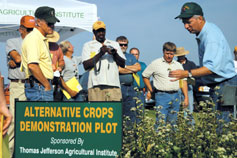
At MFAI, executive director Doetch believes that community buy-in was grounded in intensive and extensive field demonstrations of alternative crops, such as hard red winter wheat, which produces a baking-quality flour. Interest grew among farmers who had previously raised soft white wheat. At the same time, private elevator operators perked up because demand for hard red winter wheat is greatest in the Midwest and eastern U.S.
“Midwest farmers have a logistical advantage over the western Kansas farmers” where the wheat traditionally had been grown, Doetch said, and now enjoy a premium price from the elevators. “Now they’re outbidding each other to buy these farmers’ wheat.”
“Diversifying crops diversifies opportunities for communities,” said Doetch. Not only does it spark new businesses, it keeps more agricultural dollars at home. For many crops like wheat, for example, seed can be grown locally. Cleaning, warehousing and distributing can all be done locally, too.
A crop that’s harvested at a time when money isn’t normally rolling in can also put “a little jingle” into growers’ – and their towns’ – pockets, Doetch notes. While the initiative’s Wisconsin and Illinois producers are loathe to spend anticipated corn or soybean dollars until their operating loans are repaid in fall, their mid-summer wheat earnings buy discretionary items and maybe even a short family vacation while school is still out. “I always say that July money is worth a lot more than other money,” said Doetch.
Consider High-Value Specialty Crops
Specialty crops have a higher potential return per acre than commodity crops, but their intensive labor and management requirements usually restrict them to small acreages. They can be a good option for both small-scale producers and for larger farmers who can make time for them, however a number of them are perishable, needing special handling, storage and transportation and even more marketing.
Examples of high-value specialty crops include mushrooms, garlic, medicinal plants, nuts, woody ornamentals, cut flowers, native wildflower seed, and herbs and botanicals. Rare or unusual fruit and vegetable varieties often are considered specialty crops and may bring a higher price than more common horticultural crops.
Garlic Growers Share the Work and the Fun
Sometimes, effective cooperation simply involves another two or three growers. In Sussex County, N.J., garlic grower Richard Sisti decided to start “share-cropping” with other garlic growers to share laborious planting and harvesting and to consolidate the specialty crops for market efficiencies.
“The time saved by using the share-cropping model was immense,” said Sisti. At his farm, 4,400 cloves were planted in just four to five hours; at another, 84 pounds were put in the ground in four half-days. “The biggest time savings is that you’ve committed to doing one thing at one time; you put the time into it and it’s done.” By the project’s second year, two farmers were sharing a mechanical planter.
Harvests are split evenly among the share-croppers, with some garlic saved for seed and some contributed to a Sussex County Master Gardener program that makes garlic braids, swags and 15-pound wreaths.
These value-added items earned raves at the first Garden State Garlic Gathering – an event that Sisti and fellow organizers will expand to two days to accommodate spillover crowds of garlic aficionados. At the gatherings, garlic growers from New Jersey and Pennsylvania sell their garlic, seed and vinegar. They also encourage other farmers to try growing the crop and fill the shopping bags of excited consumers willing to pay six times more than they do at the supermarket.
A support-and-discussion group, web site and newsletter – all intended to help growers “avoid the pitfalls of working in isolation” – are being readied for launch. “When you’re working by yourself, you spend a lot of time reinventing the wheel,” Sisti said. Working together has even attracted a buyer for the group’s garlic curls or scapes – flowering stems of the garlic plant that are snapped off for stir-frying, sauteing and adding to pesto.