When selecting alternatives, consider which crops are a good fit for your climate, soils, marketing skills and proximity to buyers. Diversify your markets as well as your crops. “Don’t just grow for one market,” said Myers. “If one goes down, another may hold its value better.”
Consider:
- Finding other producers with experience growing the crops you are considering.
- Checking with university crop extension specialists.
- Posting queries on such electronic listservs.
- Visiting web sites developed by the Jefferson Institute, Appropriate Technology Transfer for Rural Areas (ATTRA) or Purdue University (See “Resources”).
- Applying for grant funding to test alternative crops or other sustainable production strategies through the SARE producer grant program.
The alternative crops that follow can bring new profits into your rotation. For more information about production methods for each of these crops, see the organizations listed in “Resources.”
Pearl millet, grown on 1.5 million acres of U.S. forage lands, is being developed as a feed grain for cattle, swine, catfish and poultry. Its substantially higher protein and lysine contents – when compared with feed corn – have helped drive interest by poultry producers.
In Georgia, where most livestock producers import their grain from the Corn Belt, pearl millet’s drought resistance poses a real opportunity. At the University of Georgia in Tifton, researcher Wayne Hanna is researching pearl millet as an alternative crop – and is getting two or three requests a day for seed.
“There’s a tremendous amount of interest from cattle producers and wildlife people – and the poultry people are very excited about it,” said Hanna, who got a SARE grant in the early 1990s to develop and test grain pearl millet hybrids. With its short maturing season and relative insensitivity to day length, pearl millet can be planted as late as mid-July, following wheat and canola.
Buckwheat and amaranth, which are pseudocereals, or broadleaf plants that are ground into flour like cereal grains, are a “good choice for farmers who feel comfortable with marketing,” said the Jefferson Institute’s Myers. Buckwheat, grown on 70,000 U.S. acres, commands several times the price of corn. Popular in Japan for “soba” noodles and in Russia for roasted “kasha,” buckwheat is sold in the United States for multi-grain breads, breakfast cereals and other products. A small niche market is even developing for pillows stuffed with buckwheat hulls rather than feathers or foam.
Amaranth is produced on only a few thousand acres in the U.S. each year but has earned space on grocers’ health-food shelves. Some growers also market it on the Internet. High in protein, fiber and amino acids and low in saturated fat, it is blended with wheat or other flours to make cereals, crackers, cookies, breads and other baked products.
Oilseed crops such as canola, sunflowers, flax and sesame are gaining ground rapidly as the world market expands. Typically at least 40 percent oil by weight – roughly twice as much as soybeans – alternative oilseeds are increasingly popular in edible oils and processed foods as well as for livestock, bird feeds and other non-food uses. Specialty oilseeds like meadowfoam, jojoba, lesquerella and crambe are building commercial markets as environmentally friendly, renewable alternatives to petroleum-based products.
Canola now benefits from the same price subsidies as other commodity crops and is grown on more than 1 million U.S. acres. With its low levels of saturated fats, canola oil has become a staple in many home pantries; in fact, more and more movie theatre chains are using it in their popcorn and domestic demand far exceeds supply.
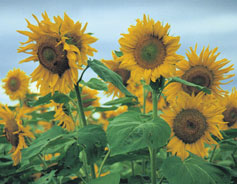
New government policies that provide oilseed loan deficiency payments are improving the economics of sunflower production. Supplies are responding, especially in the northern and western Plains states, where farmers value drought-tolerant crops. The premium market for whole “confectionery” seeds for snacks, granola bars, multi-grain breads or other baking uses about 10 to 20 percent of the crop each year. Most of the nation’s 3 million acres, however, are harvested for either vegetable oil or birdseed.
Sesame’s typically low yields are offset by a price that can run twice that of sunflowers and soybeans. Its oil is considered more stable than most vegetable oils and its seed – 50 percent oil and 25 percent protein by weight – is often used in baking. Domestic demand for sesame totals 100,000 acres, but only 10,000 to 20,000 acres are grown nationally, mostly in Texas and the Southwest. Sesame can also be grown in the Southern Plains and the lower Midwest.
Flaxseed is made into baked products and linseed oil while flax fibers are used in linen. Once commonly grown in rotation with small grains, it is now grown on about 500,000 acres in the U.S., mostly in north central states, where farmers are looking for fast-growing, cool-season alternative crops.
On their 300-acre livestock and grain farm in northern Illinois, Joel and Adela Rissman feed organically grown flaxseed to their cattle and pastured chickens and turkey. The layers get at least 15 percent flaxseed in their feed and the cattle get a half-pound a day. At those rates, the layers produce eggs with increased levels of omega-3 fatty acids. Kansas State University research shows that feeding flax to cattle just before slaughter results in elevated levels of omega-3 and other beneficial fatty acids in the beef, compared with conventionally grain-fed cattle. Consumption of these fatty acids is thought to lower the risk of heart attacks and strokes in humans. All three of their organic meats are “very profitable,” said Joel Rissman, whose farm is 70 miles from Chicago.
As nitrogen-fixing plants, legumes play an important role in improving soil fertility. In a crop rotation, they can reduce or even eliminate the need for nitrogen fertilizer. Because they convert atmospheric nitrogen into a usable form for plant growth, the resulting higher-protein plant parts enhance the diets of humans and livestock.
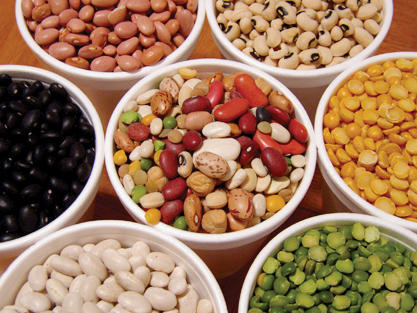
A number of domesticated or native legumes have gained acceptance as ground covers or forages. Among cash crops, however, soybeans are the only widely grown legume. Dry edible beans – including navies, pintos and kidneys – usually are highly profitable, while lentil, dry pea and chickpea sales can be significant in certain markets. Lesser-known legumes include adzuki beans, sweet white lupines, pigeon peas, cowpeas and guar.
At the University of Nebraska’s Panhandle Research and Extension Center in Scottsbluff, crop breeder David Baltensperger said spring-planted peas show promise as a legume green manure in Nebraska’s dryland wheat-millet-fallow rotations. They produced more nitrogen than fall-planted Austrian winter peas while posing fewer weed problems. They also work well as a forage crop with some nitrogen benefit.
Annual forages are an important potential alternative for producers who want to increase or stabilize their livestock production, particularly those living in areas like the central High Plains, where under-productive, inconsistent permanent pastures often leave livestock operators high and dry. In Nebraska, a SARE-funded study led by beef specialist Burt Weichenthal concluded that whole-farm sustainability increased when irrigated annual forages – such as dryland triticale, wheat, oats, barley, sorghum, sorghum-sudangrass, pearl millet and foxtail – kept cows and calves in good body condition after their dryland pasture stopped producing.
At the University of Georgia, development of grazing-tolerant alfalfa has helped move sectors of the livestock industry toward more efficient, legume-based pasture systems. Alfalfa plays a key role by fixing nitrogen and filling its edible parts with nutritious protein. In its non-traditional forms – including sprouts for salads and nutritional supplements for human diets – alfalfa sales have increased.
Cotton has long been the only significant fiber crop grown in the United States, aside from forest products. Recently kenaf – an 8- to 15-foot tall warm-season crop whose dominant use is for office papers – has gained production acreage. Best adapted to regions where cotton is grown, kenaf is being produced on a small-scale in a few southern states and California, although the rapidly growing crop can also be harvested farther north.
Besides paper, kenaf can be processed into rope, twine, bagging, rugs and poultry house bedding. The high cost of building processing plants has been a formidable barrier to kenaf’s development.
Managing an alternative crop presents different challenges than raising a more traditional crop. Producers trying alternatives may need to tap into a loose network of other growers. Crop-specific organizations or newsletters can provide valuable information. (See “Resources”)
Always begin with small test plots rather than large acreages of an unfamiliar crop. Planting single rows or small patches of three or more alternative crops – multiple varieties if possible – the first year can yield invaluable information. In the second year, increase the area devoted to testing and perhaps reduce the number of varieties or crops. By the third year, it will be evident which crops and varieties offer the best potential.
Seed Selection
For most alternative crops, far fewer seed varieties are available. Often, you need to look far afield from the typical seed sources. Contact crop buyers before purchasing seed to see whether they have contract stipulations for certain varieties. Obtain university variety test data or test a few varieties before planting a large acreage of a single variety of an unfamiliar crop.
Planting
Most alternative crops have not been bred for vigorous seedling growth and thus can be more difficult to establish. As with any crop, careful planting is crucial to its success. For specific planting guidelines, talk to your seed dealer, Extension educator or the organizations listed in “Resources”.
Although many summer annual crops have a reasonably wide window of planting times, especially in southern regions, winter annual crops must be planted by a specific time to survive. No-till planting is possible with many alternative crops, but mediocre seedling vigor, shallow planting requirements and lack of effective insect control can be challenges for no-till establishment.
Pest Management
Pest management for alternative crops depends both on the potential marketplace – organic or conventional – and the availability of pest control tools and strategies. Since few, if any, pesticides are registered for most alternative crops, you may need to rely on organic pest control strategies such as crop rotation or biological control agents.
Harvesting
Alternative fruits and vegetables may require labor-intensive hand harvest. Mechanical harvest of alternative grains and oilseeds is usually feasible with conventional equipment, but equipment adjustments or modifications may be necessary, at least to adjust for seed size.
Some alternative grains have “lodging” or seed shatter problems that make a timely harvest especially important. Since many alternative crops do not dry down evenly in the field before harvest, some air drying of stored grain may be necessary.
Insurance
Although producers can obtain crop insurance for sunflowers and other widely grown alternative species, it is not available for some new crops. USDA disaster payments may sometimes be applied to alternative crops when droughts or other widespread crop losses occur. If federal crop insurance does not cover an alternative crop, producers can apply for “non-insured crop disaster assistance” through their local Farm Service Agency office. See USDA’s Risk Management Agency website for more information.