• WebStore |
  • Advanced Search |
  • MySARE Login |
  • SARE Social Media |
  • Contact Us |
  • SANET Listserv |
  • Low Bandwidth |
Search MySARE Reports
  • Grants
    • Apply for a Grant
    • Funded Grants in Your State
  • Project Reports
    • Submit a Report
    • Search the Database
    • Project Search Tips
    • About Project Reports
    • About Search Results
    • Project Products
  • Learning Center
    • Books
    • Bulletins
    • Fact Sheets
    • Topic Rooms
    • From the Field
    • Newsletters
    • Multimedia
    • Courses and Curricula
    • Project Products
    • SARE Biennial Reports
    • SANET Listserv
    • SARE Program Materials
    • Conference Materials
    • WebStore
  • Professional Development
    • PDP Overview
    • Fellows & Search for Excellence Programs
    • Sample PDP Grant Projects
    • Educator Curriculum Guides
    • National Continuing Education Program
    • State Coordinator Contact Information
  • State Programs
    • State Coordinator Program Overview
    • State Coordinator Contact Information
    • Funded Grants in Your State
  • Events
    • Event Calendar
    • Past Conferences
  • Newsroom
    • Press Releases
    • SARE in the News
    • Media Contacts
    • Newsletters
    • Media Toolkit
    • A Guide To This Site
    • SARE and Social Media
  • About SARE
    • SARE's Four Regions
    • SARE Grants
    • Learning Center
    • Professional Development
    • SARE Outreach
    • Historical Timeline
    • Staff
    • Vision & Mission
    • Join Our Mailing List
    • What is Sustainable Agriculture?
  • Home»
  • Learning Center»
  • Bulletins»
  • Diversifying Cropping Systems»
  • Text Version
facebook
Twitter
YouTube
- + Font Size
Print
Share

Text Version

  • Why Diversify?
  • Alternative Crops
  • Protect Natural Resources
  • Agroforestry
  • Strengthen Community
  • Profiles
  • Resources
  • Printable Version

Can't find something? Ask or send feedback.

SARE's mission is to advance—to the whole of American agriculture—innovations that improve profitability, stewardship and quality of life by investing in groundbreaking research and education. SARE's vision is...

Diversifying Cropping Systems

Introduction

buckwheat flower
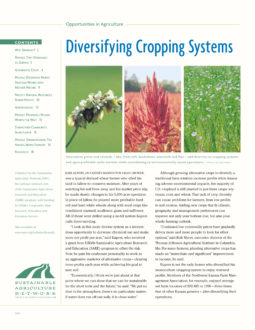
Alternative grains and oilseeds - like buckwheat - add diversity to cropping systems and open profitable niche markets while contributing to environmentally sound operations.
- Photo by Rob Myers

Karl Kupers, an eastern Washington grain grower, was a typical dryland wheat farmer who idled his land in fallow to conserve moisture. After years of watching his soil blow away and his market price slip, he made drastic changes to his 5,600-acre operation. In place of fallow, he planted more profitable hard red and hard white wheats along with seed crops like condiment mustard, sunflower, grass and safflower. All of those were drilled using a no-till system Kupers calls direct-seeding.

“I look at this more diverse system as a tremendous opportunity to decrease chemical use and make more net profit per acre,” said Kupers, who received a grant from USDA’s Sustainable Agriculture Research and Education (SARE) program to offset the risk. Now, he puts his exuberant personality to work as an aggressive marketer of alternative crops – clearing more profits each year while achieving his goal to save soil.

“Economically, I think we’re just about at that point where we can show that we can be sustainable for the short term and the future,” he said. “We put no dust in the atmosphere, there’s no particulate matter, if water does run off our soils, it is clean water.”

Although growing alternative crops to diversify a traditional farm rotation increase profits while lessening adverse environmental impacts, the majority of U.S. cropland is still planted in just three crops: soybeans, corn and wheat. That lack of crop diversity can cause problems for farmers, from low profits to soil erosion. Adding new crops that fit climate, geography and management preferences can improve not only your bottom line, but also your whole farming outlook.

“Continued low commodity prices have gradually driven more and more people to look for other options,” said Rob Myers, executive director of the Thomas Jefferson Agricultural Institute in Columbia, Mo. For some farmers, planting alternative crops has made an “immediate and significant” improvement in income, he said.

Kupers is not the only farmer who diversified his monoculture cropping system to enjoy renewed profits. Members of the Northwest Kansas Farm Management Association, for example, enjoyed average net farm incomes of $50,485 in 1998 – three times that of other Kansas growers – after diversifying their operations.

Next section

Top

You are reading the SARE bulletin Diversifying Cropping Systems.

Order this publication.

25th SARE logo USDA Logo

1122 Patapsco Building | University of Maryland | College Park, MD 20742-6715

This Web site is maintained by the national outreach office of the SARE program, supported by the National Institute of Food and Agriculture, U.S. Department of Agriculture.

North Central SARE | Northeast SARE | Southern SARE | Western SARE

Sustainable Agriculture Research & Education ©2012

  • Help |
  • RSS Feeds |
  • A Guide To This Site