• WebStore |
  • Advanced Search |
  • MySARE Login |
  • SARE Social Media |
  • Contact Us |
  • SANET Listserv |
  • Low Bandwidth |
Search MySARE Reports
  • Grants
    • Apply for a Grant
    • Funded Grants in Your State
  • Project Reports
    • Submit a Report
    • Search the Database
    • Project Search Tips
    • About Project Reports
    • About Search Results
    • Project Products
  • Learning Center
    • Books
    • Bulletins
    • Fact Sheets
    • Topic Rooms
    • From the Field
    • Newsletters
    • Multimedia
    • Courses and Curricula
    • Project Products
    • SARE Biennial Reports
    • SANET Listserv
    • SARE Program Materials
    • Conference Materials
    • WebStore
  • Professional Development
    • PDP Overview
    • Fellows & Search for Excellence Programs
    • Sample PDP Grant Projects
    • Educator Curriculum Guides
    • National Continuing Education Program
    • State Coordinator Contact Information
  • State Programs
    • State Coordinator Program Overview
    • State Coordinator Contact Information
    • State Program Webpages
    • Funded Grants in Your State
  • Events
    • Event Calendar
    • Past Conferences
  • Newsroom
    • Press Releases
    • SARE in the News
    • Media Contacts
    • Newsletters
    • Media Toolkit
    • A Guide To This Site
    • SARE and Social Media
  • About SARE
    • SARE's Four Regions
    • Join Our Mailing List
    • SARE Grants
    • Learning Center
    • Professional Development
    • SARE Outreach
    • Historical Timeline
    • Staff
    • Vision & Mission
    • What is Sustainable Agriculture?
  • Home»
  • Learning Center»
  • Books»
  • Manage Insects on Your Farm»
  • Text Version»
  • Putting it All Together»
  • Universal Principles, Farm-Specific Strategies
facebook
Twitter
YouTube
- + Font Size
Print
Share

Text Version

  • Acknowledgments
  • Introduction
  • Table of Contents
  • How Ecologically Based Pest Management Works
  • Principles of Ecologically Based Pest Management
  • Identification Key to Major Beneficials and Pests
  • Managing Soils to Minimize Crop Pests
  • Farm Feature: Triple Threat to Pests: Cover Crops, No-Till, Rotation
  • Beneficial Agents on the Farm
  • Putting it All Together
    • Designing a Habitat Management Strategy
    • Fine-Tuning Farm Management to Enhance Specific Beneficials
    • Enhancing Biota and Improving Soil Health
    • Strategies for Enhancing Plant Diversity
    • Rolling Out Your Strategy
    • Figure 2: Preventative and Reactive Strategies That Enhance Ecological Pest Management
    • Key Elements of Ecological Pest Management
    • Farm Feature: Rotation, Rotation, Rotation: Alfalfa, Cover Crops Break Pest Cycles
    • Universal Principles, Farm-Specific Strategies
    • Guidelines for Designing Healthy and Pest-Resiliant Farming Systems
    • 10 Indicators of Soil Quality
    • 10 Indicators of Crop Health
  • Resources: General Information
  • Printable Version

Can't find something? Ask or send feedback.

SARE's mission is to advance—to the whole of American agriculture—innovations that improve profitability, stewardship and quality of life by investing in groundbreaking research and education. SARE's vision is...

Universal Principles, Farm-Specific Strategies

Universal Principles, Farm-Specific Strategies

The key challenge for farmers in the 21st century is to translate the principles of agroecology into practical systems that meet the needs of their farming communities and ecosystems. You can apply these principles through various techniques and strategies, each of which will affect your farm differently, depending on local opportunities and resources and, of course, on markets. Some options may include both annual and perennial crops, while others do not. Some may transcend field and farm to encompass windbreaks, shelterbelts and living fences. Well-considered and well-implemented strategies for soil and habitat management lead to diverse and abundant — although not always sufficient — populations of natural enemies.

As you develop a healthier, more pest-resilient system for your farm, ask yourself:

How can I increase species diversity to improve pest management, compensate for pest damage and make fuller use of resources?
How can I extend the system’s longevity by including woody plants that capture and recirculate nutrients and provide more sustained support for beneficials?
How can I add more organic matter to activate soil biology, build soil nutrition and improve soil structure?
Finally, how can I diversify my landscape with mosaics of agroecosystems in different stages of succession?

Because locally adapted varieties and species can create specific genetic resilience, rely on local biodiversity, synergies and dynamics as much as you can. Use the principles of agroecology to intensify your farm’s efficiency, maintain its productivity, preserve its biodiversity and enhance its self-sustaining capacity.


Previous Section | Top | Next Section

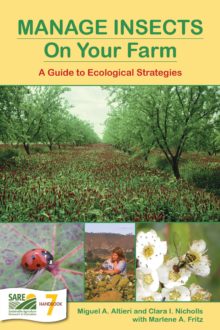
You are reading the SARE book Manage Insects on Your Farm.

Order this publication.

Sare 25 Years

1122 Patapsco Building | University of Maryland | College Park, MD 20742-6715

This Web site is maintained by the national outreach office of the SARE program, supported by the National Institute of Food and Agriculture, U.S. Department of Agriculture.

North Central SARE | Northeast SARE | Southern SARE |  Western SARE

Sustainable Agriculture Research & Education ©2012

  • Help |
  • RSS Feeds |
  • A Guide To This Site