How Ecologically Based Pest Management Works
Introduction
To bring ecological pest management to your farm, consider three key strategies:
• Select and grow a diversity of crops that are healthy, have natural defenses against pests, and/or are unattractive or unpalatable to the pests on your farm. Choose varieties with resistance or tolerance to those pests. Build your soil to produce healthy crops that can withstand pest pressure. Use crop rotation and avoid large areas of monoculture.
• Stress the pests. You can do this using various management strategies described in this book. Interrupt their life cycles, remove alternative food sources, confuse them.
• Enhance the populations of beneficial insects that attack pests. Introduce beneficial insects or attract them by providing food or shelter. Avoid harming beneficial insects by timing field operations carefully. Wherever possible, avoid the use of agrichemicals that will kill beneficials as well as pests.
EBPM relies on two main concepts:
Biodiversity in agriculture refers to all plant and animal life found in and around farms. Crops, weeds, livestock, pollinators, natural enemies, soil fauna and a wealth of other organisms, large and small, contribute to biodiversity. The more diverse the plants, animals and soil-borne organisms that inhabit a farming system, the more diverse the community of pest-fighting beneficial organisms the farm can support.
Biodiversity is critical to EBPM. Diversity, in the soil, in field boundaries, in the crops you grow and how you manage them, can reduce pest problems, decrease the risks of market and weather fluctuations, and eliminate labor bottlenecks.
Biodiversity is also critical to crop defenses: Biodiversity may make plants less “apparent” to pests. By contrast, crops growing in monocultures over large areas may be so obvious to pests that the plants’ defenses fall short of protecting them.
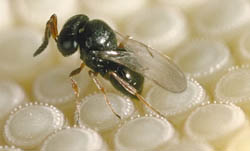
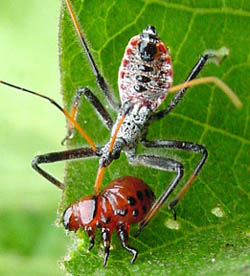
Biological control is the use of natural enemies — usually called “beneficial insects” or “beneficials” — to reduce, prevent or delay outbreaks of insects, nematodes, weeds or plant diseases. Biological control agents can be introduced, or they can be attracted to the farming system through ecosystem design.
Naturally occurring beneficials, at sufficient levels, can take a big bite out of your pest populations. To exploit them effectively, you must:
1) identify which beneficial organisms are present;
2) understand their individual biological cycles and resource requirements; and
3) change your management to enhance populations of beneficials.
“It’s a subtle effect, but over time the advantage increases. Your system moves slowly toward a natural balance and your pest problems decrease.”— Zach Berkowitz, california vineyard consultant
The goal of biological control is to hold a target pest below economically damaging levels — not to eliminate it completely — since decimating the population also removes a critical food resource for the natural enemies that depend on it.
In Michigan, ladybugs feed on aphids in most field crops or — if prey is scarce — on pollen from crops like corn. In the fall, they move to forest patches, where they hibernate by the hundreds under plant litter and snow. When spring arrives, they feed on pollen produced by such early-season flowers as dandelions. As the weather warms, they disperse to alfalfa or wheat before moving on to corn. Each component of biodiversity — whether planned or unplanned — is significant. For example, if dandelions are destroyed during spring plowing, the ladybugs lose an important food source. As a result, the ladybugs may move on to greener pastures, or fail to reproduce, reducing the population available to manage aphids in your cash crop.
Research shows that farmers can indeed bring pests and natural enemies into balance on biodiverse farms by encouraging practices that build the greatest abundance and diversity of above- and below-ground organisms (Figure 1). By gaining a better understanding of the intricate relationships among soils, microbes, crops, pests and natural enemies, you can reap the benefits of biodiversity in your farm design. Further, a highly functioning diversity of crucial organisms improves soil biology, recycles nutrients, moderates micro-climates, detoxifies noxious chemicals and regulates hydrological processes.