
Analysis of Diversifying a Rotation in Wheat Country
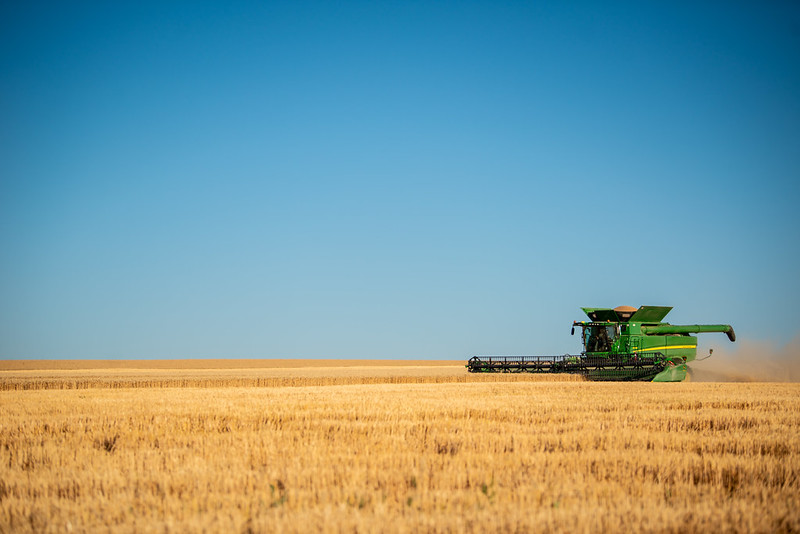
Warren Miller farms in Washington state in the western Palouse, a semi-arid dryland region characterized by rich soil on steep, dune-like hills. At about 1,200 acres, the farm is small by regional standards. Given the low average rainfall of approximately 17 inches per year, occurring primarily in the winter months, the land is typically cropped just two out of every three years. A fallow year precedes the main cash crop, winter wheat, which is planted in the fall and harvested the following summer. Following this crop, a spring grain crop will typically be grown, either spring wheat or spring barley. A spring grain crop isn’t as productive as winter wheat but it’s considered an excellent choice from a rotational standpoint based on this region’s precipitation.
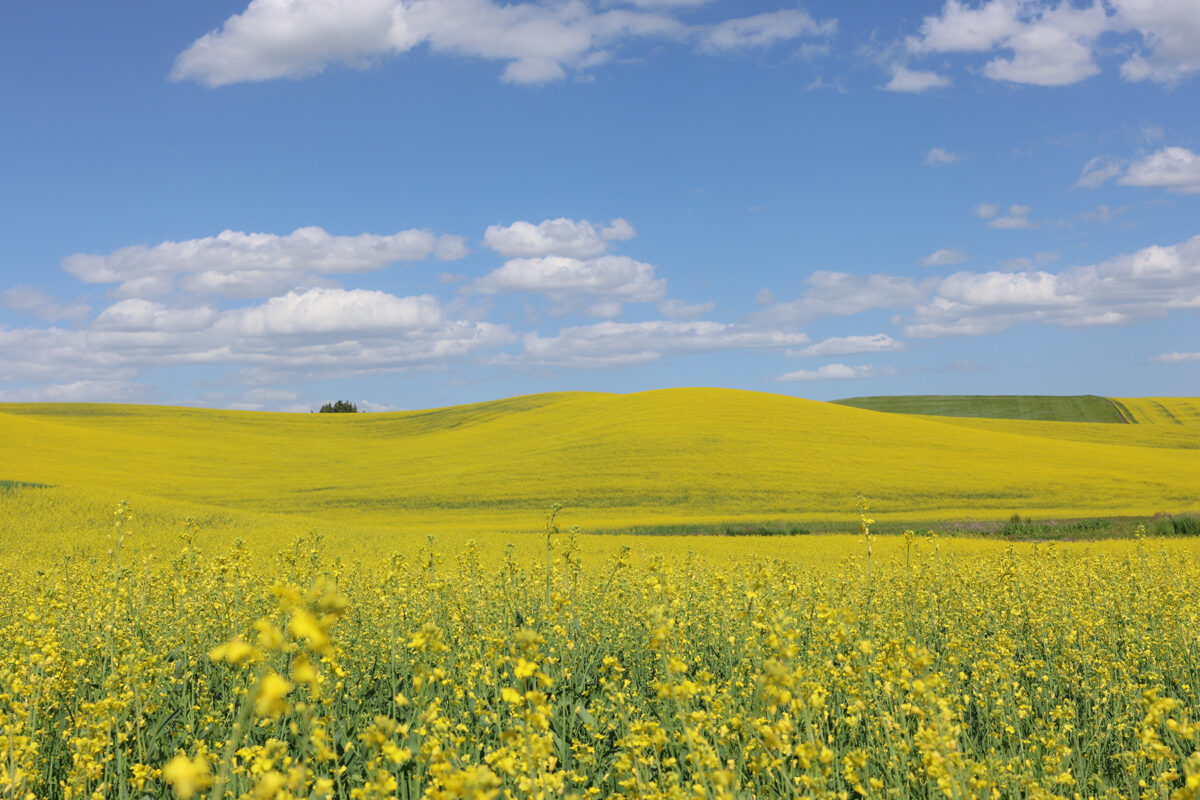
Growers in this area who are interested in sustainability are trying alternatives to summer fallow in order to intensify their crop production while adding diversity to the typical wheat monoculture. Replacing summer fallow with a crop should improve soil quality over time, including its water holding capacity, which is critical in this dryland region. Few alternative crops are grown, due to climate and profitability limitations. As an alternative to summer fallow, Miller has planted spring canola in the wetter areas of his farm.
The main concern when replacing summer fallow with a crop in this region is its impact on winter wheat yields the following year. For this reason, returns from the two three-year rotations will need to be tracked over time. The two rotations are:
- winter wheat followed by spring barley and summer fallow (WW-SB-SF)
- winter wheat followed by spring barley and spring canola (WW-SB-SC)
If the winter wheat yield suffers following a spring canola crop, the overall profitability of the rotation could decline. In this dryland region, winter wheat is typically the most profitable enterprise, as it can take advantage of nearly a full year of precipitation.
In this case study, Miller estimates the profitability of producing spring canola relative to the status quo of leaving the land fallow. He then estimates rotational returns for the two cropping systems, assuming equivalent winter wheat yields. He feels he’ll be satisfied if net returns are close for the two systems, as he’ll be making progress toward his goal of building soil organic matter. The details of all the underlying assumptions for these two cropping systems are available in a multiyear budget. This budget includes input costs, such as fuel and fertilizer, and annualized fixed costs for all farm equipment and vehicles. This comprehensive economic analysis requires taking the steps explained in the sections “Basic Recordkeeping” and “Estimating Your Farm Machinery Operating Expenses.”
While this is a time-consuming process, once you complete it you can easily update the analysis by following the instructions in this spreadsheet template. This template has color-coded instructions for maintaining links and underlying calculations. Estimates may be changed when they appear in red type. For example, crop prices are updated in the Summary sheet, where they appear in red type, but not on the individual crop budget sheets, where they appear in purple type. Profitability estimates by crop and averaged over multi-year rotations are located on the Summary sheet.
A Breakeven Analysis for 2024: Will Spring Canola Be Profitable?
Based on conservative estimates for 2024, Miller used a partial budget analysis to estimate whether spring canola would be more profitable than leaving the land in summer fallow. See the partial budget for this situation in Figure 5.
- Section 1: Additional returns. This section includes Miller’s conservative estimate of spring canola revenue of $297 per acre.
- Section 2: Reduced costs. This section includes an estimate of $36 in variable costs for chemical and mechanical weed control when fallowing, which he won’t have to spend if he plants canola instead.
- Section 3: Additional costs. This section includes an estimate of the variable costs associated with planting spring canola, $278 per acre, and a land rent charge of $67 per acre. (There is no land rent per se associated with summer fallow in this region due the use of cost-share arrangements and the lack of a crop during fallow.) Finally, the spring canola budget has additional fixed costs of $48.50, associated with annualized fixed costs for machinery and additional overhead.
- Section 4: Reduced returns. This section is blank because there are no reductions in returns for this situation.
The bottom line in Figure 5 calculates the net change in income from this proposed change, which is calculated as:
net change in income = total change in benefits (Section 1 + Section 2) - total change in costs (Section 3 + Section 4)
The net change is estimated to be -$60.50 per acre, a negative outcome using these conservative estimates. Although the difference between estimated returns over variable costs for spring canola ($19 per acre) and summer fallow (-$36 per acre) on the budget sheet Summary of Returns by Crop and Rotation, Planning Estimates indicates a $55 gain in returns over variable costs, adding the fixed costs of land rent, plus additional fixed costs, creates a negative outcome from this change.
Another use of the partial budgeting tool is to calculate the breakeven value for a specific variable. In this case, Miller wants to determine the breakeven price that would make this proposed change equivalent to the status quo. As we mentioned earlier in this publication, you do this by replacing the value in question with a variable (such as the letter “x”) then placing the pros on one side of an equation and the cons on the other, just like in the partial budget template in Figure 5. You then solve for your variable. The equation is set up to estimate the point at which the positive changes would just equal the negative changes, or the breakeven point.
The term breakeven price is the variable in this example, specifically for a canola crop:
- Positive changes = Negative changes
- Revenue from canola (i.e., yield x breakeven price) + Summer fallow costs = Costs of canola production
- 1,650 pounds per acre x (breakeven price) + $36 per acre = $393.50 per acre
- 1,650 pounds per acre x (breakeven price) = ($393.50 - $36) per acre
- 1,650 pounds per acre x (breakeven price) = $357.50 per acre
- Breakeven price = $357.50 per acre ÷ 1,650 pounds per acre
- Breakeven price of canola = $0.22 per pound
Thus, the breakeven price for canola that would make returns from this alternative equal to a summer fallow year is $0.22 per pound. You can also assess risk by asking yourself whether this possibility is very likely. While Miller has noticed that canola prices are fluctuating, and have been about 25% lower than what he received in 2023, a conservative estimate for 2024 is $0.18 per pound. If this price estimate is correct, it’s quite a bit lower than his estimated breakeven price.
Another option with this approach is to estimate his breakeven yield. To do this, Miller would simply use his conservative market price estimate for canola ($0.18 per pound) and the variable to solve for would be the breakeven yield amount. In this case, he can return to step 5 above and modify it by inserting the market price and changing yield to his variable:
Breakeven yield x $0.18 per pound = $357.50 per acre
Breakeven yield = $357.50 per acre ÷ $0.18 per pound
Breakeven yield = 1,986 pounds per acre
This breakeven yield of 1,986 pounds per acre, given our assumptions, is about 20% higher than his conservative estimate of 1,650 pounds per acre. Knowing these breakeven estimates should be helpful when analyzing the riskiness of a specific change.
Figure 5. A Partial Budget Template Comparing Spring Canola Production with Summer Fallow
| Scenario: Replace summer fallow with spring canola | |||||||
| Section 1. | Section 3. | ||||||
| Additional returns from proposed changed | Price/unit | Quantity | Amount of Change | Additional cost of proposed change | Price/unit | Quantity | Amount of Change |
| Spring canola production | $0.18 | 1650 | $297 | Variable costs for spring cattle | $278 | 1 | $278 |
| $0.0 | Land rent for spring canola | $67 | 1 | $67 | |||
| Other additional fixed costs | $48.50 | 1 | $48.50 | ||||
Subtotal additional returns | $297 | Subtotal additional cost | $394 | ||||
| Section 2. | Section 4. | ||||||
| Reduced costs from proposed change | Price/unit | Quantity | Amount of Change | Reduced returns from proposed change | Price/unit | Quantity | Amount of Change |
| Variable costs for summer fallow | $36 | 1 | $36 | $0.0 | |||
| $0.0 | $0.0 | ||||||
Subtotal reduced costs | $0.0 | Subtotal reduced returns | $0.0 | ||||
| Summary Section | |||||||
| Total Change in Benefits (Section 1 + Section 2) | $333 | Total Change in Costs (Section 3 + Section 4) | $393.50 | ||||
| Net Change in Income (Change in Benefits - Change in Costs) | -$60.50 | ||||||
Examining the Bottom Line
The big question for risk averse growers in this region is whether replacing a fallow year with a spring canola crop will negatively impact the yield of their main cash crop, winter wheat. In the longer run, soil quality improvements should enhance water holding capacity and thus crop yields, but if the near-term yield of the one crop that’s reliably profitable is negatively affected, growers may be unwilling to take this risk.
Using best-guess estimates for yield, prices, and costs of production by crop, Miller calculated profitability for each three-year system by dividing total net returns by three. (See the budget sheet Summary of Returns by Crop and Rotation, Planning Estimates.) With these assumptions, net returns over total costs for the system with canola (WW-SB-SC) average -$46 per acre, while the system with fallow (WW-SB-SF) averages -$28 per acre. Total costs include land costs as well as non-cash fixed costs such as depreciation and interest on machinery. This difference represents the economic tradeoff for this choice. The spring canola system also requires more labor: about an hour per acre compared to about 0.2 hours per acre for fallow, or about $16 per acre in machine labor. This might be an additional management consideration.
As in Case Study 1, the spring canola rotation (WW-SB-SC) appears more profitable than the status quo when you only look at returns over variable costs. Average net returns over variable costs average $75 per acre for WW-SB-SC, while returns for the WW-SB-SF average $56 per acre (see the summary sheet). However, fixed costs, including land rent and machinery fixed costs, are higher relative to the status quo system (WW-SB-SF), in which just two-thirds of the land is cropped. When fixed costs are included, net returns for the WW-SB-SF system are $18 per acre higher. This difference represents the tradeoff associated with trying an alternative system that may well enhance soil quality in the long run. However, for a risk-averse producer in a semi-arid farming area, adding $18 to a negative net return may be unacceptable. On the other hand, if the farmer ignores machinery labor expense, the difference in profitability for the two systems is just $2 per acre, which may well be an acceptable tradeoff.