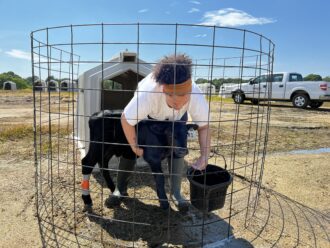
Calf digestive issues can be a substantial hindrance to livestock health and productivity in the U.S dairy and beef industries. SARE-funded research conducted by Peixin Fan may provide insights on microbiome-guided strategies that offer beef and dairy farmers new options for improving livestock resilience and profitability.
Fan, then a PhD student at the University of Florida, examined a multi-breed Angus-Brahman beef cattle herd to better understand how the microbiomes of calves, influenced by genetic composition and diet, could reduce calf susceptibility to digestion concerns. With support from a Southern SARE Graduate Student grant, Fan studied the relationship between calf microbiomes and health, focusing on identifying beneficial bacteria that could combat harmful pathogens.
The results were promising and confirmed earlier findings that cattle with a higher Brahman genetic composition are more resistant to parasite diseases. The study also isolated bacteria strains associated with combatting diarrhea pathogens. By manipulating calf microbiomes through diet and strategic interbreeding, farmers may be able to reduce the incidence of loose stool with less reliance on costly antibiotics or other treatments.
A recent post-project evaluation of SARE projects awarded between 2016–2019 found that SARE’s unique support for graduate student research that helps farmers solve problems was key to the project’s success.
“Our intention with what we're calling a microbiome guided strategy is to use our research findings to enhance calves’ microbiomes by suggesting to farmers how they can breed and manipulate the animal diet to boost their economic outcomes,” said Fan.
Fan’s work was made possible with the support of her PhD advisor Kwang Cheol Jeong (University of Florida), Mauricio Elzo (University of Florida), and Miju Kim (Kyung Hee University).
Visit https://www.sare.org/sare-impacts-GS19-206 for more information on this project's impact.
Developing Efficient Probiotics for Microbiota of Diarrhea-Resistant Livestock is part of a series produced by Insight for Action as part of a post-project evaluation of SARE's regional grant programs. For more information visit https://www.sare.org/sare-impacts.
For information on grants and resources available from SARE, visit www.sare.org.