Farmers with 10+ years of experience help provide insights into incentive program design, monetization, and management practices that drive returns on investment.
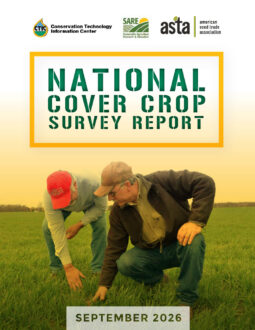
Results of the 2026 National Cover Crop Report released Sept. 1 at the Farm Progress Show indicate strong interest in cover crops among many farmers who produce a wide range of crops and livestock. Among respondents to the survey, the average acreage planted with cover crops was 397.9, and their projections anticipate crossing the 400-acre mark by next year. Almost half of the cover crop users in the survey had 10+ years of experience with cover crops.
The 2026 survey was conducted by the Conservation Technology Information Center (CTIC), USDA Sustainable Agriculture Research and Education (SARE) program, and American Seed Trade Association (ASTA) and is the ninth National Cover Crop Report published by CTIC and SARE since 2013.
Cover crops are of great interest to USDA, notes Farm Production and Conservation Under Secretary Richard Fordyce.
“We work closely with agricultural producers to implement conservation practices – like cover crops – that strengthen soil health and ensure long-term productivity and profitability of our nation’s agricultural operations,” says Fordyce. “USDA is putting farmers first through our conservation programs and technical assistance, and we thank farmers for their voluntary efforts to conserve our nation’s natural resources while feeding, fueling and clothing our nation.”
That emphasis by farmers and policymakers makes the survey especially important, notes Dr. Rob Myers at the University of Missouri, who has led the survey program since its inception.
"The National Cover Crop Report has become a benchmark in tracking not only the growing use of cover crops, but also the growing appreciation of cover crops' benefits and understanding of how farmers succeed with the practice," Myers says. "Data from these surveys has been used in farmer outreach programs on cover crops and conservation policy development. Every time we conduct one of these surveys, we gather new insights to share, and this year was no exception."
This year's survey was completed online by 657 farmers in 46 U.S. states and Puerto Rico. Farmers who used cover crops in the past were grouped as "intermittent users" instead of “former users” to acknowledge the role that cover crops play in adaptive management systems, notes Ryan Heiniger, executive director of CTIC and Iowa farmer. Of those intermittent users, 28.6% said they were definitely or probably open to considering cover crops again, and another 34.7% said "maybe" they would consider the practice.
Cover Crop Use Isn’t Binary
"Though many fans of cover crops can't imagine not using them, other farmers choose whether or not to plant covers based on economics, field conditions, crop rotations, or other factors," says Heiniger, who uses cover crops on his southeast Iowa farm. "In the past, research had a tendency to group people as 'users' or 'non-users.' We've learned — and through this survey, confirmed — that intermittent use of cover crops can be a dynamic decision, not an abandonment of the practice or its principles. Better data showing a positive return on investment and incentive programs to help cover the costs of cover crop establishment could bring cover crops back to many of those acres."
More than 60% of cover crop users said in this year's survey that there are years when they do not use cover crops on certain fields. Late harvest of cash crops accounted for non-use among 41.8% of the respondents, followed by "conditions too dry or wet to plant covers" selected by 38.6%, and "not enough time or labor to plant covers," which was selected by 38%. In addition, 73.5% of the respondents who reported never using cover crops indicated that they were open to trying the practice.
Incentives Can Help
This year's survey indicated that although many cover crop users or intermittent users have not received payments to try cover crops, incentive programs can play a significant role in encouraging adoption of the practice — particularly if they are well-designed programs.
Of 256 cover crop users in the survey who reported receiving an incentive payment for cover crops in 2025, 81.6% said they probably or definitely would continue. Only 4.7% said they probably would not continue using cover crops beyond the term of their incentive program.
Just 21.6% of the previous or intermittent cover crop users in the survey reported receiving cover crop incentive payments of some sort. Of those, 70% said they were inspired to try cover crops because the incentive payments reduced financial risk or helped offset direct costs of the practice. None of the past users who had received payments indicated that any issue with the incentive program contributed to their decision not to use cover crops later.
The survey indicated that programs that offer easy enrollment and clear terms were most attractive to growers. Competition for enrollment did not dissuade most of the respondents, but lack of familiarity with carbon markets or other program details — together accounting for 48.4% of cover crop users who had not participated in an incentive program — was the most dissuasive factor in signing up for an incentive. Concern about long-term commitments dissuaded 32.4%, insufficient payment was cited by 19.6%, eligibility was a barrier for 14.7%, and unpredictable payments discouraged 11.9%. Just 13.8% said lack of interest drove the decision not to participate in an incentive program.
Procurement, Application, and Integrated Livestock
The survey asked farmers about details on how cover crop users purchase or grow their own cover crop seed.
“The cover crop survey is an invaluable resource for the seed industry," says Andy LaVigne, president and CEO of ASTA. "It helps seed producers understand trends and ensure a reliable supply of high-quality, professionally produced cover crop seed. By utilizing the information in this survey, the seed industry can help support conservation efforts by ensuring growers have access to the right seed, at the right time, to achieve their conservation goals, leading to a more secure and reliable food supply and a healthier environment."
Among other insights in the 2026 National Cover Crop Report are:
- A mean yield increase of 3.5 bushels per acre of corn and 1.4 bushels of soybeans per acre following cover crops.
- Better weed control following cover crops was reported by 31.2% of all cover crop users, and by 87% of the growers who "planted green" into live, standing covers.
- One in three cover crop users reported grazing cover crops or harvesting them for consumption by livestock, and 77% of the ones who grazed said it increased their profit. Also, 85% of respondents who reported an interest in virtual fencing said the technology would increase their use of cover crop grazing.
- With two-thirds of cover crop users not grazing their cover crops, there is plenty of acreage to help rebuild America's beef herd. Farmers can team up with cattle producers to graze cover crops.
- Interest in using drones for cover crop seeding or termination is off to a strong start — 16.3% of cover crop users reported working with drones in their cover crops. As recently as the 2023 National Cover Crop Report, only one in 553 cover crop users reported seeding covers with a drone.
Visit www.sare.org/covercropsurvey to download the CTIC/SARE/ASTA 2026 National Cover Crop Report or read previous reports dating back to 2013.
About Conservation Technology Information Center: Founded in 1982, CTIC champions, promotes, and provides information on technologies and sustainable agricultural systems that conserve and enhance soil, water, air and wildlife resources, and are productive and profitable. It is one of the oldest nonprofit membership organizations solely dedicated to the advancement of conservation agriculture research, policies, and program delivery for producers.
About Sustainable Agriculture Research and Education: The SARE program is a producer-driven, decentralized competitive grants and education program operating in every state and island protectorate. Funded by the United States Department of Agriculture's National Institute for Food and Agriculture, the program is run by four regions (North Central, Northeast, South and West) hosted by land grant institutions. SARE Outreach provides communication and technical support at the national level.
About the American Seed Trade Association: Founded in 1883, ASTA is one of the oldest trade organizations in the United States. Its membership consists of over 650 companies involved in seed production and distribution, plant breeding, and related industries in North America. As an authority on plant germplasm, ASTA advocates science and policy issues of industry-wide importance. ASTA’s mission is to be an effective voice of action in all matters concerning the development, marketing and movement of seed, associated products and services throughout the world.