• WebStore |
  • Advanced Search |
  • MySARE Login |
  • SARE Social Media |
  • Contact Us |
  • SANET Listserv |
  • Low Bandwidth |
Search MySARE Reports
  • Grants
    • Apply for a Grant
    • Funded Grants in Your State
  • Project Reports
    • Submit a Report
    • Search the Database
    • Project Search Tips
    • About Project Reports
    • About Search Results
    • Project Products
  • Learning Center
    • Books
    • Bulletins
    • Fact Sheets
    • Topic Rooms
    • From the Field
    • Newsletters
    • Multimedia
    • Courses and Curricula
    • Project Products
    • SARE Biennial Reports
    • SANET Listserv
    • SARE Program Materials
    • Conference Materials
    • WebStore
  • Professional Development
    • PDP Overview
    • Fellows & Search for Excellence Programs
    • Sample PDP Grant Projects
    • Educator Curriculum Guides
    • National Continuing Education Program
    • State Coordinator Contact Information
  • State Programs
    • State Coordinator Program Overview
    • State Coordinator Contact Information
    • State Program Webpages
    • Funded Grants in Your State
  • Events
    • Event Calendar
    • Past Conferences
  • Newsroom
    • Press Releases
    • SARE in the News
    • Media Contacts
    • Newsletters
    • Media Toolkit
    • A Guide To This Site
    • SARE and Social Media
  • About SARE
    • SARE's Four Regions
    • Join Our Mailing List
    • SARE Grants
    • Learning Center
    • Professional Development
    • SARE Outreach
    • Historical Timeline
    • Staff
    • Vision & Mission
    • What is Sustainable Agriculture?
  • Home»
  • Learning Center»
  • From the Field»
  • Southern SARE From the Field»
  • Multi-State Resource Tool Addresses Small Ruminant Production Needs
facebook
Twitter
YouTube
- + Font Size
Print
Share
  • by Type
  • by Topic
  • Books
  • Bulletins
  • Fact Sheets
  • Topic Rooms
  • From the Field
  • Newsletters
  • Multimedia
  • Courses and Curricula
  • Project Products
  • SARE Biennial Reports
  • SANET Listserv
  • SARE Program Materials
  • Conference Materials
  • WebStore
  • Animal Production
  • Community Development
  • Cover Crops
  • Crop Production
  • Economic/Marketing
  • Education & Training
  • Energy Conservation & Renewable Energy
  • For Consumers
  • Integrated Systems
  • Natural Resources/Environment
  • Pest Management
  • Quality of Life
  • Season Extension
  • Soil Management
  • Specialty Crops
  • Value Added
  • WebStore

Southern SARE From the Field Profile

Multi-State Resource Tool Addresses Small Ruminant Production Needs

goatforage

A comprehensive small ruminant resource tool covering all manners of production, planning, marketing, health, and facilities has been developed to aid producers and the Extension agents who work with them in improving sheep and goat profitability and sustainability.

Linda Coffey, agriculture specialist with the National Center for Appropriate Technology (NCAT), said that the popularity of raising small ruminants is increasing because of the various advantages the animals offer for farmers, including their relatively inexpensive production, suitability for grass-fed and small-scale operations, high return on investment, and market profitability. However, many challenges exist with raising and marketing sheep and goats that Extension agents, and beginning and experienced farmers seeking new enterprises may not be well versed in.

“The purpose of this resource is to increase the ability of educators to assist sheep and goat producers, thereby encouraging diversification of agricultural enterprises and increasing sustainability, while helping producers improve on-farm efforts by encouraging them to take a whole farm approach,” said Coffey. “Information is power. You can make a lot of thoughtless mistakes if you don’t understand small ruminants.”

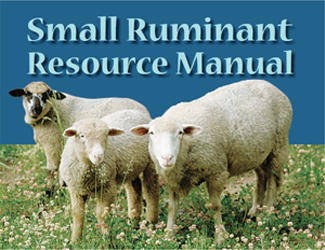
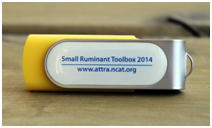
The Small Ruminant Toolbox, funded by a $61,523 Southern Sustainable Agriculture Research and Education (SARE) Professional Development Program Grant, includes the NCAT Small Ruminant Resources Manual, Power Point presentations covering a wide variety of small ruminant topics, a Frequently Asked Questions fact sheet, tips on how to use the Toolbox and building a workshop, and a Small Ruminant Sustainability Checksheet.

“The checksheet is the centerpiece of the Toolbox and of the workshops that are given,” said Coffey. “The document, which is an on-farm assessment tool for farmers, is an offshoot of similar checksheets that were developed from a previous SARE project for educators and producers in beef and dairy production. The checksheet is intended to help producers focus on the whole farm when it comes to small ruminants, and not just one aspect of production or management.”

Part of the Power Point presentations includes the Tennessee Master Meat Goat Producer Program, which was launched four years ago by Tennessee State University Small Ruminant Extension specialist An Peischel, to aid producers in improving production management skills and increase profitability.

Since the program began, the Tennessee Master Meat Goat Producer Program has reached over 1,000 farm families across the state. With its incorporation into the Small Ruminant Toolbox, the program has been introduced to all 95 counties in the state, provided to Extension agents for trainings and workshops, and given to high school students.

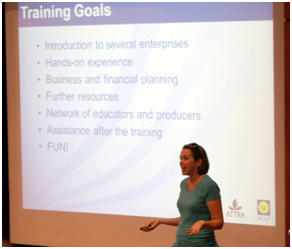
Small Ruminant Training

Small Ruminant Toolbox Training conducted in Georgia in 2011.

“Getting the kind of information out to Extension agents, students and farmers that is reliable and of good quality is extremely important,” said Peischel, adding that Tennessee ranks second in the nation in small ruminant production. “It’s easy to do a search on the Internet, but to find exactly what you are looking for from a reliable source is challenging. This Small Ruminant Toolbox provides those quality educational resources all in one place.”

Will Getz, professor and Extension specialist at Fort Valley State University, agrees that consolidating “all of the good stuff” has been a benefit to Extension agents and small ruminant producers in Georgia.

“The Small Ruminant Toolbox and the workshops we’ve conducted have been one of our most successful endeavors for small ruminant production and management,” said Getz, who estimates that the efforts have directly impacted 40 to 45 producers across the state. “We’ve involved county agents, agriculture teachers, NRCS personnel and other interested parties, and they’ve all indicated that these resources give them the tools they need to expand their training and educational efforts and to guide their clients.”

Steve Jones, a small ruminant specialist with the University of Arkansas Cooperative Extension Service, said that the Small Ruminant Toolbox has been instrumental in connecting Extension agents with small ruminant producers.

“County agents jumped on it and provided resources to the producers who were hungry for it,” said Jones. “The results of the effort have been fabulous. It’s had the multiplying effect that it was intended to have.”

Using the Small Ruminant Toolbox, Jones conducted two small ruminant field days and three short courses within a six-month period. In addition, he provided the Toolbox to county 4-H offices and vo-ag teachers across the state.

“The greatest benefit of the Small Ruminant Toolbox is exposing the producers to the research and applying that research on their farms,” said Jones. “For example, we conducted two on-farm demonstrations using forage brassicas as an alternative to feeding hay and supplement. We estimate that farmers saved $2 a head on average as a result of the on-farm demos. One farm in particular, so far has saved over $3,000 and the potential is there to save up to $15,000.”

Since its development last year, the Small Ruminant Toolbox has been distributed to several hundred Extension agents across the Southern region and training workshops have been conducted in Georgia, Tennessee, Arkansas, Oklahoma, and Kentucky. It’s estimated that 800 producers to date have been reached through the training programs and the Toolbox resources.

Additional project participants include Margo Hale with NCAT; Kenneth Andries, Kentucky State University; Steve Hart, Langston University; Susan Schoenian, Maryland Cooperative Extension Service; and Dianne Hellwig, Dianne Hellwig Consulting.

Portions of the Small Ruminant Toolbox are available online at the NCAT website at https://attra.ncat.org/attra-pub/livestock/livestock.html#sheep_goat. For additional information on the Small Ruminant Toolbox, contact Linda Coffey at  lindac@ncat.org or call ATTRA at 800-346-9140.

Want more information? See the related SARE grant(s) ES08-089, Toolbox for Small Ruminant Educators: Building on the Small Ruminant Resource Manual.


How to Order

Only available online


More Small Ruminant Resources

You may be interested in these stories and resources on small ruminants, created for Southern producers but also applicable in other parts of the country:

Sustainable Control of Internal Parasites in Small Ruminant Production (fact sheet)

FAMACHA: Sustainable Control of GI Nematodes in Small Ruminants (grantee-produced tool)

A Toolbox of Innovations to Control Small Ruminant Parasites (From the Field profile)

Multi-State Resource Tool Addresses Small Ruminant Production Needs (From the Field profile)

Sare 25 Years

1122 Patapsco Building | University of Maryland | College Park, MD 20742-6715

This Web site is maintained by the national outreach office of the SARE program, supported by the National Institute of Food and Agriculture, U.S. Department of Agriculture.

North Central SARE | Northeast SARE | Southern SARE |  Western SARE

Sustainable Agriculture Research & Education ©2012

  • Help |
  • RSS Feeds |
  • A Guide To This Site