• WebStore |
  • Advanced Search |
  • MySARE Login |
  • SARE Social Media |
  • Contact Us |
  • SANET Listserv |
  • Low Bandwidth |
Search MySARE Reports
  • Grants
    • Apply for a Grant
    • Funded Grants in Your State
  • Project Reports
    • Submit a Report
    • Search the Database
    • Project Search Tips
    • About Project Reports
    • About Search Results
    • Project Products
  • Learning Center
    • Books
    • Bulletins
    • Fact Sheets
    • Topic Rooms
    • From the Field
    • Newsletters
    • Multimedia
    • Courses and Curricula
    • Project Products
    • SARE Biennial Reports
    • SANET Listserv
    • SARE Program Materials
    • Conference Materials
    • WebStore
  • Professional Development
    • PDP Overview
    • Fellows & Search for Excellence Programs
    • Sample PDP Grant Projects
    • Educator Curriculum Guides
    • National Continuing Education Program
    • State Coordinator Contact Information
  • State Programs
    • State Coordinator Program Overview
    • State Coordinator Contact Information
    • State Program Webpages
    • Funded Grants in Your State
  • Events
    • Event Calendar
    • Past Conferences
  • Newsroom
    • Press Releases
    • SARE in the News
    • Media Contacts
    • Newsletters
    • Media Toolkit
    • A Guide To This Site
    • SARE and Social Media
  • About SARE
    • SARE's Four Regions
    • Join Our Mailing List
    • SARE Grants
    • Learning Center
    • Professional Development
    • SARE Outreach
    • Historical Timeline
    • Staff
    • Vision & Mission
    • What is Sustainable Agriculture?
  • Home»
  • Learning Center»
  • Fact Sheets»
  • Selecting Cattle to Improve Grazing Distribution Patterns, Rangeland Health and Water Quality»
  • Text Version»
  • Management Implications»
  • Management Implications, Page 2
facebook
Twitter
YouTube
- + Font Size
Print
Share

Text Version

  • Management Implications
    • Management Implications, Page 2
    • Management Implications , Page 3
  • Research Synopsis
  • References
  • Printable Version

Can't find something? Ask or send feedback.

SARE's mission is to advance—to the whole of American agriculture—innovations that improve profitability, stewardship and quality of life by investing in groundbreaking research and education. SARE's vision is...

Management Implications, Page 2

Management Implications

Cull animals with undesirable grazing patterns and select animals with desirable patterns
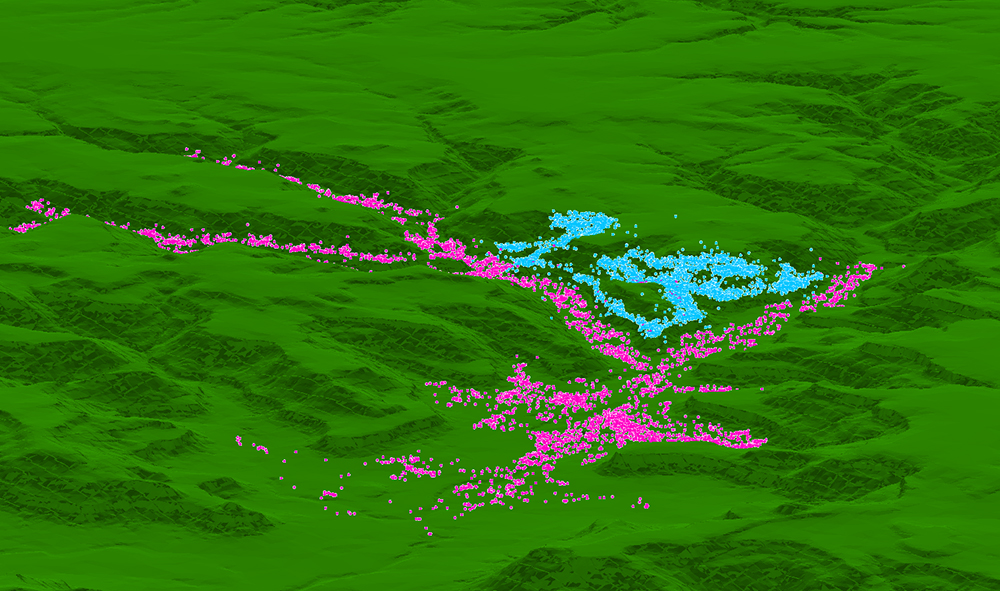
Individual cows within a herd can have very different grazing patterns. Culling or removing cows that prefer bottoms and riparian areas and spend a disproportionate amount of time in sensitive rangeland can potentially increase uniformity and sustainability of grazing (Figure 1). The problem with this approach is accurately identifying cows with undesirable grazing patterns and determining how many cows should be culled.

figure 1
Figure 1. Example of the potential differences in distribution patterns of cows grazing similar pastures during similar time periods. The size of these two study pastures were roughly 420 acres each with changes in topographic relief over 330 feet. Dots represent locations of a hill climber cow () and bottom dweller cow () recorded at 10 minute intervals over a two-week period during August. Blue line ( ) are locations of streams and were the only water sources in the pastures.

The best time to observe cattle to categorize their grazing patterns as desirable or undesirable is when animals are first released into a pasture. Observations also should be collected during the early morning when cows begin grazing (e.g., 0600 to 0900). Cattle typically graze for two periods (or bouts) each day, during the morning and evening. At mid-day, cows are often resting near water, especially during the summer.

Research conducted as part of this project showed that the cow’s location during the early morning was a good indicator of where she grazed during the current morning grazing bout as well as the previous evening grazing period. Cattle grazing patterns also can vary greatly form day to day, so to get an accurate estimate of a cow’s grazing patterns, several observations are needed. In our study, we observed cows in multiple pastures and recorded their location at least 10 times in each pasture. If cows are observed on multiple occasions in bottoms or riparian areas during the early morning shortly after being turned into a pasture (first third or first half), it likely that their grazing patterns may be undesirable and could be considered for culling.

Determining how many cows should be culled is a difficult question that should be researched more thoroughly. In this project, we separated our cow herd in half, which is equivalent to a 50% culling rate. A 15% culling rate is typically recommended for most cattle producers. Many other factors other than distribution such as pregnancy status (open or pregnant) should be considered when determining which cows to cull. It may be difficult to make appreciable difference in grazing distribution, because only a limited number of cattle could be culled for distribution based on normal ranching practices. If grazing distribution is a major issue for a ranch, more emphasis on selection for desirable grazing patterns may be practical. Preliminary analyses have shown that grazing patterns of cows sired by different bulls within the same breed had different grazing patterns. If additional research shows that grazing distribution can be inherited, grazing distribution could be used as a trait for bull selection. Much more rapid progress can be made through bull selection than can be made from culling cows.

Page: 1 | 2 | 3

Top

You are reading the SARE fact sheet Selecting Cattle to Improve Grazing Distribution Patterns, Rangeland Health and Water Quality.

Order this publication.

Sare 25 Years

1122 Patapsco Building | University of Maryland | College Park, MD 20742-6715

This Web site is maintained by the national outreach office of the SARE program, supported by the National Institute of Food and Agriculture, U.S. Department of Agriculture.

North Central SARE | Northeast SARE | Southern SARE |  Western SARE

Sustainable Agriculture Research & Education ©2012

  • Help |
  • RSS Feeds |
  • A Guide To This Site