Selecting cattle with desirable grazing patterns and culling cattle with undesirable grazing patterns have been suggested as tools for improving distribution.
One approach for such selection is to use breeds adapted to rugged and extensive rangelands. Research conducted as part of our first SARE-funded project (SW98-064) showed that cattle breeds developed in mountainous terrain utilize rugged rangeland more extensively than breeds developed in more gentle terrain. Ranchers in mountainous rangeland areas may be able to alleviate some of their grazing distribution problems by incorporating into their breeding programs breeds that evolved and were developed in rugged terrain, such as Tarentaise and Salers.
To test this hypothesis, two breeds developed in different parts of Europe, as well as their crosses, were observed at the Thackeray Ranch in north central Montana. Tarentaise cattle developed in the French Alps consistently climbed higher and used higher elevations (greater vertical distance to water) than Herefords, which were developed in more gentle terrain in England [6]. Similarly, cows sired by Piedmontese and Charolais bulls were observed farther horizontally from water in foothill pastures than cows sired by Angus bulls [7]. Piedmontese cattle were developed in the foothills of the Italian Alps, while Angus cattle were developed in eastern Scotland. These differences in sire breeds are especially surprising considering that only half of the cow’s genotype was contributed by the bull.
In hot desert rangeland, ranchers may want to use breeds with Brahman breeding so that the cattle are adapted to hot, dry climates and are more willing to travel far from water. Santa Gertrudis cattle, a Shorthorn and Brahman cross, walked farther than Herefords in southern New Mexico [8]. In another study in southern New Mexico, Brahman cows walked farther each day than Brangus or Angus cows; however, there was no advantage in use of areas far from water by any breed [9]. Brahman cows displayed a very winding (i.e., back and forth) grazing path than either Angus or Brangus cattle.
Other research has shown that calves learn where to graze from their mothers [10]. Anecdotal information suggests that problems may arise when cattle developed in gentle terrain or irrigated pastures are released into arid or rugged rangeland. In such situations, cattle may not venture far from water or up steep slopes. A study conducted in southern New Mexico showed that cows that were raised and remained in desert rangeland traveled farther from water than naïve cows from a sub-tropical area (east Texas) or cows that were raised in the desert but kept in east Texas for the three years before the study [11]. The management implication of this study was that when purchasing female replacements, producers should try to find animals that were raised in terrain and vegetation that is similar to what they will be grazing.
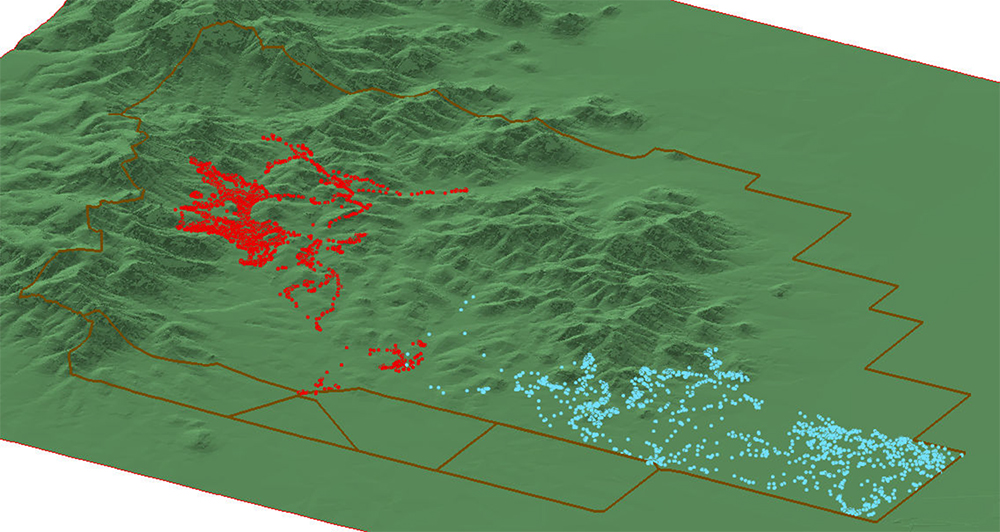
Individual cows within a herd can have very different grazing patterns (Figure 1). Culling or removing cows that prefer bottoms and riparian areas and spend a disproportionate amount of time in sensitive rangeland can potentially increase uniformity and the sustainability of grazing. The problem with this approach is accurately identifying cows with undesirable grazing patterns and determining how many cows should be culled.
The best time to observe cattle to categorize their grazing patterns as desirable or undesirable is when animals are first released into a pasture. Observations also should be collected during the early morning when cows begin grazing (e.g., 6–9 am). Cattle typically graze for two periods (or bouts) each day, during the morning and evening. At mid-day, cows are often resting near water, especially during the summer.
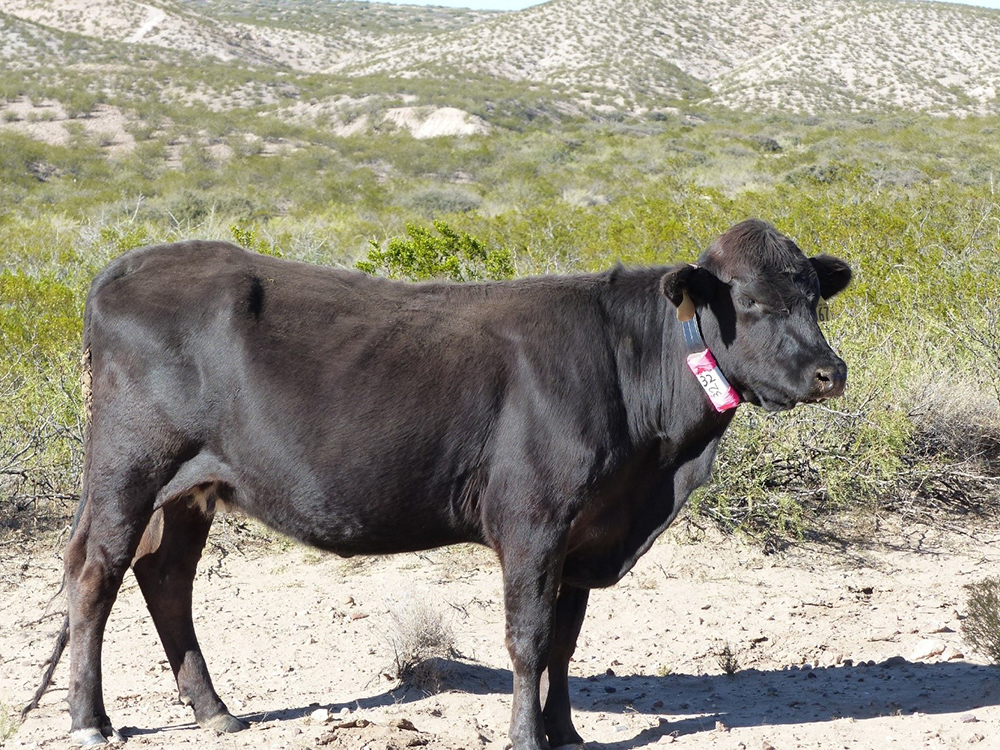
Research conducted during our first SARE project showed that a cow’s location during the early morning was a good indicator of where she would spend the majority of her time grazing during that morning’s grazing bout, as well as where she had grazed during the previous evening’s grazing period [12]. Cattle grazing patterns also can vary greatly from day to day, so several observations are needed to get an accurate estimate of a cow’s grazing patterns. In our latest SARE project, GPS tracking data collected over a three-month period were evaluated, and data from one-, two- or three-month intervals were compared. These analyses suggest that two-month tracking periods are equivalent to three-month tracking periods for identifying differences in terrain-use among beef cows. In our first SARE project, we observed cows in multiple pastures and recorded their location at least 10 times in each pasture. That study supported that when cows are observed on multiple occasions in bottoms or riparian areas during the early morning shortly after being turned into a pasture (first third or first half), it is likely that their grazing patterns may be undesirable and they could be considered for culling.