In 2013–14, University of California Davis Extension Specialist Ken Tate interviewed ranchers and asked if their current management strategies would be sufficient to deal with more frequent drought events (5–8 drought years in a 10-year period). Most (82%) did not think so, and more than half said they would reduce their base herd size as a result.
Better options exist, however, according to Tate, whose effort to help ranchers adapt to more persistent drought was funded by SARE. “We can place management strategies into two bins: proactive in case of drought and reactive when there is drought. The best adaptive capacity is to have a good mix of both of these strategies as part of an actual drought management plan.”
Proactive strategies for cow-calf ranchers, particularly:
- Stock the herd at a moderate level with a safe number of animals should drought occur. Tate advises ranchers to protect their herd’s genetics and not to impulsively add or sell cows from their basic herds at random in response to adverse weather.
- In good years, scale up the number of short-term tenants on pastures to use up forage. Consider buying 500–600 pound stockers and putting them on grass.
- Keep 10 percent of a ranch’s forage in a resting state, or stockpile for emergencies.
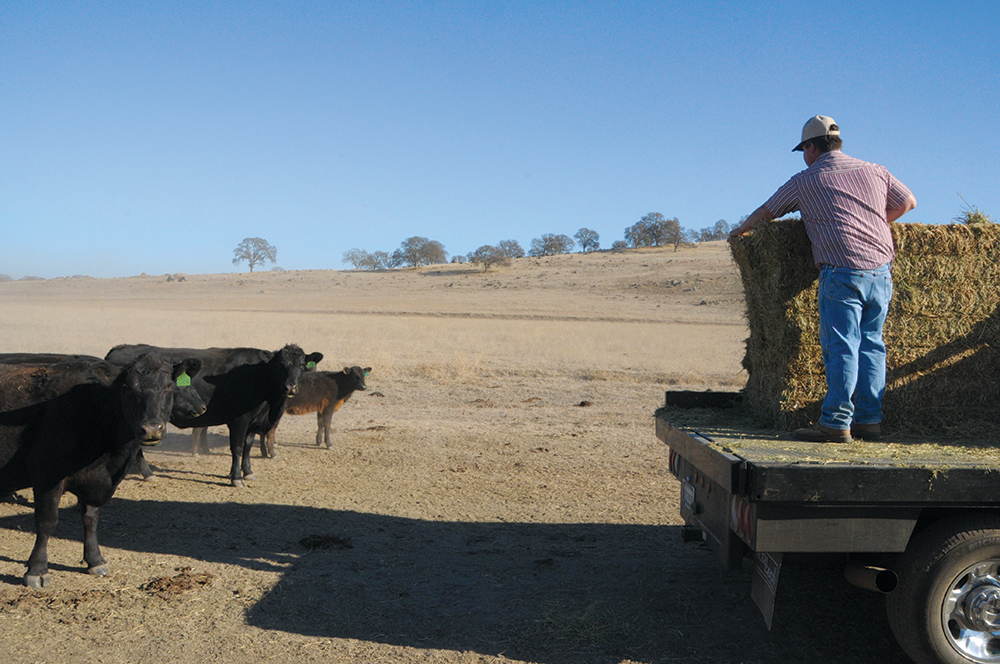
- Keep hay on hand so you don’t have to buy it during a drought.
- Be aware of specific financial risks and evaluate drought insurance.
- Be aware of federal and state programs for drought aid. Track the federal drought monitor and provide input for your region so it is accounted for in aid packages.
Reactive strategies for cow-calf producers:
- Determine which cows you would cull first during the drought and why. Cull open cows, old cows or bad-temperament cows first.
- Have price triggers in your drought plan. Watch the market as drought begins to have an impact and sell if you can get a good price.
- Replace feed with hay and realize you can’t feed your way out of a drought. Decide how long you are willing to invest in feeding cows before culling a second or third group.
“Water management is another priority. Producers need a strategy to handle water availability,” Tate notes. “It is a pain to haul water to cattle, but if you do not have enough stock tanks, ponds or creeks then you need to have a plan to improve water distribution so cows can access forage that may be farther away from existing water sources. That makes more forage available.”
For example, keep a water truck that you can take to the cattle full during a drought. Explore USDA cost-share dollars to put in equipment for improved water management. Tate adds that either option can be labor intensive but should be analyzed for long-term opportunities.
No one thing will get you through. Successful ranchers are those who are willing to be risk takers and try new things,
Ken Tate, Davis, Calif.
“Ranches on the same ground for generations have people who know what works locally. They are good resources for other ranchers,” says Tate.
For the long term, Tate encourages ranchers concerned about climate change or more frequent periods of dryness to weigh other options, including genetic selection to reduce cow size, adding or switching cattle breeds, or exploring opportunities with other ruminants.
“Take an adapt-or-perish strategy,” he states. “Switching breeds is not easy, but maybe it is a consideration. Sheep offer greater flexibility in forage and crop residue consumption and can be transported closer to urban areas for grazing than cattle can. Just don’t rush into a new enterprise. Match livestock to the environment and anticipate it not to be a good year every year.”
Other rangeland management specialists have found that adding small ruminants, such as goats and sheep, to a cattle operation can deflect the effects of drought. Large and small ruminants have different forage requirements. In addition, when drought strikes, common advice is to make the most of forage. Send the herd to graze drought-stricken crops to salvage the value of those crops, but monitor residues from drought-stressed crops for prussic acid and high nitrate levels.