As farmers in western Nebraska face higher cash rents and property taxes, many want a more profitable, sustainable alternative to fallow for crop rotation. Strahinja Stepanovic, a University of Nebraska Lincoln Extension educator, received a SARE grant to find suitable crops for the mix.
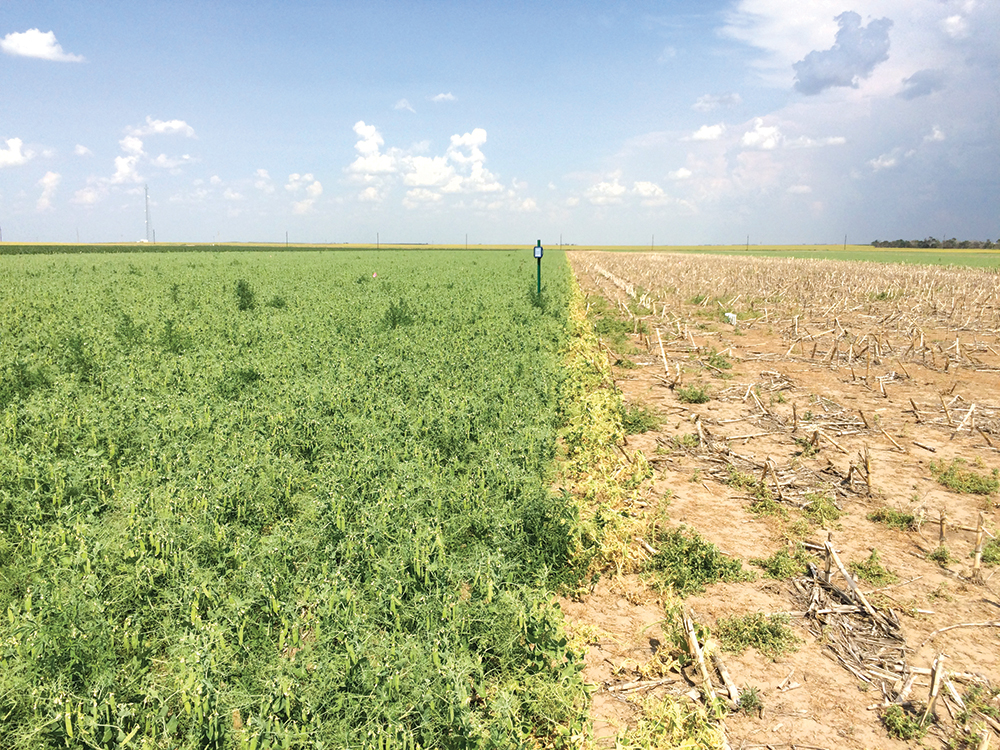
“Farmers in the semi-arid regions of western Nebraska (14–19 inches of annual precipitation) who have no irrigation often conserve soil water by rotating cereal crops, such as corn or wheat, with a period of summer fallow,” says Stepanovic. “Unfortunately, fallow expenses are increasing due to development of herbicide-resistant weeds, record-low wheat prices and low protein levels. Farmers are slowly abandoning the fallow concept and are searching for alternative crop rotations. We have shown that pulse crops like field peas and chickpeas are a solid alternative to fallow.”
Stepanovic notes that before 2013, only 10,000–20,000 acres of field peas were grown in the Nebraska panhandle. Between 2014 and 2018, as farmers became familiar with peas through research and outreach efforts by Stepanovic and others, acreage grew to 70,000 and spread into central and eastern Nebraska. Production is slated to continue to expand.
“Replacing fallow with field peas has helped many farmers intensify and diversify crop rotations, improve soil health and better cope with herbicide-resistant weeds and weather- and market-related fluctuations. Adding field peas to crop rotations helps conserve moisture.”
Strahinja Stepanovic, Lincoln, Neb.
Stepanovic says that in 2018, precipitation was above average at 22 inches from March to September. On fallow ground with 60% residue cover, 19 of those inches were lost to percolation into the aquifer (11 inches) and evaporation (8 inches), with 3 inches stored in the soil profile for fall-planted wheat.
“Water is way too valuable to lose,” Stepanovic states. “We can ‘harvest’ 11 inches of water as a 30-bushel-per-acre pea crop and still not lose as much water as during fallow.” Field peas are a short-season crop (March to July), and if the soil water profile regenerates between field pea harvest and wheat planting in September, the yield impact on the next year’s wheat crop may be negligible, he adds.
Depending on the year, farmers may report gains of $50 per acre. That is a significant improvement compared to $40–$90 per-acre expenses associated with spraying herbicides to control weeds in fallow. Additionally, three pea processors are now located in Nebraska along with about eight seed companies, so getting good quality seed and marketing are much easier now.
New research conducted since the SARE-funded project also is positive for pea farmers. Stepanovic notes one farmer planted field peas under pivot irrigation on sandy hills where irrigated corn yields were not attractive. In the dryland corners, field peas produced a 15-bushel yield while the same variety under pivot made a 65-bushel yield by supplementing only 1.5 inches of water applied at the right time.
“We learned if you irrigate properly, you can get 50–60 bushels of peas by applying only two or three inches of irrigation water, and then double-crop forage sorghum with no additional fertilizer or chemical inputs. That adds three to five inches of irrigation water between July and October to turn a pretty good profit,” Stepanovic says. Contrast that to a high-input crop like corn that requires more than 13 inches of water on sandy ground to make 180 bushels per acre, he adds. “This is how to save water with crop rotation. This is the most fundamental way to manage water.”