• WebStore |
  • Advanced Search |
  • MySARE Login |
  • SARE Social Media |
  • Contact Us |
  • SANET Listserv |
  • Low Bandwidth |
Search MySARE Reports
  • Grants
    • Apply for a Grant
    • Funded Grants in Your State
  • Project Reports
    • Submit a Report
    • Search the Database
    • Project Search Tips
    • About Project Reports
    • About Search Results
    • Project Products
  • Learning Center
    • Books
    • Bulletins
    • Fact Sheets
    • Topic Rooms
    • From the Field
    • Newsletters
    • Multimedia
    • Courses and Curricula
    • Project Products
    • SARE Biennial Reports
    • SANET Listserv
    • SARE Program Materials
    • Conference Materials
    • WebStore
  • Professional Development
    • PDP Overview
    • Fellows & Search for Excellence Programs
    • Sample PDP Grant Projects
    • Educator Curriculum Guides
    • National Continuing Education Program
    • State Coordinator Contact Information
  • State Programs
    • State Coordinator Program Overview
    • State Coordinator Contact Information
    • Funded Grants in Your State
  • Events
    • Event Calendar
    • Past Conferences
  • Newsroom
    • Press Releases
    • SARE in the News
    • Media Contacts
    • Newsletters
    • Media Toolkit
    • A Guide To This Site
    • SARE and Social Media
  • About SARE
    • SARE's Four Regions
    • SARE Grants
    • Learning Center
    • Professional Development
    • SARE Outreach
    • Historical Timeline
    • Staff
    • Vision & Mission
    • Join Our Mailing List
    • What is Sustainable Agriculture?
  • Home»
  • Learning Center»
  • Books»
  • Manage Insects on Your Farm»
  • Text Version»
  • Resources: General Information»
  • Regional Experts
facebook
Twitter
YouTube
- + Font Size
Print
Share

Text Version

  • Acknowledgments
  • Introduction
  • Table of Contents
  • How Ecologically Based Pest Management Works
  • Principles of Ecologically Based Pest Management
  • Identification Key to Major Beneficials and Pests
  • Managing Soils to Minimize Crop Pests
  • Farm Feature: Triple Threat to Pests: Cover Crops, No-Till, Rotation
  • Beneficial Agents on the Farm
  • Putting it All Together
  • Resources: General Information
    • Publications
    • Websites
    • Regional Experts
  • Printable Version

Can't find something? Ask or send feedback.

SARE's mission is to advance—to the whole of American agriculture—innovations that improve profitability, stewardship and quality of life by investing in groundbreaking research and education. SARE's vision is...

Regional Experts

General Information | Publications | Websites | Regional Experts

Resources: Regional Experts

These individuals are willing to respond to specific questions in their area of expertise, or to provide referral to others in the pest management field. Please respect their schedules and limited ability to respond. Consider visiting their web-sites before contacting them directly.

One important source of information is your local Cooperative Extension Service office. Each U.S. state and territory has a state office at its land-grant university and a network of local or regional offices. See http://www.csrees.usda.gov/Extension/ for a listing of all offices.

Select a Region: Northeast | North Central | Southern | Western

Northeast Region

Mary Barbercheck
Department of Entomology
516 ASI Building
Penn State University
University Park, PA 16802
(814) 863-2982
(814) 865-3048 – fax
meb34@psu.edu
http://www.ento.psu.edu/Personnel/Faculty/barbercheck.htm
Soil quality and arthropod diversity as it relates to management of insect pests. Biology and ecology of entomopathogenic (insect-parasitic) nematodes for management of soil-dwelling insect pests.

Brian Caldwell
NOFA-NY Farm Education Coordinator
Northeast Organic Farming Association of New York
education@nofany.org
www.nofany.org
Organic pest management for vegetables and fruit.

Ruth V. Hazzard
University of Massachusetts Amherst
Extension Agriculture and Landscape Program, Vegetable Team
rhazzard@umext.umass.edu
www.umassvegetable.org
IPM, ecological and organic pest management in vegetables.

Fred Magdoff
Department of Plant and Soil Sciences
University of Vermont
frederick.magdoff@uvm.edu
Soil quality, soil testing, ecological soil management.

Abby Seaman
New York State Integrated Pest Management Program
Cornell Cooperative Extension
ajs32@cornell.edu
www.nysipm.cornell.edu
Integrating biological controls into vegetable IPM systems

Kimberly Stoner
The Connecticut Agricultural Experiment Station
Kimberly.Stoner@po.state.ct.us
http://www.caes.state.ct.us/
Alternatives to insecticides for managing vegetable insects

John R. Teasdale
USDA-ARS
Beltsville, MD
teasdale@ba.ars.usda.gov
http://www.barc.usda.gov/anri/sasl/sasl.html
Integrated weed management, cover crop management

North Central Region

Dale R. Mutch
Michigan State University
Mutchd@msue.msu.edu
www.kbs.msu.edu/extension
Pest management in farming systems utilizing cover crops

Southern Region

W. Joe Lewis
Research Entomologist
USDA - ARS
Tifton, Georgia
wjl@tifton.usda.gov
http://sacs.cpes.peachnet.edu/lewis/
Sustainable pest management, understanding and enhancing the parasitic and predacious insects that attack plant feeding insects.

David B. Orr
Dept. of Entomology
North Carolina State University
Raleigh, NC 27695-7613
david_orr@ncsu.edu
http://cipm.ncsu.edu/ent/biocontrol/
Biological control of insects in field crops and organic production systems

Sharad C. Phatak, Ph.D.
Professor of Horticulture
100 Horticulture Building
4604 Research Way
University of Georgia
Tifton, GA 31793
(229) 386-3901
(229) 386-3356 – fax
phatak@.uga.edu
Sustainable farming systems, cropping systems, cover crops, conservation tillage and pest management, soil quality and pest management, non-chemical weed management.
Debbie Roos
Agricultural Extension Agent
North Carolina State University
Post Office Box 279
Pittsboro, NC 27312
debbie_roos@ncsu.edu
(919) 542-8202
(919) 542-8246 – fax
http://www.ces.ncsu.edu/chatham/ag/SustAg/index.html
Organic and sustainable agriculture and pest management

Glynn Tillman
USDA-ARS
Tifton, Georgia
pgt@tifton.usda.gov
Biological control of insect pests in cotton

Western Region

Miguel Altieri, Ph.D.
Professor of Agroecology
Division of Insect Biology
University of California, Berkeley
agroeco3@nature.berkeley.edu
www.agroeco.org
Agroecosystem design, biodiversity, ecological pest management

Robert L. Bugg, Ph.D.
Senior Analyst
Agricultural Ecology
U.C. Sustainable Agriculture Research and Education Program
University of California
One Shields Avenue
Davis, CA 95616-8716
(530) 754-8549
(530) 754-8550 – fax
rlbugg@ucdavis.edu
http://www.sarep.ucdavis.edu
Biological control, on-farm restoration ecology, earthworms, pollinators, California native plants, cover crops, hedgerows.

Clara I. Nicholls, Ph.D.
Research Fellow
Divison of Insect Biology
University of California, Berkeley
nicholls@berkeley.edu
www.agroeco.org
Habitat management, biological control


Select a Region: Northeast | North Central | Southern | Western


General Information | Publications | Websites | Regional Experts

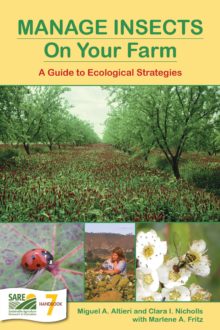
You are reading the SARE book Manage Insects on Your Farm.

Order this publication.

25th SARE logo USDA Logo

1122 Patapsco Building | University of Maryland | College Park, MD 20742-6715

This Web site is maintained by the national outreach office of the SARE program, supported by the National Institute of Food and Agriculture, U.S. Department of Agriculture.

North Central SARE | Northeast SARE | Southern SARE | Western SARE

Sustainable Agriculture Research & Education ©2012

  • Help |
  • RSS Feeds |
  • A Guide To This Site