• WebStore |
  • Advanced Search |
  • MySARE Login |
  • SARE Social Media |
  • Contact Us |
  • SANET Listserv |
  • Low Bandwidth |
Search MySARE Reports
  • Grants
    • Apply for a Grant
    • Funded Grants in Your State
  • Project Reports
    • Submit a Report
    • Search the Database
    • Project Search Tips
    • About Project Reports
    • About Search Results
    • Project Products
  • Learning Center
    • Books
    • Bulletins
    • Fact Sheets
    • Topic Rooms
    • From the Field
    • Newsletters
    • Multimedia
    • Courses and Curricula
    • Project Products
    • SARE Biennial Reports
    • SANET Listserv
    • SARE Program Materials
    • Conference Materials
    • WebStore
  • Professional Development
    • PDP Overview
    • Fellows & Search for Excellence Programs
    • Sample PDP Grant Projects
    • Educator Curriculum Guides
    • National Continuing Education Program
    • State Coordinator Contact Information
  • State Programs
    • State Coordinator Program Overview
    • State Coordinator Contact Information
    • State Program Webpages
    • Funded Grants in Your State
  • Events
    • Event Calendar
    • Past Conferences
  • Newsroom
    • Press Releases
    • SARE in the News
    • Media Contacts
    • Newsletters
    • Media Toolkit
    • A Guide To This Site
    • SARE and Social Media
  • About SARE
    • SARE's Four Regions
    • Join Our Mailing List
    • SARE Grants
    • Learning Center
    • Professional Development
    • SARE Outreach
    • Historical Timeline
    • Staff
    • Vision & Mission
    • What is Sustainable Agriculture?
  • Home»
  • Learning Center»
  • Books»
  • Manage Insects on Your Farm»
  • Text Version»
  • Principles of Ecologically Based Pest Management»
  • Sidebar: Reduce Mowing Frequency to Attract Beneficials
facebook
Twitter
YouTube
- + Font Size
Print
Share

Text Version

  • Acknowledgments
  • Introduction
  • Table of Contents
  • How Ecologically Based Pest Management Works
  • Principles of Ecologically Based Pest Management
    • Managing Aboveground Habitat
    • Strategies to Enhance Beneficials
    • Innovative Tart Cherry Orchard Systems
    • Farm Feature: No-Till Cover Crops Yield Soil and Pest Benefits
    • Farm Feature: A Toast to Ecological Grape Production
    • Sidebar: Reduce Mowing Frequency to Attract Beneficials
    • Beetle Banks Boost Beneficials
    • Surrounding Crops With Perimeter Fools Pests
    • Table 1: Flowering Plants That Attract Natural Enemies
    • Farm Feature: Resistant Fruit Varieties Reduce Risk
  • Identification Key to Major Beneficials and Pests
  • Managing Soils to Minimize Crop Pests
  • Farm Feature: Triple Threat to Pests: Cover Crops, No-Till, Rotation
  • Beneficial Agents on the Farm
  • Putting it All Together
  • Resources: General Information
  • Printable Version

Can't find something? Ask or send feedback.

SARE's mission is to advance—to the whole of American agriculture—innovations that improve profitability, stewardship and quality of life by investing in groundbreaking research and education. SARE's vision is...

Sidebar: Reduce Mowing Frequency to Attract Beneficials

Reduce Mowing Frequency to Increase Beneficials

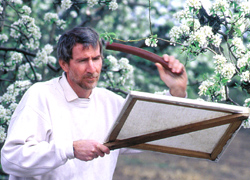
conducting IPM in pear orchard

USDA ARS Researcher Dave Horton found that less frequent mowing in orchards attracts more beneficial insects to prey on pear psylla, leaf miners and other serious pests.

Tree fruit growers seeking alternatives to broad-spectrum pesticides are looking to manage insect pests using a more environmentally friendly approach. In Washington state pear orchards, SARE-funded research has found that mowing once a month rather than two or three times a month creates alluring habitats for beneficial insects.

An ARS researcher partly funded by SARE ran trials at three orchards and varied mowing frequency (weekly, monthly and just once a season). With less frequent mowing, the natural enemies moved into the ground cover in greater numbers, likely attracted to the pollen and nectar newly available from flowering plants as well as more abundant prey, such as aphids and thrips. Researcher Dave Horton found more lacewing larvae, spiders, ladybug beetles, damsel bugs, parasitoids and minute pirate bugs. “If you mow a lot, you won’t have much in the way of natural enemies on the ground,” Horton said. “By reducing the frequency to once a month, you see a dramatic increase in natural enemies moving into the ground cover without a big increase in pests that feed on fruit.”

Questions remain whether the predators migrate from the ground cover into the pear trees to attack orchard pests, although evidence supports that some predators, especially spiders, appeared in higher numbers in pear trees in the less frequently mowed plots, good news for pear growers.

One of Horton’s farmer collaborators, who received a SARE farmer/rancher grant to study similar ways to manage orchard pests, is convinced that minimal mowing provides control. “I’m practicing this, and I’ve never had to spray for mites,” said George Ing of Hood River, Ore., who has a 16-year-old orchard. “Other orchards that are conventionally treated have more pests. I’m convinced it helped.” At the behest of area growers, who provided a research grant through their pear and apple association, Horton will test how seeding cover crops such as white clover between tree rows affects populations of both pests and pest predators.


Previous Section | Top | Next Section

You are reading the SARE book Manage Insects on Your Farm.

Order this publication.

Sare 25 Years

1122 Patapsco Building | University of Maryland | College Park, MD 20742-6715

This Web site is maintained by the national outreach office of the SARE program, supported by the National Institute of Food and Agriculture, U.S. Department of Agriculture.

North Central SARE | Northeast SARE | Southern SARE |  Western SARE

Sustainable Agriculture Research & Education ©2012

  • Help |
  • RSS Feeds |
  • A Guide To This Site