• WebStore |
  • Advanced Search |
  • MySARE Login |
  • SARE Social Media |
  • Contact Us |
  • SANET Listserv |
  • Low Bandwidth |
Search MySARE Reports
  • Grants
    • Apply for a Grant
    • Funded Grants in Your State
  • Project Reports
    • Submit a Report
    • Search the Database
    • Project Search Tips
    • About Project Reports
    • About Search Results
    • Project Products
  • Learning Center
    • Books
    • Bulletins
    • Fact Sheets
    • Topic Rooms
    • From the Field
    • Newsletters
    • Multimedia
    • Courses and Curricula
    • Project Products
    • SARE Biennial Reports
    • SANET Listserv
    • SARE Program Materials
    • Conference Materials
    • WebStore
  • Professional Development
    • PDP Overview
    • Fellows & Search for Excellence Programs
    • Sample PDP Grant Projects
    • Educator Curriculum Guides
    • National Continuing Education Program
    • State Coordinator Contact Information
  • State Programs
    • State Coordinator Program Overview
    • State Coordinator Contact Information
    • State Program Webpages
    • Funded Grants in Your State
  • Events
    • Event Calendar
    • Past Conferences
  • Newsroom
    • Press Releases
    • SARE in the News
    • Media Contacts
    • Newsletters
    • Media Toolkit
    • A Guide To This Site
    • SARE and Social Media
  • About SARE
    • SARE's Four Regions
    • Join Our Mailing List
    • SARE Grants
    • Learning Center
    • Professional Development
    • SARE Outreach
    • Historical Timeline
    • Staff
    • Vision & Mission
    • What is Sustainable Agriculture?
  • Home»
  • Learning Center»
  • Books»
  • Manage Insects on Your Farm»
  • Text Version»
  • Principles of Ecologically Based Pest Management»
  • Innovative Tart Cherry Orchard Systems
facebook
Twitter
YouTube
- + Font Size
Print
Share

Text Version

  • Acknowledgments
  • Introduction
  • Table of Contents
  • How Ecologically Based Pest Management Works
  • Principles of Ecologically Based Pest Management
    • Managing Aboveground Habitat
    • Strategies to Enhance Beneficials
    • Innovative Tart Cherry Orchard Systems
    • Farm Feature: No-Till Cover Crops Yield Soil and Pest Benefits
    • Farm Feature: A Toast to Ecological Grape Production
    • Sidebar: Reduce Mowing Frequency to Attract Beneficials
    • Beetle Banks Boost Beneficials
    • Surrounding Crops With Perimeter Fools Pests
    • Table 1: Flowering Plants That Attract Natural Enemies
    • Farm Feature: Resistant Fruit Varieties Reduce Risk
  • Identification Key to Major Beneficials and Pests
  • Managing Soils to Minimize Crop Pests
  • Farm Feature: Triple Threat to Pests: Cover Crops, No-Till, Rotation
  • Beneficial Agents on the Farm
  • Putting it All Together
  • Resources: General Information
  • Printable Version

Can't find something? Ask or send feedback.

SARE's mission is to advance—to the whole of American agriculture—innovations that improve profitability, stewardship and quality of life by investing in groundbreaking research and education. SARE's vision is...

Innovative Tart Cherry Orchard Systems

Innovative Tart Cherry Orchard Systems

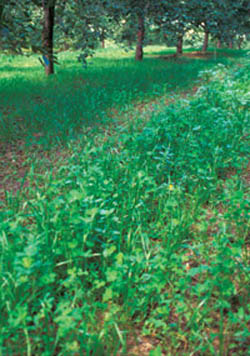
red clover cover crop

Season-long populations of beneficial mites were attributed to the use of a red clover cover crop. Photo by Charles Edson, Mich. State Univ.

Michigan State University scientists have evaluated orchard-scale ground cover experiments in established commercial orchards and in a new tart cherry orchard at the Northwest Horticultural Research Station. They studied orchard floors covered with compost, mulch or cover crops such as crimson clover, berseem clover, white clover, white Dutch clover, Michigan red clover, crown vetch, indigo vetch, alfalfa, rye, annual ryegrass, hard fescue and Buffalo grass. So far, findings include:

Season-long populations of beneficial mites were attributed to the use of a red clover cover crop.
Season-long, vegetation-free strips using either herbicide or mulch increase pest mite populations.
Orchards with ground covers—irrigated but not treated with herbicides to manage weeds—had fruit yields that were not significantly lower than conventional practices over a five-year period. Note the irrigation may be critical in this system to prevent the ground cover from competing with the fruit trees for water.
Adding mulch, cover crops and/or compost increases soil organic matter, populations of beneficial soil microbes and amounts of active soil carbon and nitrogen available to trees.
Fewer beneficial nematodes, more plant-parasitic nematodes and more nitrate leaching were associated with lower-quality conventional-system soils.
Hay or straw mulch, applied 6 to 8 inches deep, improved tree growth and yields despite higher pest mite populations.
Nitrate leaching—greatest in spring and fall—was substantially reduced by vegetation growing under trees during these periods.
In-row soil population densities of beneficial nematodes, mycorrhizae and earthworms were greater under an organic production system.
Young trees benefited from adding mulch or compost but can be severely stunted by competition with groundcover plants for moisture and nutrients.
Trees with heavy mulches produced soft fruit in two of seven years.

The scientists also are examining the impact of mixed-species hedgerows on insect pest movement into and out of orchards. In addition, they are evaluating insect pheromone mating disruption, mass trapping of plum curculio, 14-inch groundcover bands around mulched center lines, and intercropping with such income-generating woody species as sea buckthorn and Siberian pea.

Orchards offer advantages over annual row crops in biological pest control, says MSU IPM tree fruit integrator David Epstein. Because they do not undergo major renovation every year, orchard systems can be developed to let beneficials get established. “Ground covers can be used to encourage beneficials to build up their populations and remain in the orchard throughout the year,” he says.

How much the beneficials actually reduce pests, however, depends on weather, pest populations and the effectiveness of growers’ monitoring programs. “To say that if you plant red clover you’ll never have to spray for mites again would be erroneous,” says Epstein. “But if you know what’s out there—what levels of pests, predators and parasitoids you have—then you can make an informed decision as to whether or not you can save a spray.” (For more information about this project, see http://www.ipm.msu.edu/tartcherry.htm)


Previous Section | Top | Next Section

You are reading the SARE book Manage Insects on Your Farm.

Order this publication.

Sare 25 Years

1122 Patapsco Building | University of Maryland | College Park, MD 20742-6715

This Web site is maintained by the national outreach office of the SARE program, supported by the National Institute of Food and Agriculture, U.S. Department of Agriculture.

North Central SARE | Northeast SARE | Southern SARE |  Western SARE

Sustainable Agriculture Research & Education ©2012

  • Help |
  • RSS Feeds |
  • A Guide To This Site