• WebStore |
  • Advanced Search |
  • MySARE Login |
  • SARE Social Media |
  • Contact Us |
  • SANET Listserv |
  • Low Bandwidth |
Search MySARE Reports
  • Grants
    • Apply for a Grant
    • Funded Grants in Your State
  • Project Reports
    • Submit a Report
    • Search the Database
    • Project Search Tips
    • About Project Reports
    • About Search Results
    • Project Products
  • Learning Center
    • Books
    • Bulletins
    • Fact Sheets
    • Topic Rooms
    • From the Field
    • Newsletters
    • Multimedia
    • Courses and Curricula
    • Project Products
    • SARE Biennial Reports
    • SANET Listserv
    • SARE Program Materials
    • Conference Materials
    • WebStore
  • Professional Development
    • PDP Overview
    • Fellows & Search for Excellence Programs
    • Sample PDP Grant Projects
    • Educator Curriculum Guides
    • National Continuing Education Program
    • State Coordinator Contact Information
  • State Programs
    • State Coordinator Program Overview
    • State Coordinator Contact Information
    • Funded Grants in Your State
  • Events
    • Event Calendar
    • Past Conferences
  • Newsroom
    • Press Releases
    • SARE in the News
    • Media Contacts
    • Newsletters
    • Media Toolkit
    • A Guide To This Site
    • SARE and Social Media
  • About SARE
    • SARE's Four Regions
    • SARE Grants
    • Learning Center
    • Professional Development
    • SARE Outreach
    • Historical Timeline
    • Staff
    • Vision & Mission
    • Join Our Mailing List
    • What is Sustainable Agriculture?
  • Home»
  • Learning Center»
  • Books»
  • Manage Insects on Your Farm»
  • Text Version»
  • Managing Soils to Minimize Crop Pests»
  • Managing Pests With Healthy Soils
facebook
Twitter
YouTube
- + Font Size
Print
Share

Text Version

  • Acknowledgments
  • Introduction
  • Table of Contents
  • How Ecologically Based Pest Management Works
  • Principles of Ecologically Based Pest Management
  • Identification Key to Major Beneficials and Pests
  • Managing Soils to Minimize Crop Pests
    • Healthy Soils Produce Healthy Crops
    • Qualities of a Healthy Soil
    • Managing Pests With Healthy Soils
  • Farm Feature: Triple Threat to Pests: Cover Crops, No-Till, Rotation
  • Beneficial Agents on the Farm
  • Putting it All Together
  • Resources: General Information
  • Printable Version

Can't find something? Ask or send feedback.

SARE's mission is to advance—to the whole of American agriculture—innovations that improve profitability, stewardship and quality of life by investing in groundbreaking research and education. SARE's vision is...

Managing Pests With Healthy Soils

Managing Pests With Healthy Soils

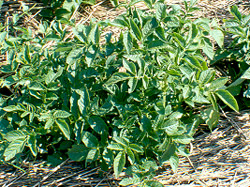
potato plants growing in rye residue
Potato plants grown in rye residue in plots run by USDA-ARS's Insect Biocontrol lab (top) fare better than those grown using a system without cover crops (below). Photos by Aref Abdul-Baki, USDA ARS
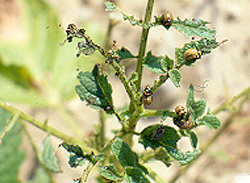
insect damage on potatoes

Healthier soils produce crops that are less damaged by pests. Some soil-management practices boost plant-defense mechanisms, making plants more resistant and/or less attractive to pests. Other practices — or the favorable conditions they produce — restrict the severity of pest damage by decreasing pest numbers or building beneficials. Using multiple tactics — rather than one major tactic like a single pesticide — lessens pest damage through a third strategy: it diminishes the odds that a pest will adapt to the ecological pest management measures.

Practices that promote soil health constitute one of the fundamental pillars of ecological pest management. When stress is alleviated, a plant can better express its inherent abilities to resist pests (Figure 2). Ecological pest management emphasizes preventative strategies that enhance the “immunity” of the agroecosystem. Farmers should be cautious of using reactive management practices that may hinder the crop’s immunity. Healthier soils also harbor more diverse and active populations of the soil organisms that compete with, antagonize and ultimately curb soil-borne pests. Some of those organisms — such as springtails — serve as alternate food for beneficials when pests are scarce, thus maintaining viable populations of beneficials in the field. You can favor beneficial organisms by using crop rotations, cover crops, animal manures and composts to supply them with additional food.
In southern Georgia, cotton and peanut growers who planted rotation crops and annual high-residue winter cover crops, then virtually eliminated tillage, no longer have problems with thrips, bollworms, budworms, aphids, fall armyworms, beet armyworms and white flies. The farmers report that the insect pests declined after three years of rotations and cover crops. They now pay $50–$100 less per acre for more environmentally benign insect control materials such as Bacillus thuringiensis (Bt), pyrethroids and/or insect growth regulators.
In their no-till research plots with cover crops and long rotations, University of Georgia scientists haven’t needed fungicides for nine years in peanuts, insecticides for 11 years in cotton, and insecticides, nematicides or fungicides for 17 years in vegetables. They also are helping growers of cucumbers, squash, peppers, eggplant, cabbage peanuts, soybeans and cotton reduce their pesticide applications to two or fewer while harvesting profitable crops. This system is described in greater detail in Managing Cover Crops Profitably, 2nd Edition (Resources).

As many as 120 species of beneficial arthropods have been found in southern Georgia soils when cotton residues were left on the surface and insecticides were not applied. In just one vegetable-growing season, 13 known beneficial insects were associated with cover crops. When eggplant was transplanted into crimson clover at 9 a.m., assassin bugs destroyed Colorado potato beetles on the eggplant by evening. Similarly, other beneficials killed cucumber beetles on cucumber plants within a day.

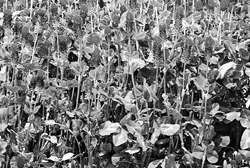
crimson clover in a cover crop blend
The cover crop mixture of balansa clover, crimson clover (shown) and hairy vetch helped build beneficial insect populations early in the season. Photo by R. Weil, Univ. of Md.

Underlying those benefits, according to the Georgia researchers, was the soil-improving combination of cover crops with conservation tillage: soil organic matter increased from less than 1 percent to 3 to 8 percent in most of their plots, and a majority of growers saw similar improvements in soils and pest management.

TIP: Encourage beneficial organisms by using crop rotations, cover crops, animal manures and composts to supply them with additional food.

TIP: To support beneficial soil organisms, plant cover crops and allow their residue to accumulate on the soil surface.

Previous Section | Top | Next Section

You are reading the SARE book Manage Insects on Your Farm.

Order this publication.

25th SARE logo USDA Logo

1122 Patapsco Building | University of Maryland | College Park, MD 20742-6715

This Web site is maintained by the national outreach office of the SARE program, supported by the National Institute of Food and Agriculture, U.S. Department of Agriculture.

North Central SARE | Northeast SARE | Southern SARE | Western SARE

Sustainable Agriculture Research & Education ©2012

  • Help |
  • RSS Feeds |
  • A Guide To This Site