• WebStore |
  • Advanced Search |
  • MySARE Login |
  • SARE Social Media |
  • Contact Us |
  • SANET Listserv |
  • Low Bandwidth |
Search MySARE Reports
  • Grants
    • Apply for a Grant
    • Funded Grants in Your State
  • Project Reports
    • Submit a Report
    • Search the Database
    • Project Search Tips
    • About Project Reports
    • About Search Results
    • Project Products
  • Learning Center
    • Books
    • Bulletins
    • Fact Sheets
    • Topic Rooms
    • From the Field
    • Newsletters
    • Multimedia
    • Courses and Curricula
    • Project Products
    • SARE Biennial Reports
    • SANET Listserv
    • SARE Program Materials
    • Conference Materials
    • WebStore
  • Professional Development
    • PDP Overview
    • Fellows & Search for Excellence Programs
    • Sample PDP Grant Projects
    • Educator Curriculum Guides
    • National Continuing Education Program
    • State Coordinator Contact Information
  • State Programs
    • State Coordinator Program Overview
    • State Coordinator Contact Information
    • State Program Webpages
    • Funded Grants in Your State
  • Events
    • Event Calendar
    • Past Conferences
  • Newsroom
    • Press Releases
    • SARE in the News
    • Media Contacts
    • Newsletters
    • Media Toolkit
    • A Guide To This Site
    • SARE and Social Media
  • About SARE
    • SARE's Four Regions
    • Join Our Mailing List
    • SARE Grants
    • Learning Center
    • Professional Development
    • SARE Outreach
    • Historical Timeline
    • Staff
    • Vision & Mission
    • What is Sustainable Agriculture?
  • Home»
  • Learning Center»
  • Books»
  • Manage Insects on Your Farm»
  • Text Version»
  • Managing Soils to Minimize Crop Pests»
  • Healthy Soils Produce Healthy Crops
facebook
Twitter
YouTube
- + Font Size
Print
Share

Text Version

  • Acknowledgments
  • Introduction
  • Table of Contents
  • How Ecologically Based Pest Management Works
  • Principles of Ecologically Based Pest Management
  • Identification Key to Major Beneficials and Pests
  • Managing Soils to Minimize Crop Pests
    • Healthy Soils Produce Healthy Crops
    • Qualities of a Healthy Soil
    • Managing Pests With Healthy Soils
  • Farm Feature: Triple Threat to Pests: Cover Crops, No-Till, Rotation
  • Beneficial Agents on the Farm
  • Putting it All Together
  • Resources: General Information
  • Printable Version

Can't find something? Ask or send feedback.

SARE's mission is to advance—to the whole of American agriculture—innovations that improve profitability, stewardship and quality of life by investing in groundbreaking research and education. SARE's vision is...

Healthy Soils Produce Healthy Crops

Healthy Soils Produce Healthy Crops

close-up of soil structure
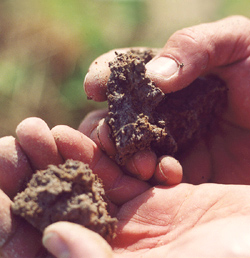
By adding cover crops and switching to no-till, Junior Upton drastically improved his habitually compacted soil. Photo by Dan Anderson, Univ. of Ill.
peanut crop
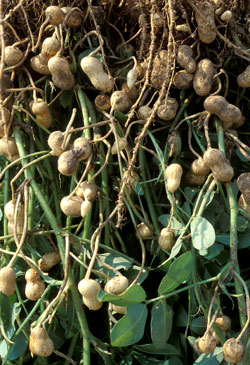
Nitrogen-fixing symbiotic bacteria flourish in healthy soil. Photo by David Nance, USDA ARS

A healthy soil produces healthy crops with minimal amounts of external inputs and few to no adverse ecological effects. It contains favorable biological, physical and chemical properties.

A biologically healthy soil harbors a multitude of different organisms — microorganisms such as bacteria, fungi, amoebae and paramecia, as well as larger organisms like nematodes, springtails, insect larvae, ants, earthworms and ground beetles. Most are helpful to plants, enhancing the availability of nutrients and producing chemicals that stimulate plant growth.

Among the vital functions of soil organisms are:

Breaking down litter and cycling nutrients
Converting atmospheric nitrogen into organic forms and reconverting organic nitrogen into inorganic forms that plants can use
Synthesizing enzymes, vitamins, hormones and other important substances
Altering soil structuren Eating and/or decomposing weed seeds
Suppressing and/or feeding on soil-borne plant pathogens and plant-parasitic nematodes
A healthy, biodiverse soil will support high levels of potentially beneficial soil organisms and low levels of potentially harmful ones. A soil rich in fresh residues — sometimes called particulate or light fraction organic matter — can feed huge numbers of organisms and foster abundant biological activity.

A soil’s physical condition — its degree of compaction, capacity for water storage and ease of drainage — is also critical to soil and plant health. Good soil tilth promotes rainfall infiltration, thereby reducing runoff and allowing moisture to be stored for later plant use. It also encourages proper root development.

When aeration and water availability are ideal, plant health and growth benefit. For example, crops growing in friable soils with adequate aeration are less adversely affected by both wet and dry conditions than those growing in compacted soils. Soils with good physical structure remain sufficiently aerated during wet periods, and — in contrast to compacted soils — they are less likely to become physical barriers to root growth as conditions become very dry. Organic matter improves aeration by promoting the aggregation of soil particles. Secretions of mycorrhizal fungi, which flourish in organic matter, also improve a soil’s physical properties.

Among the important chemical determinants of a soil’s health are its pH, salt content and levels of available nutrients. Low quantities of nutrients, high levels of such toxic elements as aluminum and high concentrations of salts can adversely affect the growth of your crops. Healthy soils have adequate — but not excessive — nutrients. Excessive available nitrogen can make plants more attractive or susceptible to insects, and overabundant nitrogen and phosphorus can pollute surface and groundwater. Well-decomposed organic matter helps healthy soils hold onto calcium, magnesium and potassium, keeping these nutrients in the plants’ root zone.

The biological, physical and chemical aspects of soils all interact with and affect one another. For example, if your soil is very compact, it will have few large pores and thus will be less hospitable to such organisms as springtails, mites and earthworms. In addition, its lower levels of oxygen may influence both the forms of nutrients that are present and their availability; under anaerobic conditions, for instance, significant quantities of nitrate may be converted to gaseous nitrogen and lost to the atmosphere.

Previous Section | Top | Next Section


You are reading the SARE book Manage Insects on Your Farm.

Order this publication.

Sare 25 Years

1122 Patapsco Building | University of Maryland | College Park, MD 20742-6715

This Web site is maintained by the national outreach office of the SARE program, supported by the National Institute of Food and Agriculture, U.S. Department of Agriculture.

North Central SARE | Northeast SARE | Southern SARE |  Western SARE

Sustainable Agriculture Research & Education ©2012

  • Help |
  • RSS Feeds |
  • A Guide To This Site