Introduction
Agricultural pests — insects, weeds, nematodes and disease pathogens — blemish, damage or destroy more than 30 percent of crops worldwide. This annual loss has remained constant since the 1940s, when most farmers and ranchers began using agrichemicals to control pests.
Agrichemical methods of protecting crops are costly to the farmer, potentially harmful to the environment and, despite widespread use, have not proved 100-percent effective. Problems persist due to pest resistance and the uncanny ability of pests to overcome single-tactic control strategies.
A National Academy of Science 1997 Proceedings paper, “A Total System Approach to Sustainable Pest Management” called for “a fundamental shift to a total system approach for crop protection [which] is urgently needed to resolve escalatory economic and environmental consequences of combating agricultural pests.”
Many farmers are seeking such an approach, one that relies less on agrichemicals and more on mimicking nature’s complex relationships among different species of plants and animals. Known as “ecologically based pest management” or simply “ecological pest management,” this approach treats the whole farm as a complex system.
The old approach strives for 100 percent control of every pest using one strategy or agrichemical for each pest. The new approach, ecological pest management, aims to manage the whole farm and keep pests at acceptable populations using many complementary strategies. Ecological pest management is a preventive approach that uses “many little hammers” or strategies, rather than one big hammer, to address pest problems on the farm or ranch.
Ecological pest management employs tactics that have existed in natural ecosystems for thousands of years. Since the beginning of agriculture — indeed, long before then — plants co-evolved with pests and with the natural enemies of those pests. As plants developed inherent protective mechanisms against pests, they were helped by numerous partners in the ecosystem, for example:
- Beneficial insects that attack crop insects and mites by chewing them up or sucking out their juices
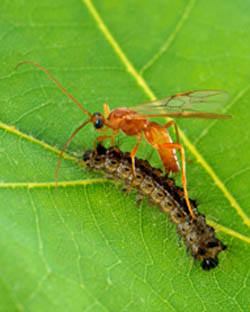
- Beneficial parasites, which commandeer pests for habitat or food
- Disease-causing organisms, including fungi, bacteria, viruses, protozoa and nematodes that fatally sicken insects or keep them from feeding or reproducing. These organisms also attack weeds.
- Insects such as ground beetles that eat weed seeds
- Beneficial fungi and bacteria that inhabit root surfaces, blocking attack by disease organisms
By integrating these natural strategies into your farming systems, you can manage pests in a way that is healthier for the environment and eliminates many of the problems associated with agrichemical use. Knowing the life cycles of pests and understanding their natural enemies allows you to better manipulate the system to enhance, rather than detract from, the built-in defenses available in nature. Another National Academy of Science report (1996), Ecologically Based Pest Management (EBPM), stated that EBPM “should be based on a broad knowledge of the agro-ecosystem and will seek to manage rather than eliminate pests” in ways that are “profitable, safe, and durable.”
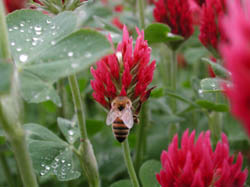
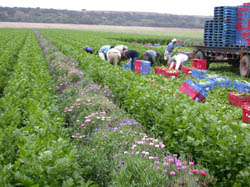
In addition to reducing pest damage, shifting your farming system to ecological pest management will bring multiple benefits to your operation. For example, moving from monoculture to longer rotations improves water- and nutrient-use efficiency. Cover crops planted to attract beneficial insects also suppress weeds, improve the soil, provide moisture-conserving mulch, fix or store nitrogen for subsequent crops and contribute to overall nutrient management goals.
About Manage Insects on Your Farm
Pests of agricultural crops include weeds, insects, pathogens and nematodes. This book is focused mostly on managing insect pests, but it addresses all crop pests to some degree, because no pest or category of pests can be addressed in isolation. The ecological pest management strategies presented here will contribute to overall ecosystem health.
We first lay out the principles behind ecologically based pest management. Then, we describe strategies used by farmers around the world to address insect problems within the context of their whole farm systems. A full section is devoted to how you can manage your soil to minimize insect damage. Flip to Chapter 5 to learn about beneficial insects you can put to work for you.
Throughout the book, we present specific examples of successful pest management strategies. While some examples may fit your farm or ranch, most are crop- or climate-dependent and will serve mostly to stimulate your imagination and help you better understand that while every system is unique, the general principles of ecological pest management apply universally. Use this book as a stepping-stone to develop a more complex, more diverse system on your own farm. Look for “Tip” boxes throughout the book for specific suggestions.
This book does not address the multiple ecological benefits of further diversifying your farm or ranch by integrating livestock into the system. If you also raise animals, consult other information resources about the management and benefits of integrated crop-livestock systems.
In short, nature has already provided many of the tools needed to successfully combat agricultural pests. This book aims to describe those tools and present successful strategies for using them to manage insects on your farm or ranch.
Cover Crop System Deters Pests
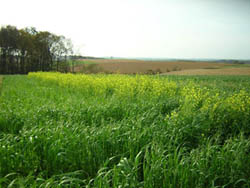
In Lancaster County, Pa., Steve Groff built a farming system based on cover crops, intensive crop rotation and no-till. Although he designed his crop and vegetable farm without targeting specific pests, Groff and the scientists using his farm as a real-world laboratory have documented significant benefits in pest management, including:
- Increased populations of beneficial insects in cover crops
- Reduced populations of Colorado potato beetles in tomatoes
- Delayed onset of early blight in tomatoes
- Minimal to no aphid pressure on any of his crops
- Reduced cucumber beetle damage in pumpkins
- Tolerable levels of European corn borer, thanks to releases of the parasitic wasp, trichogramma ostriniae
- Reduced weed pressure, although monitoring and managing weeds are still a top priority on his farm
Those benefits come at some cost, however. Groff spends more time managing his complex system to ensure that cover crops are seeded and killed at the right time and to scout for weeds. Moreover, he monitors soil temperature because no-till and cover crop residues delay soil-warming in the spring.
Not all pest management problems have been solved, either. Spider mites still attack Groff’s tomatoes, particularly in dry years, while slugs sometimes hide under cover crop residues in wet years. Nonetheless, consider the numbers. Groff has cut pesticide use by 40 percent and seen soil organic matter increase by almost 50 percent with a 10 percent net increase in yield averaged over all crops. “It’s working for us,” Groff says.