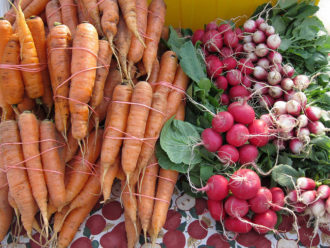
Community Involved in Sustaining Agriculture (CISA) checked in with some experts—farmers and engineers—to develop resources for farmers interested in on-farm winter storage options, available for free download here. Each resource offers a case study for a specific facility design, and both outline the following considerations for a winter storage facility:
- Crop Considerations
- Storage Facility Layout
- Cooling System and Humidity Considerations
- Free Cooling
- Cold Storage Financials
Walk-in Cooler & Squash Storage: Existing structure retrofit: Intervale Community Farm in Burlington, VT stores over 20,000 pounds of crops each winter for their 175-member winter CSA. In 2006, they retrofitted an existing pole barn structure with a cooler for root vegetables and a heated space for squash storage. Andy Jones, manager of the farm, lays out the decision-making process they went through, details about the set-up and use of the storage systems they chose.
Walk-in Cooler: New construction, stand-alone cold storage facility with free air option: GDS Associates, an engineering and consulting firm that has worked on storage facilities with local farms, produced this case study focusing on design and financial considerations for a stand-alone facility that can be equipped to use outside air to cool the space during the winter months.
Want more information? See the related SARE grant:
This material is based upon work that is supported by the National Institute of Food and Agriculture, U.S. Department of Agriculture through the Sustainable Agriculture Research and Education (SARE) program. Any opinions, findings, conclusions, or recommendations expressed in this publication are those of the author(s) and should not be construed to represent any official USDA or U.S. Government determination or policy.