• WebStore |
  • Advanced Search |
  • MySARE Login |
  • SARE Social Media |
  • Contact Us |
  • SANET Listserv |
  • Low Bandwidth |
Search MySARE Reports
  • Grants
    • Apply for a Grant
    • Funded Grants in Your State
  • Project Reports
    • Submit a Report
    • Search the Database
    • Project Search Tips
    • About Project Reports
    • About Search Results
    • Project Products
  • Learning Center
    • Books
    • Bulletins
    • Fact Sheets
    • Topic Rooms
    • From the Field
    • Newsletters
    • Multimedia
    • Courses and Curricula
    • Project Products
    • SARE Biennial Reports
    • SANET Listserv
    • SARE Program Materials
    • Conference Materials
    • WebStore
  • Professional Development
    • PDP Overview
    • Fellows & Search for Excellence Programs
    • Sample PDP Grant Projects
    • Educator Curriculum Guides
    • National Continuing Education Program
    • State Coordinator Contact Information
  • State Programs
    • State Coordinator Program Overview
    • State Coordinator Contact Information
    • State Program Webpages
    • Funded Grants in Your State
  • Events
    • Event Calendar
    • Past Conferences
  • Newsroom
    • Press Releases
    • SARE in the News
    • Media Contacts
    • Newsletters
    • Media Toolkit
    • A Guide To This Site
    • SARE and Social Media
  • About SARE
    • SARE's Four Regions
    • Join Our Mailing List
    • SARE Grants
    • Learning Center
    • Professional Development
    • SARE Outreach
    • Historical Timeline
    • Staff
    • Vision & Mission
    • What is Sustainable Agriculture?
  • Home»
  • Learning Center»
  • Fact Sheets»
  • Organic Insect Management in Sweet Corn
facebook
Twitter
YouTube
- + Font Size
Print
Share
  • by Type
  • by Topic
  • Books
  • Bulletins
  • Fact Sheets
  • Topic Rooms
  • From the Field
  • Newsletters
  • Multimedia
  • Courses and Curricula
  • Project Products
  • SARE Biennial Reports
  • SANET Listserv
  • SARE Program Materials
  • Conference Materials
  • WebStore
  • Animal Production
  • Community Development
  • Cover Crops
  • Crop Production
  • Economic/Marketing
  • Education & Training
  • Energy Conservation & Renewable Energy
  • For Consumers
  • Integrated Systems
  • Natural Resources/Environment
  • Pest Management
  • Quality of Life
  • Season Extension
  • Soil Management
  • Specialty Crops
  • Value Added
  • WebStore

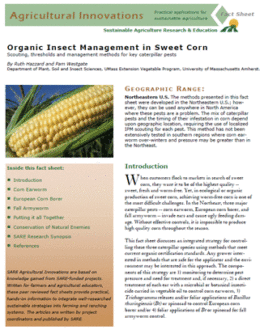
Fact Sheet

Organic Insect Management in Sweet Corn

Scouting, thresholds and management methods for key caterpillar pests

01AGI2005
Download Product

When customers flock to markets in search of sweet corn, they want it to be of the highest quality—sweet, fresh and worm-free. Yet, in ecological or organic production of sweet corn, achieving worm-free corn is one of the most difficult challenges. In the Northeast, three major caterpillar pests—corn earworm, European corn borer, and fall armyworm—invade ears and cause ugly feeding damage. Without effective controls, it is impossible to produce high quality corn throughout the season.

This fact sheet discusses an integrated strategy for controlling these three caterpillar species using methods that meet current organic certification standards. Any grower interested in methods that are safe for the applicator and the environment may be interested in this approach. The components of this strategy are 1) monitoring to determine pest pressure and need for treatment and, if necessary, 2) a direct treatment of each ear with a microbial or botanical insecticide carried in vegetable oil to control corn earworm, 3) Trichogramma releases and/or foliar applications of Bacillus thuringiensis (Bt) or spinosad to control European corn borer and/or 4) foliar applications of Bt or spinosad for fall armyworm control.

Geographic Adaptability: The methods presented in this fact sheet were developed in the Northeastern United States; however, they can be used anywhere in North America where these pests are a problem. The mix of caterpillar pests and the timing of their infestation in corn depend upon geographic location, requiring the use of localized IPM scouting for each pest. This method has not been extensively tested in southern regions where corn earworm over-winters and pressure may be greater than in the Northeast.

Want more information? See the related SARE grant(s) LNE99-118, Implementing a Biointensive Strategy for Caterpillar Control in Sweet Corn.

Product Specs

Author: Ruth Hazzard, Pam Westgate
 | 
Published: 2005
 | 
Pages: 11

How to Order

Online Version (Free)
Download File (364.92 kB)
 | 
View the Online HTML

Only available online


Related Resources

You may be interested in more information about: Pest Management.

Search the MySARE project reports database for research about Pest Management.

Sare 25 Years

1122 Patapsco Building | University of Maryland | College Park, MD 20742-6715

This Web site is maintained by the national outreach office of the SARE program, supported by the National Institute of Food and Agriculture, U.S. Department of Agriculture.

North Central SARE | Northeast SARE | Southern SARE |  Western SARE

Sustainable Agriculture Research & Education ©2012

  • Help |
  • RSS Feeds |
  • A Guide To This Site