
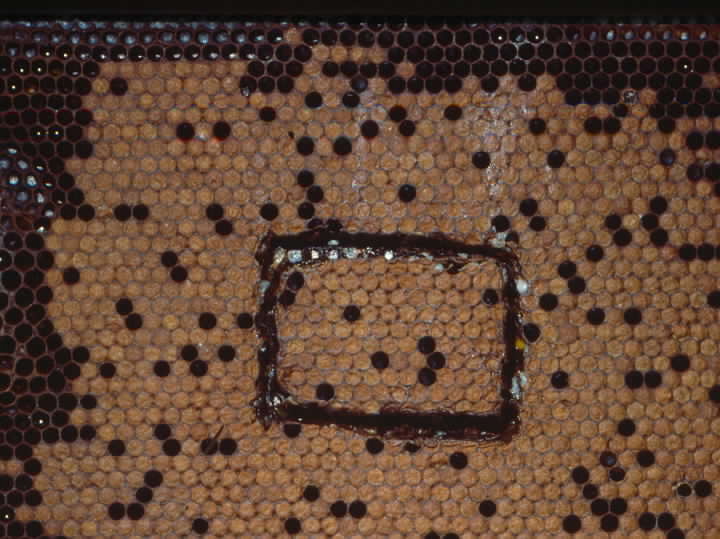
It is relatively easy to determine if a colony of bees displays hygienic behavior. If you are curious whether your bees express the behavior, you can test them using one of these methods. (Also see Spivak and Downey, 1998; Spivak and Reuter, 1998b). They involve presenting bees with freeze-killed or pin-killed brood and determining the colony’s rate of removal of the dead brood.
The ability of a colony to quickly remove freeze-killed or pin-killed brood corresponds generally with how quickly the colony detects and removes diseased or mite-infested brood. These methods are used as an initial screen to find colonies with hygienic tendencies. This initial assay should be followed by more detailed tests of a colony’s ability to detect and remove actual diseased or mite-infested brood.
Two Recommended Methods to Test for Hygienic Behavior
1. The Freeze Killed Brood Assay
In this assay, a comb section of sealed brood containing approximately 100 cells on each side (2 inches by 2.5 inches, or 5 centimeters by 6 centimeters) is cut from a frame and frozen for 24 hours at -10°F (-20°C). The frozen comb section is inserted into a frame of sealed brood in the colony being tested (Figure 2). Tests have shown that it does not matter if the frozen section comes from the same colony from which it was removed or from a different colony. The frame with the freeze-killed brood insert is placed in the center of the brood nest. One day (24 hours) later the frame is removed and the number of sealed cells remaining is recorded. A hygienic colony will have uncapped and removed over 95% of the frozen brood within 24 hours. A non-hygienic colony will take over six days to completely remove the frozen brood.
2. Liquid Nitrogen
Freezing the brood with liquid nitrogen is more efficient and less destructive to the combs than cutting, freezing and replacing comb inserts. Liquid nitrogen is relatively inexpensive and easy to obtain; check with your local gas and welding suppliers, veterinary practice or livestock artificial insemination firm. There are no laws in any state restricting the use of industrial grade liquid nitrogen by individuals. It must be kept in an appropriate tank (e.g., a Dewar tank, which can be purchased through gas and welding supply houses), and the tank should be securely fastened to the truck during travel to avoid spillage.
Common sense and several precautions must be used when handling liquid nitrogen. It has a boiling temperature of -195°C (-320°F), which means that it is extremely cold and will kill skin (causing severe frostbite) on contact. We recommend that users read the material safety data sheet on liquid nitrogen from the supplier.
You will need to construct (or find) a hollow cylinder into which you will pour the liquid nitrogen to freeze a circular section of sealed brood. We have been using a 3-inch (75 millimeter) diameter PVC pipe. The cylinder must be at least 4 inches (100 millimeters) long because the nitrogen will boil on contact with the brood.
A minimum of 10 ounces (300 milliliters) of liquid nitrogen is needed to freeze-kill all the brood (approximately 160 cells) within a 3-inch diameter cylinder. A smaller amount will not kill all of the brood, leading to erroneous results. Use a 10-ounce or larger polystyrene foam coffee cup for measuring and pouring. Other materials may shatter on contact with the liquid nitrogen.
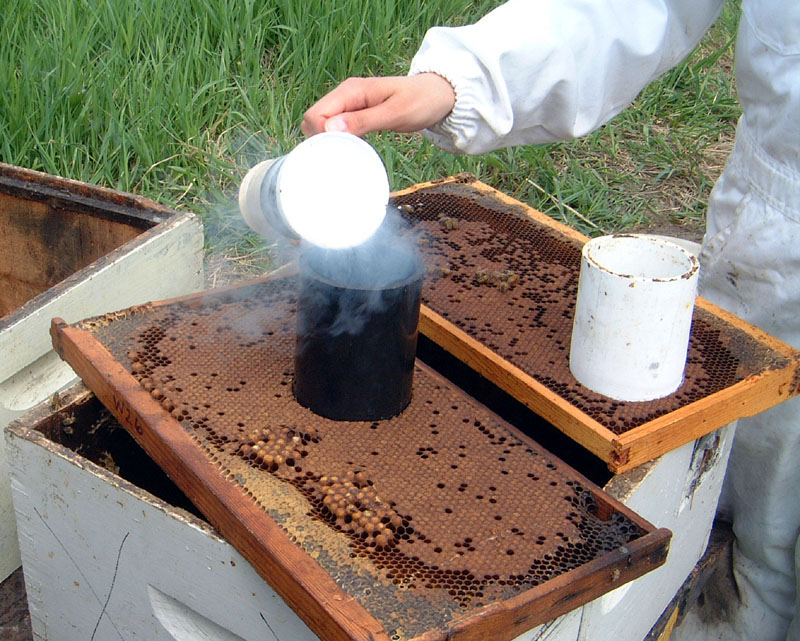
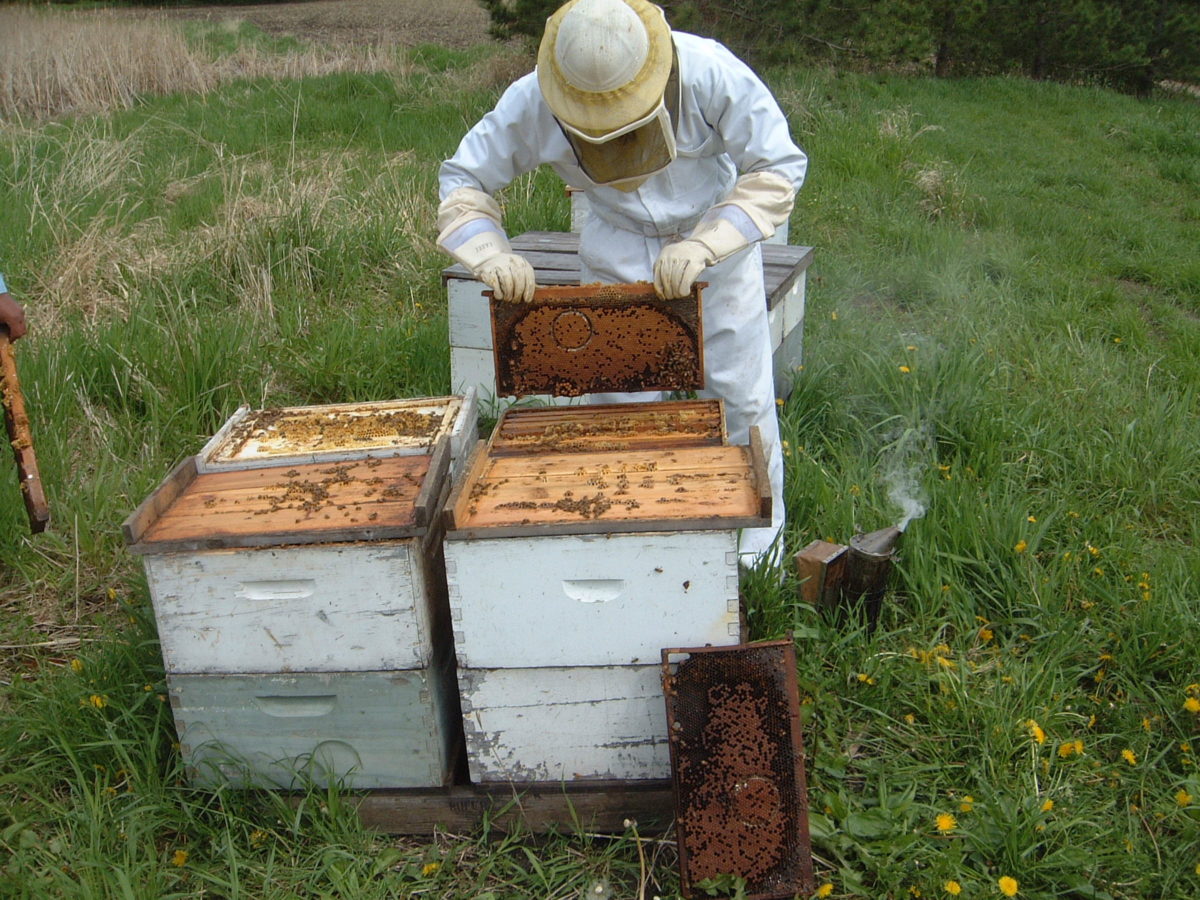
Select a frame with at least a 3-inch diameter circle of sealed brood containing fewer than 30 unsealed cells within the circle. Lay the frame horizontally across a support (e.g., an empty super). Twist the cylinder into the sealed brood until it reaches the midrib. Record the number of unsealed cells inside the cylinder. Pour 50–60 milliliters of the liquid nitrogen into the cylinder and wait for it to freeze the edges or evaporate. Then pour the remainder of the liquid nitrogen into the cylinder. Wait to remove the cylinder until it thaws, which may take three to 10 minutes (Figure 3). If you have additional cylinders, you can start the next test while you are waiting for previous ones to thaw. We put a drawing pin (thumbtack) in the top of the frame to mark the frame and the location of the test on the frame. Some hygienic colonies clean and repair the comb so quickly that it is hard to locate the test when you return. Place the frame in the center of the brood nest (Figure 4).
Remove the frame containing the frozen brood 24 hours later and record the number of sealed cells remaining within the circle. When testing a colony that has been requeened, six to eight weeks must elapse after requeening for the bees in the colony to be daughters of the new queen (Figure 5a and b).
Important note: Both of these tests should be repeated on the same colony, and you may notice that the results may vary between tests. For example, a colony may remove 95% of the frozen brood on the first test, but only 50% on the second. This colony is not hygienic! It is very important that colonies be considered hygienic only if they remove more than 95% of the brood on two consecutive tests.