• WebStore |
  • Advanced Search |
  • MySARE Login |
  • SARE Social Media |
  • Contact Us |
  • SANET Listserv |
  • Low Bandwidth |
Search MySARE Reports
  • Grants
    • Apply for a Grant
    • Funded Grants in Your State
  • Project Reports
    • Submit a Report
    • Search the Database
    • Project Search Tips
    • About Project Reports
    • About Search Results
    • Project Products
  • Learning Center
    • Books
    • Bulletins
    • Fact Sheets
    • Topic Rooms
    • From the Field
    • Newsletters
    • Multimedia
    • Courses and Curricula
    • Project Products
    • SARE Biennial Reports
    • SANET Listserv
    • SARE Program Materials
    • Conference Materials
    • WebStore
  • Professional Development
    • PDP Overview
    • Fellows & Search for Excellence Programs
    • Sample PDP Grant Projects
    • Educator Curriculum Guides
    • National Continuing Education Program
    • State Coordinator Contact Information
  • State Programs
    • State Coordinator Program Overview
    • State Coordinator Contact Information
    • State Program Webpages
    • Funded Grants in Your State
  • Events
    • Event Calendar
    • Past Conferences
  • Newsroom
    • Press Releases
    • SARE in the News
    • Media Contacts
    • Newsletters
    • Media Toolkit
    • A Guide To This Site
    • SARE and Social Media
  • About SARE
    • SARE's Four Regions
    • Join Our Mailing List
    • SARE Grants
    • Learning Center
    • Professional Development
    • SARE Outreach
    • Historical Timeline
    • Staff
    • Vision & Mission
    • What is Sustainable Agriculture?
  • Home»
  • Learning Center»
  • Bulletins»
  • Profitable Pork»
  • Text Version»
  • Profile: Pork From the Porch
facebook
Twitter
YouTube
- + Font Size
Print
Share

Text Version

  • Hog Production Systems
  • Environmental Benefits
  • Marketing Options for Pork
  • Profile: Swedish-Style Hog Production
  • Profile: Hawaiian Dry Litter Systems
  • Profile: Pork From the Porch
  • Community, Family and Lifestyle Benefits
  • Resources
  • Printable Version

Can't find something? Ask or send feedback.

SARE's mission is to advance—to the whole of American agriculture—innovations that improve profitability, stewardship and quality of life by investing in groundbreaking research and education. SARE's vision is...

Profile: Pork From the Porch

by Barb Baylor Anderson
modified greenhouse design
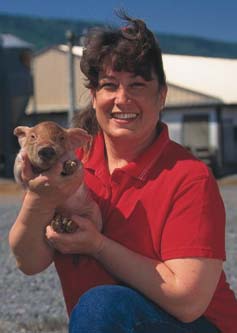
Pennsylvania hog producer Barbara Wiand, who received a SARE grant to explore new ways to market pork, graced the cover of Successful Farming magazine as one of 10 'positive thinkers.'
Photo courtesy of Successful Farming

Barbara Wiand, of Mifflinburg, Penn., retails her farm's pork product from her back door, offering her an outlet for value-added pork and the opportunity to work from home with her young children close by. After their slaughter plant closed, she organized area pork producers to begin shipping hogs together to another plant, this one 175 miles away. That way, they could meet quota numbers and defray trucking costs.

She and her husband, Glenn, who were both raised on farms, live in a historic house they call the Olde Stonehouse Farm on 240 acres in central Pennsylvania. They raise 300 sows in a confinement crate system; each sow produces 2 1/2 litters per year. In groups of 20 to 25, their piglets remain in pens through finishing.

Previously, they sold pork under a contract, but fearing low hog prices and the changing structure of the hog industry would negatively affect their operation, Wiand began looking for ways to cover the risk. Beyond producing 7,000 market hogs per year, Wiand wanted a more rewarding outlet for pork. She began to research a marketing plan for value-added pork products, then used a SARE grant to put the plan into place.

'I felt value-added pork would increase farm income, allow us to maintain the same number of animals, improve the quality of life and continue to be active in production agriculture,' she said.

Wiand did research into all angles of the plan and set the basic framework for the business. 'It took nearly two years to develop the products, labels and retail site,' she says. 'It takes a lot of work to determine where to slaughter and package the meat and label and market it.'

She obtained a Pennsylvania Department of Agriculture certificate to sell meat as a retailer from her home and also participates in area farmers markets. A local USDA-certified packer processes the meat, which Wiand stamps with her own 'Olde Stonehouse Farm' label featuring a picture of the 1811 house. She has labels for 12 different products – smoked country bacon, Canadian bacon, boneless ham and specialty sausages among them – along with a generic label that can be used on fresh pork and even ultimately beef or lamb, if her business expands.

Wiand's retail shop, which is open Thursday-Saturday, is registered with the state department of agriculture. She currently slaughters one or two hogs per week for her local customers.

'Inventory management is challenging,' she said. 'It can be difficult to sell all of the cuts from every hog every week.' Wiand works with federal prison procurement officials to move pork at cost and is exploring opportunities to donate excess product to community shelters and nursing homes.

Reaching into the community and being able to help her family is the greatest reward of the business, Wiand said. 'I get to be with my kids and it feels good to be able to offer top-quality pork products to people. I am leaving my options open to grow the retail business or even explore ways to supply one or more major grocery chains in our area. Every step requires finding the right people to work with and convincing people your business is legitimate.'

Farm Profiles

Resources

Top

You are reading the SARE bulletin Profitable Pork.

Order this publication.

Sare 25 Years

1122 Patapsco Building | University of Maryland | College Park, MD 20742-6715

This Web site is maintained by the national outreach office of the SARE program, supported by the National Institute of Food and Agriculture, U.S. Department of Agriculture.

North Central SARE | Northeast SARE | Southern SARE |  Western SARE

Sustainable Agriculture Research & Education ©2012

  • Help |
  • RSS Feeds |
  • A Guide To This Site