• WebStore |
  • Advanced Search |
  • MySARE Login |
  • SARE Social Media |
  • Contact Us |
  • SANET Listserv |
  • Low Bandwidth |
Search MySARE Reports
  • Grants
    • Apply for a Grant
    • Funded Grants in Your State
  • Project Reports
    • Submit a Report
    • Search the Database
    • Project Search Tips
    • About Project Reports
    • About Search Results
    • Project Products
  • Learning Center
    • Books
    • Bulletins
    • Fact Sheets
    • Topic Rooms
    • From the Field
    • Newsletters
    • Multimedia
    • Courses and Curricula
    • Project Products
    • SARE Biennial Reports
    • SANET Listserv
    • SARE Program Materials
    • Conference Materials
    • WebStore
  • Professional Development
    • PDP Overview
    • Fellows & Search for Excellence Programs
    • Sample PDP Grant Projects
    • Educator Curriculum Guides
    • National Continuing Education Program
    • State Coordinator Contact Information
  • State Programs
    • State Coordinator Program Overview
    • State Coordinator Contact Information
    • State Program Webpages
    • Funded Grants in Your State
  • Events
    • Event Calendar
    • Past Conferences
  • Newsroom
    • Press Releases
    • SARE in the News
    • Media Contacts
    • Newsletters
    • Media Toolkit
    • A Guide To This Site
    • SARE and Social Media
  • About SARE
    • SARE's Four Regions
    • Join Our Mailing List
    • SARE Grants
    • Learning Center
    • Professional Development
    • SARE Outreach
    • Historical Timeline
    • Staff
    • Vision & Mission
    • What is Sustainable Agriculture?
  • Home»
  • Learning Center»
  • Bulletins»
  • Profitable Pork»
  • Text Version»
  • Hog Production Systems»
  • Hog Production Systems, Page 3
facebook
Twitter
YouTube
- + Font Size
Print
Share

Text Version

  • Hog Production Systems
    • Hog Production Systems, Page 2
    • Hog Production Systems, Page 3
    • Hog Production Systems, Page 4
  • Environmental Benefits
  • Marketing Options for Pork
  • Profile: Swedish-Style Hog Production
  • Profile: Hawaiian Dry Litter Systems
  • Profile: Pork From the Porch
  • Community, Family and Lifestyle Benefits
  • Resources
  • Printable Version

Can't find something? Ask or send feedback.

SARE's mission is to advance—to the whole of American agriculture—innovations that improve profitability, stewardship and quality of life by investing in groundbreaking research and education. SARE's vision is...

Hog Production Systems, Page 3

Raising Feeder Pigs in Hoop Structures

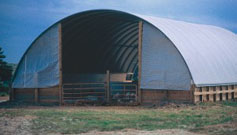
hoop barn for hog production
Pig production costs have been reduced by about $4 per hog in hoop barns, built at a fraction of the bill to erect a confinement structure. Photo by Jerry DeWitt
Tent-like shelters that house hogs for a fraction of the cost of a typical confinement house, hoop structures are gaining in popularity as producers realize the benefits of this simple structure that resembles a giant, opaque greenhouse. Originally developed in Canada, 'hoops' usually hold up to 250 hogs on an earthen floor that is heaped with a generous amount of bedding. The structures are topped with 15-feet-high steel arches covered with fabric tarps.

Iowa State University researchers found that initial investment was about one-third cheaper for hoop barns than confinement barns. Confinement operations cost a producer $180 per pig space versus just $55 for a space in a hoop structure. Initial hoop barn construction costs vary from $9,000 to $16,200 to hold 200 head – compared to $150,000 to $200,000 for confinement structures that hold 1,000 head.

'Hoops are attractive to a lot of people who don't have a lot of equity to invest,' said Mike Brumm, an extension swine specialist at the University of Nebraska. 'They can pay the day-to-day costs, but don't have to come up with the big money up front.' Hoop structures are 'favorable to beginning farmers who don't have the equity.'

Most hoop structures are used for finishing feeder pigs. Since 1996, close to 3,000 hoop structures have been built in Iowa, where much of the research into alternative swine housing systems is taking place. At Iowa State University, a team of researchers comparing finishing pigs in hoops versus confinement systems found that 'hoop pigs' grew slower in winter and were less efficient than the confinement pigs. In summer, however, the opposite was true.

Yet, weight gain must be compared to costs of production. Overall pig production costs in hoops have been reduced by approximately $4 per hog, according to the nonprofit information clearinghouse, Appropriate Technology Transfer for Rural Areas (ATTRA).

Deep bedding really works as a source of heat. In the winter, researchers have recorded bedding temperatures in hoops to be at least 80º F.

Another big difference between hoop barns and standard hog confinement houses is air flow. While hoop barns are naturally ventilated, confinement systems have forced air systems that rely on electrical power. If a farmer experiences a blackout, the fans cut out and the pigs may die from toxic gas buildup. Most confinement systems therefore include backup generators, which are an added expense and worry for producers. By contrast, Canadian researchers have found that 94 percent of hogs raised in hoop barns exhibited normal lung function, compared with 70 percent of the hogs reared in confinement.

Pigs raised in hoops may develop internal parasites, so aggressive worming is recommended. Otherwise, pigs in hoops are reportedly quite healthy, with foot and leg problems greatly reduced. (See 'Animal Health' in Part II.) Hoop structures require labor to unload bedding, haul solid manure and check pigs.

When evaluating hoop houses:
Remember that a supply of good-quality bedding is a major consideration.
Expect higher feeding costs. During the colder months, pigs in hoop structures may need about 10 percent more feed than their confinement counterparts to recover the energy spent keeping warm.
Make sure you have the equipment necessary for manure loading and handling..
Develop an internal parasite control program.

Take advantage of the versatility of hoop structures, which may be used for other livestock or storage needs.

Page: 1 | 2 | 3 | 4

Top

You are reading the SARE bulletin Profitable Pork.

Order this publication.

Sare 25 Years

1122 Patapsco Building | University of Maryland | College Park, MD 20742-6715

This Web site is maintained by the national outreach office of the SARE program, supported by the National Institute of Food and Agriculture, U.S. Department of Agriculture.

North Central SARE | Northeast SARE | Southern SARE |  Western SARE

Sustainable Agriculture Research & Education ©2012

  • Help |
  • RSS Feeds |
  • A Guide To This Site