• WebStore |
  • Advanced Search |
  • MySARE Login |
  • SARE Social Media |
  • Contact Us |
  • SANET Listserv |
  • Low Bandwidth |
Search MySARE Reports
  • Grants
    • Apply for a Grant
    • Funded Grants in Your State
  • Project Reports
    • Submit a Report
    • Search the Database
    • Project Search Tips
    • About Project Reports
    • About Search Results
    • Project Products
  • Learning Center
    • Books
    • Bulletins
    • Fact Sheets
    • Topic Rooms
    • From the Field
    • Newsletters
    • Multimedia
    • Courses and Curricula
    • Project Products
    • SARE Biennial Reports
    • SANET Listserv
    • SARE Program Materials
    • Conference Materials
    • WebStore
  • Professional Development
    • PDP Overview
    • Fellows & Search for Excellence Programs
    • Sample PDP Grant Projects
    • Educator Curriculum Guides
    • National Continuing Education Program
    • State Coordinator Contact Information
  • State Programs
    • State Coordinator Program Overview
    • State Coordinator Contact Information
    • State Program Webpages
    • Funded Grants in Your State
  • Events
    • Event Calendar
    • Past Conferences
  • Newsroom
    • Press Releases
    • SARE in the News
    • Media Contacts
    • Newsletters
    • Media Toolkit
    • A Guide To This Site
    • SARE and Social Media
  • About SARE
    • SARE's Four Regions
    • Join Our Mailing List
    • SARE Grants
    • Learning Center
    • Professional Development
    • SARE Outreach
    • Historical Timeline
    • Staff
    • Vision & Mission
    • What is Sustainable Agriculture?
  • Home»
  • Learning Center»
  • Bulletins»
  • Profitable Pork»
  • Text Version»
  • Hog Production Systems
facebook
Twitter
YouTube
- + Font Size
Print
Share

Text Version

  • Hog Production Systems
    • Hog Production Systems, Page 2
    • Hog Production Systems, Page 3
    • Hog Production Systems, Page 4
  • Environmental Benefits
  • Marketing Options for Pork
  • Profile: Swedish-Style Hog Production
  • Profile: Hawaiian Dry Litter Systems
  • Profile: Pork From the Porch
  • Community, Family and Lifestyle Benefits
  • Resources
  • Printable Version

Can't find something? Ask or send feedback.

SARE's mission is to advance—to the whole of American agriculture—innovations that improve profitability, stewardship and quality of life by investing in groundbreaking research and education. SARE's vision is...

Hog Production Systems

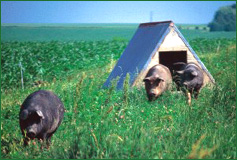
hogs in a pasture system
In a well-managed farrow-to-finish pasture system, producers can net more than $10 per pig, according to Texas Tech University.
Photo by Jerry DeWitt
Years ago, pigs foraged in pastures, wallowed in mud to stay cool and nested in family units. Now, most pig producers raise their animals in confinement buildings containing thousands of pigs with sows in two-feet-wide crates. Lately, some farmers and consumers have begun to balk at that system.

"When the current conventional systems create profound, widespread concerns, we are compelled to look elsewhere for solutions," said Mark Honeyman, an Iowa State University researcher and national expert on alternative swine housing options. "The public's growing concern about the environment and the impact of vertical integration upon rural communities, worker health and animal welfare calls for innovative approaches and ethical judgment in the ways producers raise pigs."


Why Switch?
Minimize environmental concerns such as water and air quality
Improve hog worker health, which can be compromised by dust and gases in confinement buildings
Assume less financial risk
Create fewer objectionable odors
Assume lower start-up costs
Minimize neighbor problems when farming near population centers
Manage animals rather than equipment and automated machinery
Provide pigs with access to bedding, freedom of movement, sunshine and each other

Determining the Right Alternative Hog System
Before overhauling a hog production system, evaluate your resources, define your goals and visualize what type of operation might work best. In weighing your options, consider your buildings and what might be renovated to fit your goals, as well as your pasture or forage options.

Consider also your location and whether you have access to processing and markets. For more information about planning for a new farm enterprise, consult "Hogs Your Way." (See "Resources")

The significantly lower start-up costs for alternative swine systems may be one of the most convincing factors for producers, especially beginning farmers who may have difficulty raising capital. Other farmers adopt the systems because they allow great flexibility. Inexpensive, easy-to-build hoop structures, for example, incur no debt and are easy to adapt for other uses.

"These systems appeal to someone who doesn't want to borrow capital," said Honeyman. "If you construct a building that costs hundreds of thousands of dollars, you're going to produce, whatever happens. If you want more flexibility, you need a lower cost option. In a rapidly changing industry, why not create a system that's flexible rather than one that locks you into a certain production system?"

Page: 1 | 2 | 3 | 4

Top

You are reading the SARE bulletin Profitable Pork.

Order this publication.

Sare 25 Years

1122 Patapsco Building | University of Maryland | College Park, MD 20742-6715

This Web site is maintained by the national outreach office of the SARE program, supported by the National Institute of Food and Agriculture, U.S. Department of Agriculture.

North Central SARE | Northeast SARE | Southern SARE |  Western SARE

Sustainable Agriculture Research & Education ©2012

  • Help |
  • RSS Feeds |
  • A Guide To This Site