Manure Management
The best type of waste management in any livestock operation converts manure into a resource rather than creates a disposal problem. Many hog producers also raise crops, so manure, treated correctly, offers a valuable soil amendment. Manure from a 50-sow operation is worth about $4,000 as a fertilizer, although other benefits such as increasing organic matter, enhancing soil structure and building more diverse soil organisms make it even more valuable.
In pastured hog operations, the hogs distribute manure themselves as they move across a field. With proper rotations and a reasonable stocking rate, manure does not pose a problem. Manure from hogs raised in deep bedding mixes with the straw or other material and becomes a solid pack that is relatively easy to handle. The manure-bedding mix adds another plus. Bedding materials contain high amounts of complex substances, such as lignin, that do not decompose rapidly and therefore improve the soil's organic matter and tilth over the long term.
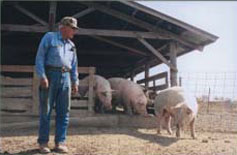
Roger Hubmer of Mankato, Minn., analyzes his manure mixed with cornstalk bedding so he can knowledgeably apply it to his crop fields. Hubmer, who began finishing hogs in hoop barns when he realized he didn't want to spend $100,000 on a new confinement barn, spreads compost based on the phosphorus rating.
Odor and Pollution
One of the biggest considerations about raising hogs is odor generated from manure. Stories about bad-smelling manure lagoons and community opposition to large hog confinement operations regularly appear in the media. Liquid manure stored in a lagoon sits in an anaerobic state, and that creates disagreeable odors. The smell might be unpleasant for people nearby, but some of the gases produced methane, hydrogen sulfide, carbon monoxide and ammonia can be toxic.
If there's a power outage in a confinement building, pigs face very real dangers, including death, from heat and the gases that build up in liquid anaerobic manure systems. Many confinement hog operators equip their buildings with alarm systems and backup generators. Such high-tech systems come at considerable cost. The free flow of air through a hoop structure, however, eliminates the need for such expensive systems.
'Hog odor is the most divisive issue ever in agriculture, damaging the fabric of rural society and disenfranchising pork producers from their communities, even on the roads in front of their farm,' said R. Douglas Hurt, director of Iowa State's Center for Agriculture History and Rural Studies.
Outdoor systems eliminate the problem. There is virtually no odor at Texas Tech's pastured pig demonstration site, said John McGlone, who runs the facility. 'I told some colleagues from NRCS that it wouldn't smell and they didn't believe me,' he said. 'I had them out there in the fields a year after we started and they couldn't believe it. It doesn't smell.'
Perhaps worse than odor concerns is the potential of swine lagoons to leak into surface water or groundwater. In September 1999, Hurricane Floyd wreaked havoc throughout North Carolina. Particularly hard hit was the state's huge hog industry. Overall farm losses were estimated at more than $1 billion, with at least 21,000 hogs drowned or washed away in their pens. Water pollution became a serious threat partly due to floodwaters carrying away manure from countless hog lagoons.
'Confinement poses more risks,' Honeyman said. 'If we concentrate these animals, we also concentrate animal waste, so our risks of environmental degradation increase.'
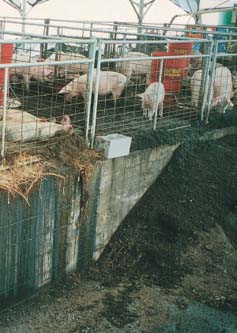
A solid manure system, on the other hand, doesn't leak or spill. The only threat to water quality is possible leaching from the composting bedding pack if it is stored outside in heavy rain. As an aerobic process, composting, done correctly, shouldn't emit objectionable odors.
'It may sound funny,' said Hubmer, the Mankato, Minn., farmer, 'but the composted manure that comes out of the hoops is almost sweet-smelling.'
Pastured systems pose even less of a risk. At Texas Tech, researchers installed a buffer of Old World bluestem around the site to catch runoff from heavy storms. It works, too, McGlone said. 'You can see the runoff isn't leaving,' he said. 'Our pastures are dark green, while the buffer is pale green,' indicating that nitrogen is staying on the pastures.
'If it's done right, manure and nutrient runoff is not an issue.'