• WebStore |
  • Advanced Search |
  • MySARE Login |
  • SARE Social Media |
  • Contact Us |
  • SANET Listserv |
  • Low Bandwidth |
Search MySARE Reports
  • Grants
    • Apply for a Grant
    • Funded Grants in Your State
  • Project Reports
    • Submit a Report
    • Search the Database
    • Project Search Tips
    • About Project Reports
    • About Search Results
    • Project Products
  • Learning Center
    • Books
    • Bulletins
    • Fact Sheets
    • Topic Rooms
    • From the Field
    • Newsletters
    • Multimedia
    • Courses and Curricula
    • Project Products
    • SARE Biennial Reports
    • SANET Listserv
    • SARE Program Materials
    • Conference Materials
    • WebStore
  • Professional Development
    • PDP Overview
    • Fellows & Search for Excellence Programs
    • Sample PDP Grant Projects
    • Educator Curriculum Guides
    • National Continuing Education Program
    • State Coordinator Contact Information
  • State Programs
    • State Coordinator Program Overview
    • State Coordinator Contact Information
    • Funded Grants in Your State
  • Events
    • Event Calendar
    • Past Conferences
  • Newsroom
    • Press Releases
    • SARE in the News
    • Media Contacts
    • Newsletters
    • Media Toolkit
    • A Guide To This Site
    • SARE and Social Media
  • About SARE
    • SARE's Four Regions
    • SARE Grants
    • Learning Center
    • Professional Development
    • SARE Outreach
    • Historical Timeline
    • Staff
    • Vision & Mission
    • Join Our Mailing List
    • What is Sustainable Agriculture?
  • Home»
  • Learning Center»
  • Bulletins»
  • Profitable Pork»
  • Text Version»
  • Community, Family and Lifestyle Benefits»
  • Community, Family and Lifestyle Benefits, Page 2
facebook
Twitter
YouTube
- + Font Size
Print
Share

Text Version

  • Hog Production Systems
  • Environmental Benefits
  • Marketing Options for Pork
  • Profile: Swedish-Style Hog Production
  • Profile: Hawaiian Dry Litter Systems
  • Profile: Pork From the Porch
  • Community, Family and Lifestyle Benefits
    • Community, Family and Lifestyle Benefits, Page 2
  • Resources
  • Printable Version

Can't find something? Ask or send feedback.

SARE's mission is to advance—to the whole of American agriculture—innovations that improve profitability, stewardship and quality of life by investing in groundbreaking research and education. SARE's vision is...

Community, Family and Lifestyle Benefits, Page 2

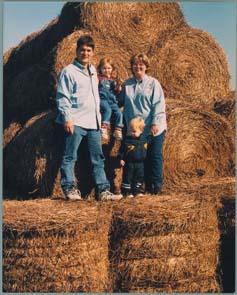
Greg Gunthorp family
Greg Gunthorp's prices average 10 times what hogs fetch on the commodities market, although the bottom line for Gunthorp is making enough money to keep his family healthy and happy.
Photo by Kathy Dutro, Indiana Farm Bureau

Family and Community Benefits

Alternative hog production systems provide excellent opportunities for producers to work with other family members and develop relationships with other workers. In some cases, children can check and bed huts, while older children can help with fencing, feeding, watering and bedding. An alternative system also allows family members to work as a team in moving pigs, setting up pastures, placing huts and shelters, laying water lines and feeders and rounding up pigs for weaning or treatments.

Vic Madsen of Audobon, Iowa, who uses hoop houses in his hog production system, told participants at an annual Iowa swine systems conference in 1999, that alternative systems meet the 'fun test' in helping producers do a better job.

'This winter, my 15-year-old son helped me put cornstalk bedding in a hoop with finishing hogs,' Madsen said. 'When we were done, he started laughing out loud. One of the pigs had picked up a corncob, had it sideways in his mouth like a big old cigar, and was literally prancing around the building. That pig made chores fun for my son.'

Dwight Ault finds raising pigs on pasture enjoyable as well as profitable and environmentally sound.

'It is a real treat for me and the sows when they are taken to pasture,' he said. 'It is good for mental outlook, a kind of therapy that farmers need. To me, it is a joy when you watch sows munching green legumes and grass after a winter of dry feed.'

Small, independent producers also can stimulate local economies. Independent producers use local veterinarians, farm supply stores and feed companies, and pay local truckers to transport their animals. Other businesses may receive indirect support from additional dollars circulating in the local economy.

Profits from an independent producer can multiply three or four times in a community, said University of Missouri rural sociologist William Heffernan. Profits from a corporate or private company-owned farm leave the community almost immediately.

Patchwork Family Farms in Columbia, Mo., brings different segments of society together that are connected by an interest in quality meat or pork raised by independent producers. The co-op, which sells pork from its retail outlet, collects about $3,000 in four hours on sales days. With prices competitive with conventionally raised pork, the co-op is able to serve both low-income and affluent residents.

'You'll see a homeless shelter resident, a doctor in a suit and a university professor, and they're all standing in line talking,' said Lindsay Howerton, the co-op's marketing coordinator. 'We know this is something special, because usually these people wouldn't interact. They're all talking about where their food comes from.'

Page: 1 | 2

Farm Profiles

Resources

Top

You are reading the SARE bulletin Profitable Pork.

Order this publication.

25th SARE logo USDA Logo

1122 Patapsco Building | University of Maryland | College Park, MD 20742-6715

This Web site is maintained by the national outreach office of the SARE program, supported by the National Institute of Food and Agriculture, U.S. Department of Agriculture.

North Central SARE | Northeast SARE | Southern SARE | Western SARE

Sustainable Agriculture Research & Education ©2012

  • Help |
  • RSS Feeds |
  • A Guide To This Site