• WebStore |
  • Advanced Search |
  • MySARE Login |
  • SARE Social Media |
  • Contact Us |
  • SANET Listserv |
  • Low Bandwidth |
Search MySARE Reports
  • Grants
    • Apply for a Grant
    • Funded Grants in Your State
  • Project Reports
    • Submit a Report
    • Search the Database
    • Project Search Tips
    • About Project Reports
    • About Search Results
    • Project Products
  • Learning Center
    • Books
    • Bulletins
    • Fact Sheets
    • Topic Rooms
    • From the Field
    • Newsletters
    • Multimedia
    • Courses and Curricula
    • Project Products
    • SARE Biennial Reports
    • SANET Listserv
    • SARE Program Materials
    • Conference Materials
    • WebStore
  • Professional Development
    • PDP Overview
    • Fellows & Search for Excellence Programs
    • Sample PDP Grant Projects
    • Educator Curriculum Guides
    • National Continuing Education Program
    • State Coordinator Contact Information
  • State Programs
    • State Coordinator Program Overview
    • State Coordinator Contact Information
    • Funded Grants in Your State
  • Events
    • Event Calendar
    • Past Conferences
  • Newsroom
    • Press Releases
    • SARE in the News
    • Media Contacts
    • Newsletters
    • Media Toolkit
    • A Guide To This Site
    • SARE and Social Media
  • About SARE
    • SARE's Four Regions
    • SARE Grants
    • Learning Center
    • Professional Development
    • SARE Outreach
    • Historical Timeline
    • Staff
    • Vision & Mission
    • Join Our Mailing List
    • What is Sustainable Agriculture?
  • Home»
  • Learning Center»
  • Fact Sheets»
  • Tomato Grafting for Disease Resistance and Increased Productivity
facebook
Twitter
YouTube
- + Font Size
Print
Share
  • by Type
  • by Topic
  • Books
  • Bulletins
  • Fact Sheets
  • Topic Rooms
  • From the Field
  • Newsletters
  • Multimedia
  • Courses and Curricula
  • Project Products
  • SARE Biennial Reports
  • SANET Listserv
  • SARE Program Materials
  • Conference Materials
  • WebStore
  • Animal Production
  • Community Development
  • Cover Crops
  • Crop Production
  • Economic/Marketing
  • Education & Training
  • Energy Conservation & Renewable Energy
  • For Consumers
  • Integrated Systems
  • Natural Resources/Environment
  • Pest Management
  • Quality of Life
  • Season Extension
  • Soil Management
  • Specialty Crops
  • Value Added
  • WebStore

Fact Sheet

Tomato Grafting for Disease Resistance and Increased Productivity

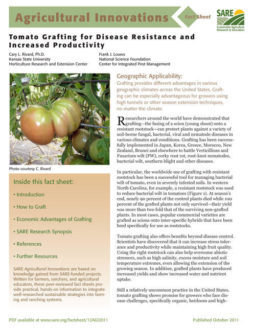
Tomato Grafting Fact Sheet
Download Product

Researchers around the world have demonstrated that grafting can protect plants against a variety of soil-borne diseases in various climates and conditions. Grafting has been successfully implemented in many countries to battle diseases such as Verticillium and Fusarium wilt, corky root rot and bacterial wilt, among others. Along with maintaining high fruit quality, tomato grafting can also help overcome abiotic stressors, such as high salinity, excess moisture and soil temperature extremes, even allowing the extension of the growing season.

Want more information? See the related SARE grant(s) GS05-046, Inducing Disease Resistance and Increased Production in Organic Heirloom Tomato Production Through Grafting, GS07-060, Potential of grafting to improve nutrient management of heirloom tomatoes on organic farms, LS06-193, Grafting Rootstocks onto Heirloom and Locally Adapted Tomato Selections to Confer Resistance to Root-knot Nematodes and other Soil Borne Diseases and to Increase Nutrient Uptake Efficiency in an Intensive Farming System for Market Gardeners, and OS09-046, Grafting Heirloom Tomatoes on Disease Resistant Rootstock in Western North Carolina.

Product Specs

Author: Cary Rivard, Frank Louws
 | 
Pages: 8

How to Order

Online Version (Free)
Download File (2.58 MB)

Only available online


Related Resources

You may be interested in more information about: Pest Management.

Search the MySARE project reports database for research about Pest Management.

25th SARE logo USDA Logo

1122 Patapsco Building | University of Maryland | College Park, MD 20742-6715

This Web site is maintained by the national outreach office of the SARE program, supported by the National Institute of Food and Agriculture, U.S. Department of Agriculture.

North Central SARE | Northeast SARE | Southern SARE | Western SARE

Sustainable Agriculture Research & Education ©2012

  • Help |
  • RSS Feeds |
  • A Guide To This Site