• WebStore |
  • Advanced Search |
  • MySARE Login |
  • SARE Social Media |
  • Contact Us |
  • SANET Listserv |
  • Low Bandwidth |
Search MySARE Reports
  • Grants
    • Apply for a Grant
    • Funded Grants in Your State
  • Project Reports
    • Submit a Report
    • Search the Database
    • Project Search Tips
    • About Project Reports
    • About Search Results
    • Project Products
  • Learning Center
    • Books
    • Bulletins
    • Fact Sheets
    • Topic Rooms
    • From the Field
    • Newsletters
    • Multimedia
    • Courses and Curricula
    • Project Products
    • SARE Biennial Reports
    • SANET Listserv
    • SARE Program Materials
    • Conference Materials
    • WebStore
  • Professional Development
    • PDP Overview
    • Fellows & Search for Excellence Programs
    • Sample PDP Grant Projects
    • Educator Curriculum Guides
    • National Continuing Education Program
    • State Coordinator Contact Information
  • State Programs
    • State Coordinator Program Overview
    • State Coordinator Contact Information
    • State Program Webpages
    • Funded Grants in Your State
  • Events
    • Event Calendar
    • Past Conferences
  • Newsroom
    • Press Releases
    • SARE in the News
    • Media Contacts
    • Newsletters
    • Media Toolkit
    • A Guide To This Site
    • SARE and Social Media
  • About SARE
    • SARE's Four Regions
    • Join Our Mailing List
    • SARE Grants
    • Learning Center
    • Professional Development
    • SARE Outreach
    • Historical Timeline
    • Staff
    • Vision & Mission
    • What is Sustainable Agriculture?
  • Home»
  • Learning Center»
  • Fact Sheets
facebook
Twitter
YouTube
- + Font Size
Print
Share
  • by Type
  • by Topic
  • Books
  • Bulletins
  • Fact Sheets
  • Topic Rooms
  • From the Field
  • Newsletters
  • Multimedia
  • Courses and Curricula
  • Project Products
  • SARE Biennial Reports
  • SANET Listserv
  • SARE Program Materials
  • Conference Materials
  • WebStore
  • Animal Production
  • Community Development
  • Cover Crops
  • Crop Production
  • Economic/Marketing
  • Education & Training
  • Energy Conservation & Renewable Energy
  • For Consumers
  • Integrated Systems
  • Natural Resources/Environment
  • Pest Management
  • Quality of Life
  • Season Extension
  • Soil Management
  • Specialty Crops
  • Value Added
  • WebStore

Fact Sheets

Agricultural Innovations translate the best SARE research into topic-specific, peer-reviewed, how-to fact sheets for farmers and agricultural educators.

Curious about a particular topic? Use topic tabs on left (searches all Learning Center products).

Cover image of fact sheet

Alternative Continuous-Cover Dairy Forage System for Profitability, Flexibility and Soil Health

Type: Fact Sheet

In a SARE-funded study in New York, a team of farmers, researchers and consultants addressed economic, labor and weather constraints in dairy farm rotations by developing an alternative forage cropping system with multiple options to produce high-quality forages. This system produces forage with yields comparable to traditional cropping systems, and is based on soil health management.

Download File (2.39 MB)
Tomato Grafting Fact Sheet

Tomato Grafting for Disease Resistance and Increased Productivity

Type: Fact Sheet

Researchers around the world have demonstrated that grafting—the fusing of a scion (young shoot) onto a resistant rootstock—can protect plants against a variety of soil-borne fungal, bacterial, viral and nematode diseases invarious climates and conditions.

Download File (2.58 MB)
Fact sheet Sheep Grazing to Manage Residues, Insects and Weeds Cover Image

Sheep Grazing to Manage Crop Residues, Insects and Weeds in Northern Plains Grain and Alfalfa Systems

Type: Fact Sheet

In a SARE-funded project coordinated by Montana State University, researchers have demonstrated that using sheep to graze crop residue and summer fallow can help address insect, weed and residue management challenges.

Download File (1.26 MB)
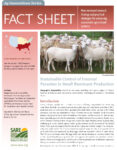
Cover of Internal Parasite Control of Small Ruminants Fact Sheet

Sustainable Control of Internal Parasites in Small Ruminant Production

Type: Fact Sheet

Small ruminants (sheep and goats) are adaptable to many different production systems and can be raised with relatively few inputs, but they face huge production challenges. Control of internal parasites, especially gastrointestinal nematodes including Haemonchus contortus (barberpole worm, stomach worm), is a primary concern for many sheep and goat producers and is particularly challenging in humid regions. 

Download File (1.03 MB)
01AGI2005

Organic Insect Management in Sweet Corn

Scouting, thresholds and management methods for key caterpillar pests

Type: Fact Sheet

This fact sheet discusses an integrated strategy for controlling three caterpillar species—corn earworm, European corn borer and fall armyworm—using methods that meet current organic certification standards. Any grower interested in methods that are safe for the applicator and the environment may be interested in this approach.

Download File (364.92 kB)
 | 
View the Online HTML
02AGI2005

Integrated Pest Management for Varroa Destructor in the Northeastern United States using Drone Brood Removal and Formic Acid

Type: Fact Sheet

This bulletin focuses on the management of the parasitic honey bee mite Varroa destructor (V. destructor) in the northeastern U.S. It contains information that will allow a beekeeper to: 1) identify V. destructor, 2) recognize the symptoms of mite infestation, 3) determine pest densities, and 4) implement an effective IPM program for keeping mite populations below the economic injury level.

Download File (559.86 kB)
 | 
View the Online HTML
03AGI2005

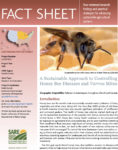
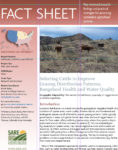
A Sustainable Approach to Controlling Honey Bee Diseases and Varroa Mites

Type: Fact Sheet

This fact sheet describes efforts to breed honey bees, Apis mellifera, resistant to diseases and parasitic mites to reduce the amount of antibiotics and pesticides used in bee colonies and to ensure that our breeding methods and stock are accessible to beekeepers everywhere.
Download File (474.52 kB)
 | 
View the Online HTML
04AGI2005

In-House Composting in High-Rise, Caged Layer Facilities

Type: Fact Sheet

This fact sheet describes research on composting manure inside of the buildings housing laying hens. Research showed that the addition of a carbon source coupled with frequent aeration of compost in a layer house produced temperatures high enough to inhibit fly reproduction in the material, and odor problems are diminished.

Download File (412.08 kB)
 | 
View the Online HTML
05AGI2005

Selecting Cattle to Improve Grazing Distribution Patterns, Rangeland Health and Water Quality

Type: Fact Sheet

This project is the first and only study that we are aware of that has evaluated whether grazing distribution has the potential to be improved through intensive breed selection. Most of the management approaches currently used to increase grazing uniformity, such as water developments and fencing, can resolve livestock grazing distribution problems on both private and public lands. However, these practices usually require large capital expenditures.

Download File (480.73 kB)
 | 
View the Online HTML
06AGI2005

Cultural Practices for Root-Knot and Root-Lesion Nematode Suppression in Vegetable Crop Rotations

Type: Fact Sheet

This publication discusses the use of non-host crops, sorghum sudangrass and castor bean grown as cover crops, RKN-resistant crops, and the application of poultry litter (PL) and PL compost to manage RKN and root-lesion nematode.

Download File (329.22 kB)
 | 
View the Online HTML
07AGI2005

Polyculture and Reservoir Ranching

Sustainable Aquaculture Strategies for Paddlefish (Polyodon spathula) Production

Type: Fact Sheet

The purpose of this fact sheet is to describe two production systems, polyculture and reservoir ranching, that show promise of becoming popular methods for increasing fish production and profits in inland waters compared to a traditional monoculture system.

Download File (341.72 kB)
 | 
View the Online HTML
08AGI2005

Production and Marketing of Beach Plum, a Heritage Fruit Crop

Type: Fact Sheet

Beach plum (Prunus maritima Marsh) is one of several shrubby plums native to North America. The jams produced from this fruit command premium prices at farm stands and specialty markets, even in comparison with jam made from other locally grown fruit. However, the wild-collected supply of fruit does not meet this niche market’s demand.

Download File (527.43 kB)
 | 
View the Online HTML
09AGI2010

Biological Control of Pecan Weevils in the Southeast

A Sustainable Approach

Type: Fact Sheet

This fact sheet provides an alternative control strategy for pecan growers who, for a variety of reasons, find conventional spraying of insecticides unsuitable. This includes organic growers, and owners of dooryard trees, small orchards and commercial orchards who have concerns regarding spray drift. 

Download File (710.15 kB)

Spotlight

Sare 25 Years

1122 Patapsco Building | University of Maryland | College Park, MD 20742-6715

This Web site is maintained by the national outreach office of the SARE program, supported by the National Institute of Food and Agriculture, U.S. Department of Agriculture.

North Central SARE | Northeast SARE | Southern SARE |  Western SARE

Sustainable Agriculture Research & Education ©2012

  • Help |
  • RSS Feeds |
  • A Guide To This Site