A condensed version of the content on this page is available as a PDF download, High Tunnels and other Season Extension Techniques. Or use the Order button on this page to order free hard copies.
This page was created to provide information for producers and educators interested in generating more income by extending the growing season.
Getting Started With Season Extension Techniques
Spurred by enthusiasm for fresh, local agricultural products, farmers are increasing the availability of their crops beyond the traditional outdoor growing season. Premium prices and an extended income stream are some of the advantages farmers pursue with season extension techniques. Main strategies for creating extended-season sales include: growing in greenhouses, high tunnels (or “hoop houses”) or under temporary row covers; storing non-perishable crops for sale in the off season; or minimally processing crops.
Commercial hoop house production has increased rapidly in recent years because these structures promote increased crop quality and productivity, and extend the growing season. This leads to rapid payback on investment. The growing environment inside a hoop house is different from the field, and thus crop management differs in many key areas. In addition, learn more about local food systems here.
Season Extension: Types and Construction
Seasonal structures that protect crops from cold temperatures and inclement weather vary widely in size, shape, materials and purpose. The following are common types.
Row Covers
Row covers are sheets or strips of synthetic, breathable fabric of various weights and mesh diameters. Sometimes greenhouse plastic is also used. These materials are placed over individual rows, with or without supporting wire hoops, or over entire fields. “Floating” row covers are unsupported, laying directly on the plant leaves as the crop grows.
Low Tunnels and Caterpillar Tunnels
Low tunnels and caterpillar tunnels are seasonal structures covered with the same materials as row covers, but with rigid supports such as metal or plastic tubing, or electrical conduit. Low tunnels are typically 2 to 3 feet high and cover the width of a growing bed. Like row covers, they protect cold-hardy crops in winter and spring plantings from cold and wind. Low tunnels are increasingly used for pest management also. Caterpillar tunnels are three-season structures and are typically 6 to 8 feet high and 10 to 20 feet wide. They are usually held in place with ropes anchored to the ground. Ventilation must be managed manually. Caterpillars and low tunnels differ from high tunnels in that they are removed when not in use, are much less durable and are much more portable. They represent a lower investment than high tunnels.
High Tunnels or Hoop Houses
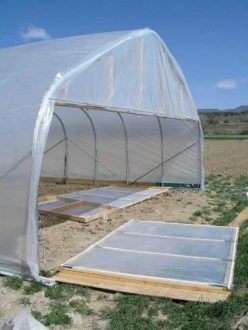
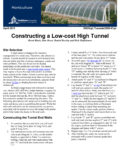
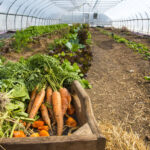
High tunnels, or hoop houses, are simple greenhouse-like structures over bare ground, without the elaborate heating and cooling systems of a greenhouse. They rely primarily on passive solar heating and passive ventilation. High tunnels generally have steel pipe frames set into the ground and are covered with one or two layers of greenhouse-grade plastic. They are irrigated using drip systems, hand watering or small sprinklers. Roll-up sidewalls, usually hand cranked but sometimes automated, provide ventilation in hoop house construction. They may also have end-wall vents (louvers) or ridge vents. Crops grow in the ground, raised beds or containers. The ground may be bare, or it may be covered with landscape fabric, plastic mulch or an organic mulch such as straw. Guides for high tunnel design and construction are abundant.
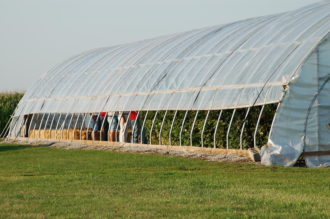
Smaller hoop houses may be Quonset shaped (half-circle frame) while larger tunnels are Gothic shaped (peaked frame). Gothic frames shed snow well. Both designs are best with internal bracing to provide stability during wind or snow. Ground posts must be securely anchored to ensure structural stability. Multi-bay high tunnels are built side by side to cover more acreage with less exposed surface area. They require gutters and structural reinforcement to handle rain and snow shed from the top of the bays. Multi-bay high tunnels are generally not considered four-season structures in regions with snowy winters, as they cannot bear a snow load.
Greenhouses
Greenhouses tend to be similar in size to high tunnels or larger, often with more structural strength. They may or may not have a permanent foundation. They are covered with one or two layers of greenhouse plastic, rigid polycarbonate or glass. Greenhouses have supplemental heat from a furnace or boiler, and automated ventilation with fans and/or louvers. As greenhouse heating, cooling and irrigation are automated, full electrical service is required.
Special Considerations for Seasonal High Tunnel Production
The growing environment inside a high tunnel varies in many important ways from field production, and those differences will influence the way crops are managed.
Cultivar Selection and Variety Trials
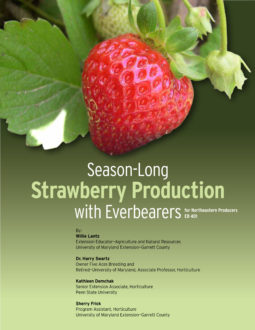
The desirable characteristics of crop cultivars/varieties for seasonal high tunnel production are much the same as field production: good yield, high quality and pest tolerance. However, depending on the season, hoop house cultivars/varieties must be able to thrive in higher temperatures and relative humidity, tolerate freezing, or have their day-length requirement met. Thus, the best field cultivars/varieties are often not ideal for commercial hoop house farming. Pest pressure is also different, so tolerance to diseases or insects that are not prevalent outdoors may be a consideration. A good primer is the video What to Plant, part of a Kansas State series on commercial high tunnel vegetable production.
Fertility Management
In a seasonal high tunnel, plant growth may start earlier, last longer and/or lead to a significant increase in biomass and yield. Thus, nutrient needs may vary from field production, so plan fertilization accordingly. In addition, salt accumulation is a greater concern in a hoop house because rainfall does not leach nutrients from the soil. In a high tunnel, carefully monitor soil fertility status, including soluble salts, and conduct plant tissue analyses when making fertility decisions. Soil test annually in high tunnels, as pH can rise quickly in the absence of rain.
Pest Management
Many foliar diseases are eliminated from high tunnels, as rain and soil splashing are eliminated. However, due to higher humidity levels, a handful of diseases become more severe inside; thus proper ventilation is critical. Higher temperatures, the exclusion of rain and a humid microclimate inside the plant canopy can promote certain insect pests, especially if there is little or no fallow period. Aphids, thrips, spider mites and whiteflies are common insect pests inside high tunnels. The good news is that high tunnels are an excellent setting for using biological control agents due to the high value of the crops, the enclosed space (if ventilation openings are covered with mesh screens) and controlled environmental conditions that improve persistence. Seek out resources on such hoop house pest management strategies as tomato grafting for disease resistance, beneficial insects, physical pest exclusion and biofumigation.
Water Management
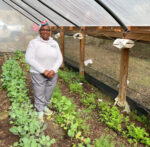
To take full advantage of hoop house farming, one must precisely control the supply of water to crops. Use drip irrigation to deliver water directly to the root zone, without wetting the foliage. This helps avoid foliar diseases and the washing off of foliar bioinsecticides. When there is plenty of light, high temperature and low humidity, crops will use a lot of water, but be careful not to overwater, as excessively wet soil can be difficult to dry out. Use soil-moisture monitoring devices to match the amount and timing of water to the crop’s needs. Consider providing soluble fertilizers through the drip system to “spoon feed” crops.
In a video and associated fact sheet, Iowa State University Extension specialists describe how to build a rainwater catchment system on a high tunnel and reuse the water for irrigation.

Temperature Management
In some hoop houses, the sun may satisfy all energy needs, with the soil acting as a nightly heat reservoir. Other hoop houses may have supplemental or emergency heating systems. High tunnels in colder climates where heat-loving crops are produced on the “shoulders” of the growing season will typically have furnaces or boilers to maintain the optimal temperature for growth. Understanding the temperature requirements of the crop, and then ventilating or heating to maintain that temperature is critical. Important energy conservation measures for high tunnels range from sealing cracks around doors and ventilation louvers to installing night-time heat curtains. Low tunnels can be instrumental in retaining heat stored in the soil during the night. Some high tunnels are also using renewable fuels to provide heat, such as biodiesel, shell corn, wood and solar hot water collectors. For low-growing crops, heating the soil with circulating water pipes below ground may be more efficient than heating the air inside the tunnel.
Marketing and Economics
Thousands of commercial high tunnels are in use around the country because they make economic and marketing sense for many growers. High tunnels generally allow for improved pest control, making them a good option for organic production. However, carefully consider the potential costs and returns prior to getting into high tunnel farming. A possible avenue of support is through the USDA Natural Resources Conservation Service, which offers financial assistance for high tunnel construction. The net profit from high tunnel crops ranges from just a few cents per square foot up to several dollars per square foot, depending on yield, production expenses and grower skill. Labor is a special consideration. Be aware that high tunnel farming is relatively labor intensive and requires skill, and that such labor must be available to perform tasks in a timely fashion to ensure profitability.
Storing Crops
Storing field crops such as carrots or potatoes can lengthen their marketing window, which is another approach to season extension. The length of time that crops can be stored is a function of their postharvest physiology as well as pre-storage activities, including how they are produced, harvested and handled. Optimal storage conditions vary among crops. Five common sets of storage conditions for vegetable crops are:
- Cold and moist = 32°F and 90-95 percent relative humidity (RH). Beets, cabbage, carrots, parsnips, turnips, etc.
- Cold and dry = 32°F and 65-70 percent RH. Garlic and dry onions.
- Cool and moist = 45°F and 90 percent RH. Potatoes for table stock.
- Warm and moist = 57°F and 85-90 percent RH. Sweet potatoes.
- Warm and dry = 55°F and 50-70 percent RH. Winter squashes, including pumpkins.
Storage options include cold cellars or root cellars, walk-in coolers and cold rooms fitted with air conditioners and temperature-override controllers. Cold cellars are a low-cost, low-energy-use option, but may lack the environmental control of other options. Walk-in coolers use refrigeration systems and are widely found on wholesale farms, supermarkets and other places that handle large volumes of fresh produce. Cold rooms are widely used on farms with small volumes of storage produce.
Air conditioner temperature-override controllers such as CoolBot™ units allow residential air conditioners to provide cooling in small-scale storage units. These units require a sealed, well-insulated storage room to be effective, and they may have trouble cooling down produce with a lot of field heat in it. Here are guides on building a walk-in cooler and retrofitting an existing structure, developed by a Massachusetts nonprofit.
More Season Extension Resources
-
 Bulletins
Best Practices for the Sustainable Urban Farm
Bulletins
Best Practices for the Sustainable Urban Farm
-
Bulletins
Sustainable Production and Use of On-Farm Energy
-
Decision-Making Tools
High Tunnel Growing: Is it Right for Me?
-
Fact Sheets
Sustainable Pest Management in Greenhouses and High Tunnels
-
Fact Sheets
Winter Storage Options for the Northeast
-
Fact Sheets
Success Basics in High Tunnel Production: Three Maryland Case Studies
-
Fact Sheets
On-Farm Fertigation Trials in Kansas City-Area Organic High Tunnels
-
Fact Sheets
Organic Heirloom Tomato Production in High Tunnel and Open Field Systems