• WebStore |
  • Advanced Search |
  • MySARE Login |
  • SARE Social Media |
  • Contact Us |
  • SANET Listserv |
  • Low Bandwidth |
Search MySARE Reports
  • Grants
    • Apply for a Grant
    • Funded Grants in Your State
  • Project Reports
    • Submit a Report
    • Search the Database
    • Project Search Tips
    • About Project Reports
    • About Search Results
    • Project Products
  • Learning Center
    • Books
    • Bulletins
    • Fact Sheets
    • Topic Rooms
    • From the Field
    • Newsletters
    • Multimedia
    • Courses and Curricula
    • Project Products
    • SARE Biennial Reports
    • SANET Listserv
    • SARE Program Materials
    • Conference Materials
    • WebStore
  • Professional Development
    • PDP Overview
    • Fellows & Search for Excellence Programs
    • Sample PDP Grant Projects
    • Educator Curriculum Guides
    • National Continuing Education Program
    • State Coordinator Contact Information
  • State Programs
    • State Coordinator Program Overview
    • State Coordinator Contact Information
    • State Program Webpages
    • Funded Grants in Your State
  • Events
    • Event Calendar
    • Past Conferences
  • Newsroom
    • Press Releases
    • SARE in the News
    • Media Contacts
    • Newsletters
    • Media Toolkit
    • A Guide To This Site
    • SARE and Social Media
  • About SARE
    • SARE's Four Regions
    • Join Our Mailing List
    • SARE Grants
    • Learning Center
    • Professional Development
    • SARE Outreach
    • Historical Timeline
    • Staff
    • Vision & Mission
    • What is Sustainable Agriculture?
  • Home»
  • Learning Center»
  • Books»
  • Managing Cover Crops Profitably, 3rd Edition»
  • Text Version»
  • Foreword
facebook
Twitter
YouTube
- + Font Size
Print
Share

Text Version

  • Acknowledgments
  • Printable Version
  • Foreword
  • Table of Contents
  • How to Use This Book
  • Benefits of Cover Crops
  • Selecting the Best
  • Building Soil Fertility
  • Managing Pests
  • Crop Rotation with Cover Crops
  • Managing Cover Crops in Conservation Tillage Systems
  • Charts
  • Nonlegume Cover Crops
  • Legume Cover Crops
  • Producer Profiles
  • Appendix A
  • Appendix B
  • Appendix C
  • Appendix D
  • Appendix E
  • Appendix F
  • Printable Version

Can't find something? Ask or send feedback.

SARE's mission is to advance—to the whole of American agriculture—innovations that improve profitability, stewardship and quality of life by investing in groundbreaking research and education. SARE's vision is...

Foreword

Foreword

Cover crops slow erosion, improve soil, smother weeds, enhance nutrient and moisture availability, help control many pests and bring a host of other benefits to your farm. At the same time, they can reduce costs, increase profits and even create new sources of income. You’ll reap dividends on your cover crop investments for years, because their benefits accumulate over the long term.

Increasing energy costs will have a profound effect on farm economics in coming years. As we go to press, it is impossible to predict how fast energy costs will increase, but since cover crop economics are rooted in nitrogen dynamics (how much N you save or produce with cover crops), fuel costs (the cost of N and trips across the field) and commodity prices, energy prices will certainly impact the economics of cover crop use.

Economic comparisons in the 2nd edition were based on the old economy of two-dollar corn, twenty-cent nitrogen and cheap gas. Some studies showed that cover crops become more profitable as the price of nitrogen increases. We retained some of these excellent studies because data from new studies is not yet available. What we do know is that cover crops can help you to increase yields, save on nitrogen costs, reduce trips across the field and also reap many additional agronomic benefits.

There is a cover crop to fit just about every farming situation. The purpose of this book is to help you find which ones are right for you.

Farmers around the country are increasingly looking at the long-term contributions of cover crops to their whole farm system. Some of the most successful are those who have seen the benefits and are committed to making cover crops work for them. They are re-tooling their cropping systems to better fit cover crop growth patterns, rather than squeezing cover crops into their existing system, time permitting.

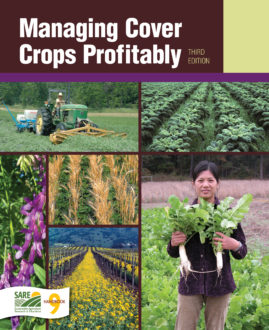
This 3rd edition of Managing Cover Crops Profitably aims to capture farmer and other research results from the past ten years. We verified the information from the 2nd edition, added new results and updated farmer profiles and research data throughout. We also added two new chapters.

Brassicas and Mustards lays out the current theory and management of cover crops in the BRASSICACEAE family. Brassica cover crops are thought to play a role in management of nematodes, weeds and disease by releasing chemical compounds from decomposing residue. Results are promising but inconsistent. Try brassicas on small plots and consult local expertise for additional information.

Managing Cover Crops in Conservation Tillage Systems addresses the management complexities of reduced tillage systems. If you are already using cover crops, the chapter will help you reduce tillage. If you are already using conservation tillage, it shows you how to add or better manage cover crops. Cover crops and conservation tillage team up to reduce energy use on your farm and that means more profits.

We have tried to include enough information for you to select and use cover crops appropriate to your operation. We recommend that you define your reasons for growing a cover crop—the section, Selecting the Best Cover Crops for Your Farm can help with this—and take as much care in selecting and managing cover crops as you would a cash crop.

Regional and site-specific factors can complicate cover crop management. No book can adequately address all the variables that make up a crop production system. Before planting a cover crop, learn as much as you can from this book and talk to others who are experienced with that cover crop.

We hope that this updated and expanded edition of Managing Cover Crops Profitably will lead to the successful use of cover crops on a wider scale as we continue to increase the sustainability of our farming systems.

Andy Clark, Communications Director
SARE Outreach
June 2007


Top | Table of Contents

You are reading the SARE book Managing Cover Crops Profitably, 3rd Edition.

Order this publication.

Sare 25 Years

1122 Patapsco Building | University of Maryland | College Park, MD 20742-6715

This Web site is maintained by the national outreach office of the SARE program, supported by the National Institute of Food and Agriculture, U.S. Department of Agriculture.

North Central SARE | Northeast SARE | Southern SARE |  Western SARE

Sustainable Agriculture Research & Education ©2012

  • Help |
  • RSS Feeds |
  • A Guide To This Site