• WebStore |
  • Advanced Search |
  • MySARE Login |
  • SARE Social Media |
  • Contact Us |
  • SANET Listserv |
  • Low Bandwidth |
Search MySARE Reports
  • Grants
    • Apply for a Grant
    • Funded Grants in Your State
  • Project Reports
    • Submit a Report
    • Search the Database
    • Project Search Tips
    • About Project Reports
    • About Search Results
    • Project Products
  • Learning Center
    • Books
    • Bulletins
    • Fact Sheets
    • Topic Rooms
    • From the Field
    • Newsletters
    • Multimedia
    • Courses and Curricula
    • Project Products
    • SARE Biennial Reports
    • SANET Listserv
    • SARE Program Materials
    • Conference Materials
    • WebStore
  • Professional Development
    • PDP Overview
    • Fellows & Search for Excellence Programs
    • Sample PDP Grant Projects
    • Educator Curriculum Guides
    • National Continuing Education Program
    • State Coordinator Contact Information
  • State Programs
    • State Coordinator Program Overview
    • State Coordinator Contact Information
    • State Program Webpages
    • Funded Grants in Your State
  • Events
    • Event Calendar
    • Past Conferences
  • Newsroom
    • Press Releases
    • SARE in the News
    • Media Contacts
    • Newsletters
    • Media Toolkit
    • A Guide To This Site
    • SARE and Social Media
  • About SARE
    • SARE's Four Regions
    • Join Our Mailing List
    • SARE Grants
    • Learning Center
    • Professional Development
    • SARE Outreach
    • Historical Timeline
    • Staff
    • Vision & Mission
    • What is Sustainable Agriculture?
  • Home»
  • Learning Center»
  • Books»
  • Manage Insects on Your Farm»
  • Text Version
facebook
Twitter
YouTube
- + Font Size
Print
Share

Text Version

  • Acknowledgments
  • Introduction
  • Table of Contents
  • How Ecologically Based Pest Management Works
  • Principles of Ecologically Based Pest Management
  • Identification Key to Major Beneficials and Pests
  • Managing Soils to Minimize Crop Pests
  • Farm Feature: Triple Threat to Pests: Cover Crops, No-Till, Rotation
  • Beneficial Agents on the Farm
  • Putting it All Together
  • Resources: General Information
  • Printable Version

Can't find something? Ask or send feedback.

SARE's mission is to advance—to the whole of American agriculture—innovations that improve profitability, stewardship and quality of life by investing in groundbreaking research and education. SARE's vision is...

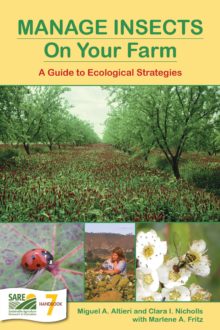
Manage Insects on Your Farm

bee on flower

Agricultural pests blemish, damage or destroy more than 30 percent of crops worldwide. This annual loss has remained constant since the 1940s, when most farmers and ranchers began using agrichemicals to control pests.

Farmers need insect pest management strategies that are effective, affordable and environmentally sound. Manage Insects on Your Farm: A Guide to Ecological Strategies is a pest management primer designed to help farmers improve their farms’ natural defenses against insect pests.

While every farming system is unique, the principles of ecological pest management apply universally. Manage Insects on Your Farm outlines the principles of ecologically based pest management and illustrates the strategies used by farmers around the world to address insect problems by:

Increasing on-farm diversity above and below ground
Encouraging beneficial insects to attack their worst pests
Enhancing plants’ natural defenses against pests
Managing soil to minimize crop pests

“Well written and illustrated, Manage Insects on Your Farm provides both a framework for understanding ecologically based pest management as well as many of the useful details to help minimize insect pest problems,” said Fred Magdoff, University of Vermont soil scientist and regional coordinator of USDA’s Sustainable Agriculture Research and Education (SARE) program.

Examples of successful pest management strategies featured throughout the book demonstrate real-life examples of how to address insect problems and develop a more complex and diverse on-farm ecosystem. Readers will learn how to minimize insect damage with wise soil management and identify beneficial insects to put these “good bugs” to work.

Top | Introduction

You are reading the SARE book Manage Insects on Your Farm.

Order this publication.

Sare 25 Years

1122 Patapsco Building | University of Maryland | College Park, MD 20742-6715

This Web site is maintained by the national outreach office of the SARE program, supported by the National Institute of Food and Agriculture, U.S. Department of Agriculture.

North Central SARE | Northeast SARE | Southern SARE |  Western SARE

Sustainable Agriculture Research & Education ©2012

  • Help |
  • RSS Feeds |
  • A Guide To This Site